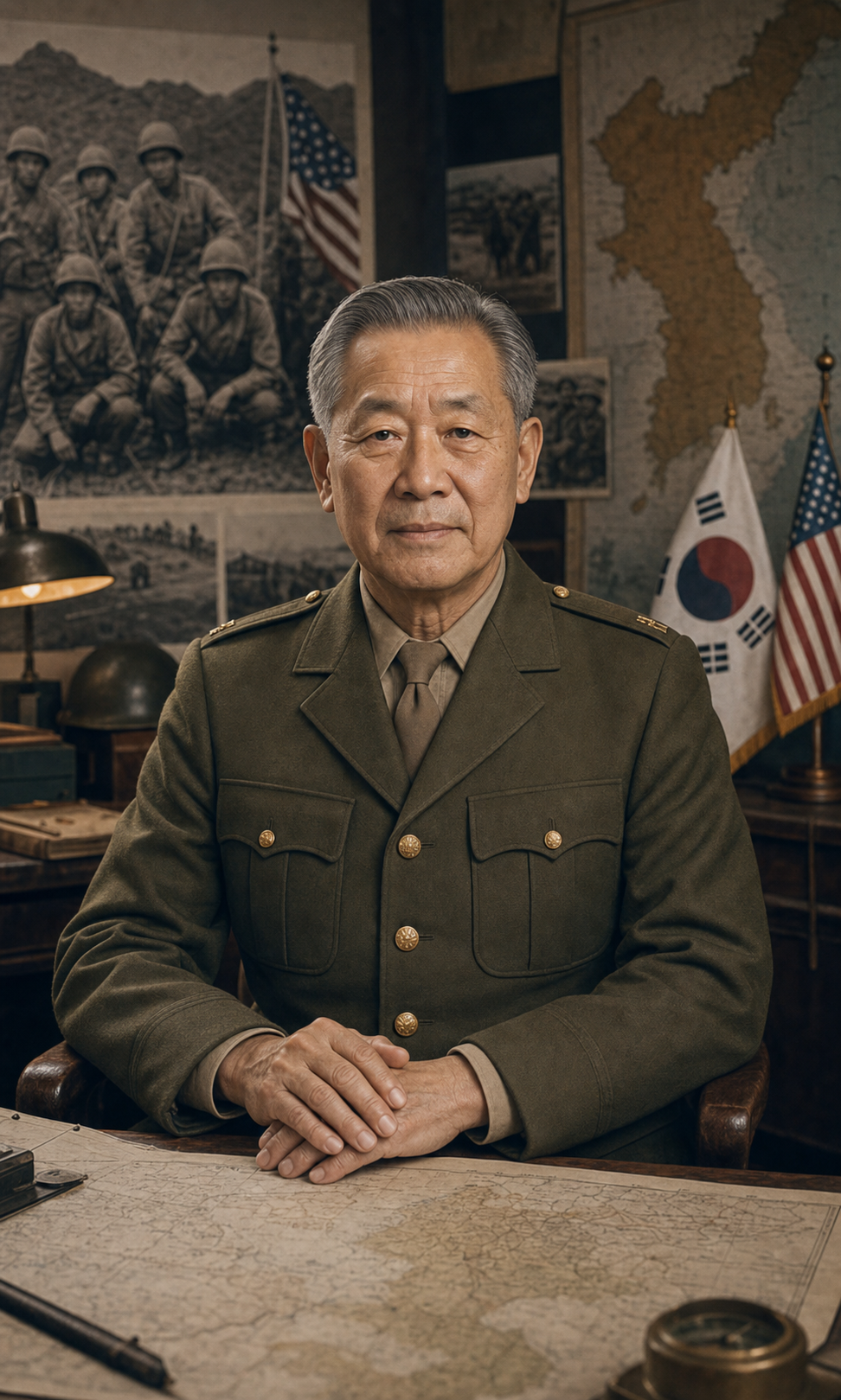
A life remembered
Young Oak Kim moved from Los Angeles community life into military service and later devoted himself to civic work. Born in January 1919 to Soon Kwan Kim and a highly educated mother whose intended studies in Chicago were redirected into immigrant family life, Kim grew up around Temple Street, Korean churches, small businesses, and independence politics. His memories place his family inside an early Korean Los Angeles where church, language, political loyalty, and survival were tightly connected.
Kim's later life became most publicly known through service in the United States Army. Drafted before World War II, he moved from mechanic to officer, served with the 100th Infantry Battalion and other Japanese American soldiers in Europe, commanded in Korea, and later held important teaching, command, and staff assignments. Retired for disability in 1972 after serious combat wounds and lasting pain, he turned the wartime vow of service into community work through Asian American nonprofit, museum, veterans, family-support, and civic organizations.
Based on interviews held by the USC Digital Library.
1910s-1920s
Family Origins and Los Angeles Roots
Young Oak Kim traced his father's migration to the years after Japan's takeover of Korea. Soon Kwan Kim left Korea with a male cousin and other companions, eventually reaching Seattle and moving through migrant labor before continuing to Los Angeles. The family memory combined practical restlessness with politics: his father wanted opportunity, but he also joined a Korean immigrant world organized around the liberation of Korea.
His mother came from Suwon and had been educated through a Methodist missionary school connected in family memory to later women's education in Korea. She arrived in the United States expecting to continue her studies, but family obligations and the legal assumptions of the period redirected her to join the husband to whom she had been betrothed in childhood. Kim described this turn as one of the great losses and sacrifices in his mother's life.
The family eventually ran a grocery store near Temple Street in Los Angeles. Kim remembered the store as a place that required English, telephones, deliveries, meat cutting, long hours, and constant judgment. His mother carried much of the practical labor of the business and household, while his father moved through community meetings, politics, and public life.
Those memories are candid, but their public meaning is larger than private family tension. Kim saw in his parents two different forms of intelligence: his father's political imagination and his mother's disciplined realism. Together they placed him inside an early Korean American Los Angeles shaped by small businesses, church networks, gender expectations, and the pressure to turn immigrant hardship into family survival.
1920s-1930s
Church, Politics, and a Mixed City
Kim remembered Korean church as far more than Sunday worship. In the small immigrant community, church gathered people for social life, language, meals, political organizing, and news from Korea. Different congregations often reflected different loyalties within the independence movement, so religion, community, and politics could not be neatly separated.
His father was associated with supporters of Syngman Rhee and with organizations devoted to Korean independence. Kim recalled that Korean leaders and factions disagreed about methods even when they shared the larger goal of freeing Korea. He remembered a community small enough that nearly everyone knew one another, but politically serious enough to sustain competing visions of Korea's future.
Los Angeles itself was also mixed and divided. Kim attended schools near downtown where Mexican, Italian, Jewish, Chinese, Japanese, a few Korean, and white students crossed paths. Neighborhoods that later became familiar as Little Tokyo, Chinatown, civic center, or freeway landscape were, in his childhood, dense with hills, streetcars, tunnels, schools, and ethnic enclaves.
Because he did not fit easily into one group, Kim learned early to move across lines. He played with children from many communities, including those who, like him, were not always where their families expected them to be after school. That childhood comfort among difference later mattered: he could work with Japanese American soldiers, white commanders, Black units, Korean civilians, and Asian American organizations without feeling that identity required isolation.
1940-1943
Drafted Into a Segregated Army
Kim entered the Army through the first peacetime draft, after an earlier attempt to enlist had met the racial limits of the period. He trained at Fort Ord and performed well, but he was first steered away from combat arms because Asian Americans were not readily imagined as front-line soldiers. The Army made him a mechanic, and he became skilled enough to serve as a motor sergeant.
A company commander later pushed him toward Officer Candidate School, seeing intelligence and leadership that the earlier assignment had ignored. Kim was reluctant because he had been kept from ordinary infantry work for much of his service, but the commander made clear that officer training was the path in front of him. At Infantry OCS, Kim began to recognize abilities that combat would later confirm.
He discovered a talent for map reading, planning, tactical sequencing, and remaining clear under pressure. He could imagine terrain from a map, organize weapons and timing, and keep track of location in difficult country. In his telling, these qualities did not make him reckless; they made him able to think when fear and confusion overwhelmed others.
The Army remained unequal, but it also opened an unexpected field in which performance could override some barriers. Kim was not a West Point graduate, not white, and not from the officer networks that shaped promotion. Yet the demands of war created moments where competence became visible, and those moments changed the course of his life.
World War II
World War II and the 100th
Kim regarded his assignment with the all-Japanese American unit in World War II as one of the defining experiences of his life. Serving with the 100th Infantry Battalion, he learned both his own capacities and the limits of individual achievement. Plans mattered, but they mattered only when soldiers and leaders could understand, adapt, and trust one another under fire.
As a Korean American officer among Japanese American soldiers, Kim understood that the unit's success carried meaning beyond one ethnic group. Japanese Americans were fighting while their families and communities faced suspicion and exclusion at home. Kim believed that if the unit proved itself, it could help push open public understanding for Japanese Americans and, more broadly, for Asian Americans.
The war also left lasting physical consequences. Kim described being wounded in Italy and France under circumstances that were sudden and unpredictable, and doctors later warned him about the possible loss of function in his right hand. He survived far longer in combat than many officers in the unit, a fact he remembered with gratitude rather than triumph.
The friendships and obligations formed there became moral commitments. Kim recalled that officers and soldiers spoke about what they would owe their communities if they survived. In his later life, that vow became a thread connecting battlefield service to nonprofit work, veterans' memorials, museums, and advocacy for Asian American communities.
1950s-1972
Korea, Command, and the Professional Army
The Korean War gave Kim another defining assignment, this time inside a regular Army structure dominated by West Point networks. General Bill McCaffrey, who had seen the reputation of Kim's wartime unit and later encountered him in Hawaii, brought him into important work and helped secure his command. Kim became an intelligence officer and then a battalion commander, entering a circle where command slots were fiercely contested.
Kim's command in Korea confirmed his standing among senior officers. He stood out as an OCS graduate and Korean American officer among West Point commanders, but battlefield performance quickly mattered more than surprise. He described mentors such as McCaffrey and Gordon Singleton as figures who gave him authority, protected him from poor assignments, and treated him with deep personal loyalty.
His service in Korea also included severe wounds, including injuries from friendly fire after his unit had advanced farther than others believed possible. Evacuation by helicopter under difficult conditions may have saved his life. The episode reinforced his sense that survival was shaped by skill, luck, and the willingness of others to take risks for him.
After Korea, Kim spent his Army career in command, military education, and high-level staff work. He taught at major Army schools, helped organize complex maneuvers in Europe, worked in planning roles, and built a reputation for direct judgment. He retired in January 1972 because of disability, carrying both professional respect and the physical cost of three decades of service.
Later Years
Retirement and Civic Work
Retirement did not mean withdrawal for Kim. Severe pain, muscle spasms, and heavy medication limited what he could do at first, but he later pursued pain control methods that helped him live more actively. Nonprofit work allowed him to contribute at a pace his health could bear while honoring the commitments he had made during wartime.
He became involved with Asian American service organizations, including the Oriental Service Center, Special Service for Groups, the Center for Pacific Asian Families, Visual Communications, the Japanese American National Museum, United Way, veterans' memorial work, and Korean American civic efforts. His military background gave him fluency with bureaucracy, governance, and institutional strategy, skills many emerging organizations needed.
Kim's oral history also reveals a private ethic of relationship. He defined family in traditional terms as relatives, spouses, and descendants, but he also recognized that chosen friends could be equally powerful. Combat comrades held a special place because shared danger created trust that time did not erase. Nieces, nephews, children, and young people also mattered to him, and he believed museums should speak to children because they were still open to change.
Medals and rank tell only part of Young Oak Kim's life. Kim's life joined Korean independence memory, Japanese American wartime service, United States Army professionalism, and Asian American civic institution-building. He considered himself fortunate, though not untouched by hardship. Service connected the different parts of his life: first to soldiers beside him, then to communities still building a public place in America.