A life remembered
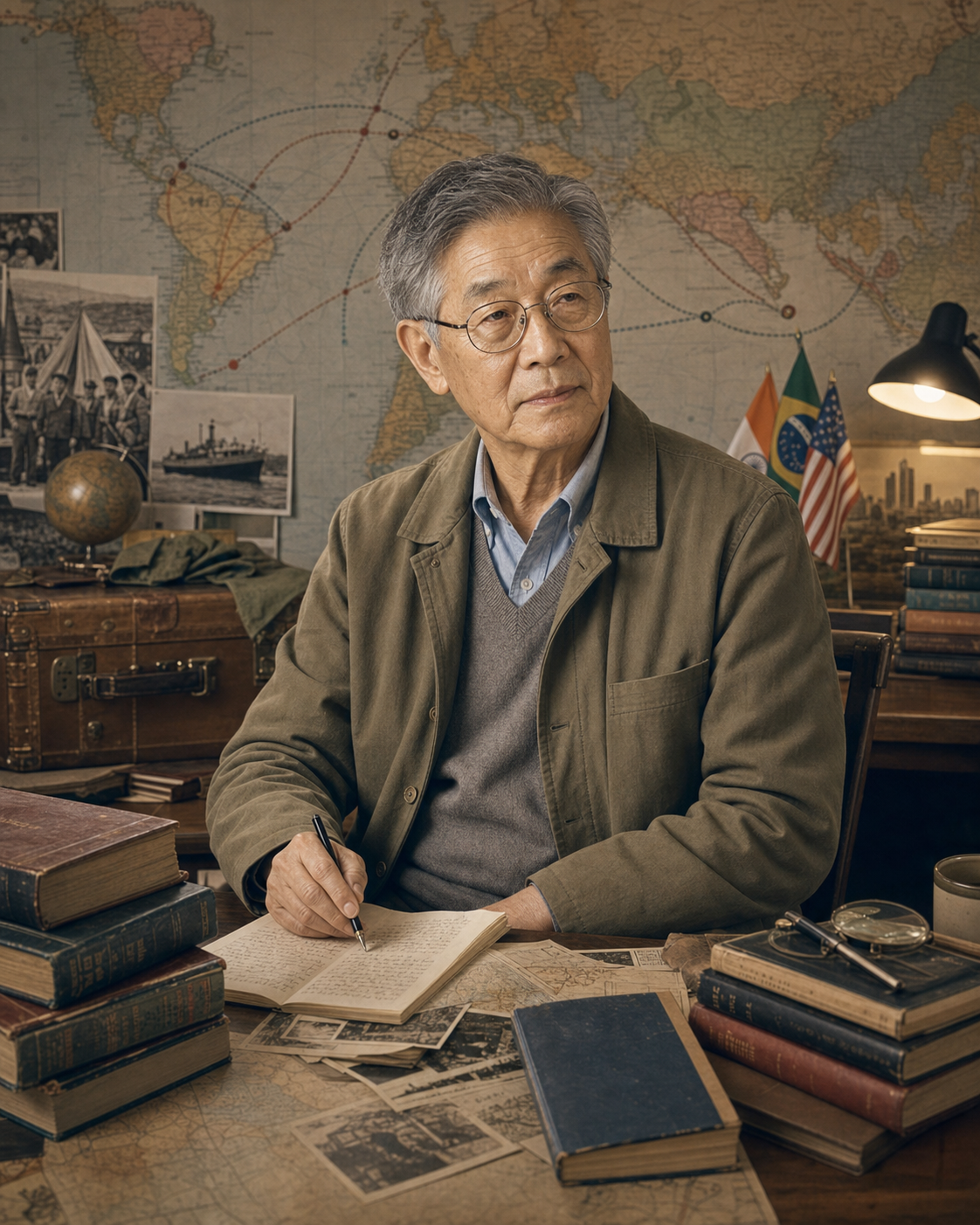
Young Bok Joo's life crossed Manchuria, the Japanese empire, Soviet-occupied North Korea, the Korean War, a neutral-country resettlement process, India, Brazil, and the United States. Born in 1924 in the Korean communities of Manchuria to parents from Hamhung, he studied in places such as Longjing, Mudanjiang, and Harbin, learned languages because history forced him to, and returned to Korea after liberation believing he was returning to his country. His testimony is also a map of twentieth-century Northeast Asia and Cold War resettlement seen from below.
The country he returned to did not become a simple home. Young Bok worked as a Russian interpreter in Soviet-backed North Korea, served as a major or officer in the North Korean military system during the Korean War, was captured, and ultimately chose neither North nor South. He lived under Indian custody as part of the neutral-nations prisoner settlement, moved to Brazil when it accepted stateless ex-prisoners, made a family there, wrote about prisoner life, compiled dictionaries and translations, and later came to Los Angeles for safety and his children's education. What makes the account distinctive is his insistence on complexity: he was not simply North Korean, South Korean, Brazilian, or American, but a person remade by each place.
Based on interviews held by the USC Digital Library.
1924-1945
Born in Manchuria to Korean Migrants
Young Bok Joo was born in 1924 in Longjing, or Yongjeong, in Manchuria. His parents came from Hamhung and, like many Koreans under Japanese colonial rule, had left Korea because farming, trade, and ordinary survival had become difficult. Some Koreans went to Manchuria, others to Russian territory, and Young Bok's family made a life in northeast China.
He studied in several places, including Longjing, Mudanjiang, Harbin, and other Chinese cities. He was careful to explain that his education should not be exaggerated into a modern university career. It was the schooling available in that time and place.
Harbin gave him Russian, while Manchuria also exposed him to Chinese, Japanese, and Korean. Printing, copying, and practical office work became part of his skill set. These languages later determined his fate because they made him useful to military and political authorities.
This borderland childhood is essential to understanding him. Young Bok was Korean by family and language, but his earliest world was already multinational, colonial, and unstable. He grew up where Chinese, Japanese, Russian, and Korean histories overlapped, so later movement across countries did not begin with emigration from a settled homeland. Displacement was built into the geography of his birth. His caution about educational labels also reflects a broader humility. Young Bok did not want later listeners to mistake survival learning for prestige. He measured education by what it allowed him to do in harsh conditions, not by titles that might sound impressive in another country. That humility makes his learning more impressive, not less.
1945-1950
Returning to a Divided Homeland
At about twenty-one, after liberation, Young Bok returned to Korea. Like many overseas Koreans, he had imagined return as a recovery of homeland, but North Korea after 1945 was being shaped by Soviet occupation and communist state-building. He entered work connected to the Soviet military headquarters because he knew Russian and could interpret.
Military life followed. Young Bok described joining the army in part because young men could receive food and structure there, and he later held a rank translated in the conversation as major. His account does not present North Korea as a beloved ideological home.
The interview also preserves family sorrow from this period. His father had died earlier, his mother and younger siblings were separated by war and movement, and he later regretted not being able to warn family members away from dangerous choices. The return to Korea brought him into history's center but scattered the family.
His return to Korea after liberation carried both hope and misrecognition. He came back expecting a recovered country, but he entered a northern state being organized through Soviet power and military need. His Russian ability opened doors, yet those doors led him into an apparatus he did not later describe with affection. Language gave him employment, but also tied him to dangerous institutions. The Soviet interpreter role also placed him in a morally ambiguous position. He was useful because of language, but usefulness did not equal power. He stood close to authority while remaining vulnerable to the state and to the war that soon consumed the peninsula.
1950-1953
War, Capture, and Refusing Both Sides
During the Korean War, Young Bok moved through battle zones and military assignments. The interview names places such as Chuncheon, Wonju, Chungju, Seoul, Incheon, Daejeon, Suwon, Mokpo, Busan, Daegu, and Geoje in a sequence that reflects both military movement and prisoner processing.
He was captured by United Nations forces, with the conversation suggesting British custody at one point, and became part of the difficult prisoner-of-war question after the armistice. Many prisoners wanted to return North, others to remain South, and some, including Young Bok, wanted neither.
That choice made him effectively stateless. He did not see either Korean state as a place where he could build a free life, and he entered the group of prisoners sent under neutral arrangements. His later writings about prisoner life grew from this experience.
Young Bok did not describe his refusal of both Koreas as easy or heroic. The decision cut him off from family, country, and any predictable citizenship. He believed that either destination would place him inside a system he could not accept, making neutrality a painful form of self-rescue. For prisoners who refused repatriation, the armistice opened another struggle over identity, custody, and destination. His war continued in negotiations over where he would be allowed to live.
1954-1970s
India, Brazil, and a Stateless Route
Young Bok went to India under neutral-nations custody, living in or near New Delhi while international authorities debated where non-repatriating prisoners could go. India, in his telling, was not a final home but a waiting place.
Brazil eventually announced through the United Nations that it would accept some of these independent or stateless former prisoners. Young Bok traveled there in 1956, part of a group that chose among possible destinations such as Brazil, Argentina, Mexico, and others. He remembered the journey as a release from limbo.
In Brazil he lived in Rio de Janeiro, Belo Horizonte, Sao Paulo, and other places over many years. He worked with translation, printing, and language, learned Portuguese out of necessity, and compiled dictionary materials. He also married a Korean woman who came from Korea through correspondence arrangements and raised two sons.
India and Brazil show the international aftermath of the Korean War at human scale. Diplomatic agreements, United Nations debates, and neutral-nation custody appear in the interview as waiting, paperwork, and uncertainty over who would receive unwanted people. Young Bok's eventual move to Brazil depended on state decisions far above him, but his life had to be rebuilt from their consequences. Brazil was not chosen from comfort, but from the limited menu history offered. That he later built work, marriage, children, and writing there makes the achievement larger. He turned a receiving country's diplomatic gesture into decades of lived adaptation. Adaptation became his answer to a choice made under constraint.
Books
Languages, Books, and Coming to America
Young Bok's languages became both livelihood and testimony. The interview credits him with Korean, Japanese, Chinese, Russian, English, and Portuguese to varying degrees. He translated, wrote, and gathered materials, including accounts connected to Korean War prisoners and his own book-length reflections.
He described Brazil first with affection and later with concern. At the time he arrived, he remembered it as safer and better than some alternatives, but over time crime and instability made life harder. His children's education also mattered.
The family eventually came to Los Angeles, where American schools and universities offered opportunities he believed Brazil could not provide as reliably. In Los Angeles, he continued to think through homeland, exile, and language, while also visiting Korea in later decades.
His writing and translation work can be read as an answer to statelessness. By making dictionaries, translating between languages, and writing about prisoners, he created forms of order after years in which states had defined him as suspect, useful, captive, or transferable. Words became tools for earning a living, but also for proving that his path had meaning. His later trips to Korea did not fully resolve the question of belonging. He wondered whether people who had left, refused, or passed through enemy categories could be understood by those who had remained within one national story. The unresolved question followed him even after passports and addresses changed. The question itself became part of his archive. It never fully closed.
Later Years
Kimchi, Amazon Rivers, and the Meaning of Home
The account ranges widely because Young Bok's memory ranged widely. He spoke of kimchi made in India and Brazil, onion kimchi when napa cabbage was unavailable, his mother's kimchi as the best, and the improvisations required when Korean ingredients were scarce.
He also described the Amazon with unusual lyricism: rivers moving silently toward the Atlantic, trees larger than houses, birds and insects, darkness without artificial light, and the feeling that nature was older and larger than human states. These passages give the story a contemplative register beyond war and politics.
Young Bok Joo's life cannot be reduced to either defection or immigrant success. It is a record of a Korean born outside Korea, pulled into North Korea, captured in war, held by international systems, resettled in Brazil, and remade again in the United States. His life asks what homeland means when language, family, food, books, and memory travel farther than any one flag.
The Amazon passages widen the historical frame. After armies, camps, and diplomatic categories, Young Bok described rivers, darkness, insects, and trees with wonder. Those memories suggest that exile did not only wound him; it also gave him new landscapes through which to think about time, belonging, and human smallness. His life story ends not with a single homeland recovered, but with a life made legible across many lands. Food and landscape became forms of belonging that required no state permission. Onion kimchi, Korean food in Brazil, and Amazon silence held what official categories could not.