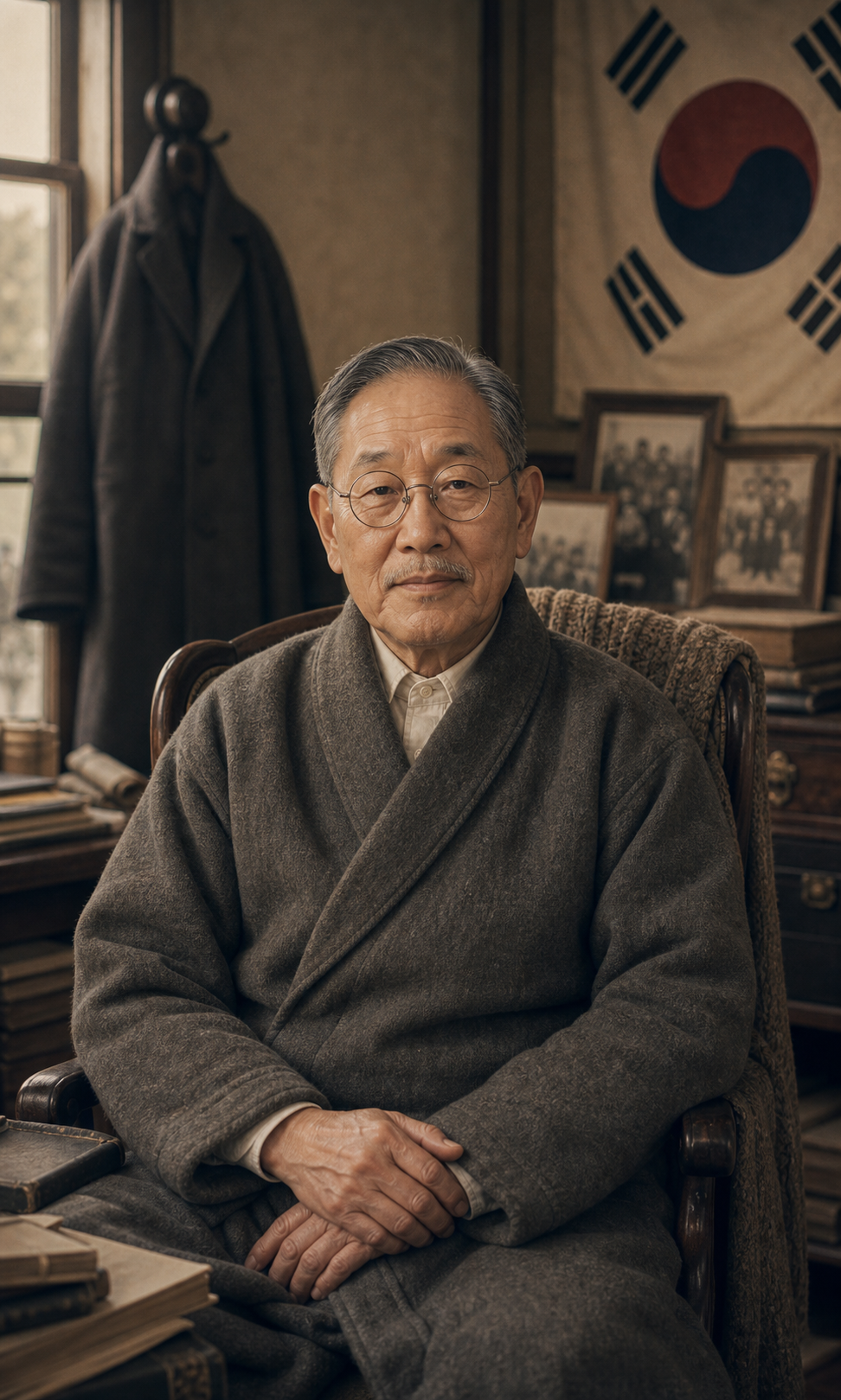
A life remembered
Recovering from illness in 1976, Warren Kim recalled a Korean independence-era life spent traveling, organizing, and preserving community records. Born in 1896 and arriving in the United States in 1917 as a student-refugee without ordinary papers, he moved through San Francisco, Colorado, Akron, Chicago, Los Angeles, Hawaii, and Korean nationalist circles. Warren described organizational labor that often disappeared behind better-known leaders.
The account's clearest thread is Warren's devotion to Korean public work, especially the Korean National Association and efforts to organize communities in Hawaii and the mainland. Warren also recalled conflict, factional struggle, and disputed charges connected with Syngman Rhee-era politics, although some details remain uncertain. Warren emerges as a scholar-organizer who valued records, newspapers, letters, and the honor of the independence movement as much as any formal title.
Based on interviews held by the USC Digital Library.
1896-1917
A Student-Refugee Arrives
Warren Kim was born in 1896 and came to the United States in 1917. He described himself as arriving by way of Shanghai, without a passport, as a student-refugee. Although the route is difficult to reconstruct fully, he entered the diaspora when Japanese colonial power had made ordinary Korean national belonging unstable.
San Francisco was his first mainland base. He remembered Korean ministers and community figures, private houses, and the effort to teach other immigrants practical English. Even in the earliest part of his American life, he appears less as an isolated newcomer than as someone drawn into the work of helping Koreans communicate and survive.
World War I briefly touched his life when he was drafted or nearly drafted, but the war ended before service took shape. Afterward he was free to move in search of work. Like many early Korean migrants, he carried both a need for wages and a public commitment to Korea's cause.
Warren remembered arrival as political displacement and student aspiration at once. That dual identity helps explain why he quickly moved between earning a living and helping other Koreans with language, organization, and public matters. As a student-refugee, he was trying to learn, work, and belong after empire had narrowed the possibilities at home.
1910s-1920s
Work Across the Mainland
Warren moved through industrial and urban America. In Colorado he worked for a steel company, learning tasks around wires, lights, and departments on the job. He then went to Akron, Ohio, where hard labor and factory wages formed part of his early employment history.
Chicago became an important stop. Warren managed a cafeteria at Union Station, where thousands of customers passed through, and the work provided steadier income than many Korean association jobs could. Others in the account recalled that he may have been among the better-off Koreans in Chicago at one point because he held a reliable position.
Yet paid work never fully displaced public work. Warren described Korean society work as poorly paid or unpaid, something one did out of obligation, often with one's own money, time, and travel energy.
His work history shows the national scale of early Korean American mobility. Colorado steel, Akron factory labor, Chicago cafeteria management, and California organizing were not separate lives but linked attempts to survive in an economy that rarely offered security. Warren's ability to pick up unfamiliar work also parallels his later ability to move through unfamiliar organizational problems. His industrial jobs also help locate him among other Korean men who circulated through American labor markets with few protections. The work could be skilled, punishing, temporary, or surprisingly lucrative, but it rarely separated them from community obligation. These jobs also placed him among migrants who treated work and public duty as inseparable.
1920s
Korean National Association Work
The Korean National Association, or Kuminhoe, stands at the center of Warren's recollections. He spoke of traveling wherever Korean society needed attention, collecting materials, and working with periods across regions. The movement appears in his memory as meetings, letters, delegates, accounts, newspapers, and arguments over authority.
Hawaii was especially important. Around 1928 and 1929, Warren was involved in efforts to bring order to divided Korean organizations there and to connect Hawaiian Koreans with mainland structures. He described plans for gathering local representatives and making the work legitimate through periods rather than through one individual's control.
He also recalled conflict with Syngman Rhee and Rhee's associates over how authority was claimed, how representatives were named, and how power could be centralized. The details are difficult, but Warren's belief in organizational legitimacy is unmistakable.
The Hawaii organizing passages are difficult, but they show how seriously Warren took process. He did not speak only of patriotism in emotional terms. He spoke of representatives, periods, authority, and the danger of one person claiming control. For him, the independence movement needed a structure that could outlast charisma and personal rivalry. This concern with structure may have come from experience. Scattered communities needed rules because distance made misunderstanding easy and because charismatic leaders could gather loyalty faster than institutions could build trust. That procedural concern is one of the clearest signs of his seriousness. The habit mattered.
Conflict
Factional Struggle and Honor
Warren's story includes a disputed embezzlement charge tied to travel money or return expenses connected with Hawaii work. The interview is too fragmented to state the full legal sequence with confidence, but Warren treated the charge as a question of honor rather than money.
The conversation around the case suggests a wider factional struggle. There are references to court, embarrassment, San Francisco, Los Angeles, Hawaii, and efforts by different groups to control association property or authority. Warren's voice, even when tired, returns to procedure, letters, and what had been promised in writing.
Because Warren was recovering from hospitalization, names and chronology sometimes slip and the accusation cannot be treated as settled fact. What remains clear is that he experienced independence politics as costly, personal, and sometimes bitter.
Association money represented trust among poor migrants supporting a national cause. An accusation against his handling of funds threatened the moral foundation of Warren's public life and, in his view, the reputation of Koreans trying to prove that their associations were disciplined and lawful. Honor was a community resource, not a private ornament.
Records
Newspapers, Books, and the Work of Memory
Warren was remembered by others in the account as a scholar of Korean community records. He handled Korean newspapers such as the Shinhan Minbo, checking issues from the beginning, binding or preserving materials, and knowing where information could be found.
He also wrote and left things out. At one point he explained that certain painful or factional episodes were not included in a Korean-language book because they were not the people's side or were too difficult to set down in that form. He treated an archive as a record shaped by choices about what could be said and what had to be left out.
The oral-history partners came to him because his memory and papers mattered. They asked about people, periods, court matters, Hollywood information, and broader Korean history. Even when he could not answer fully, the scene shows Warren as a living index to a diaspora archive.
His archival labor also suggests a different kind of leadership. Not everyone leads by speechmaking or officeholding. Some lead by keeping newspapers in order, remembering who attended which meeting, preserving letters, and knowing which painful stories have been omitted from published accounts. Warren's scholarship was practical, patient, and rooted in responsibility to future researchers. That archival role required judgment as well as memory. He had to decide what to preserve, what to publish, what to withhold, and how to protect living people from old factional wounds while still leaving enough evidence for history. His papers made memory usable for people who arrived after the battles were over.
1976
An Elder Recovering, Still Bearing Witness
The interview took place in Los Angeles on January 10, 1976, shortly after Warren had been in the hospital. He warned that his memory was unsteady and asked the person guiding the conversation to line up questions so he could furnish what he could.
Warren was clearest about the broad course of his life: arrival as a student-refugee, labor across the mainland, Korean association work, organizing in Hawaii, conflict with Rhee-aligned politics, and the preservation of community records.
Warren believed that Korean Americans needed periods, records, language, newspapers, and accountability. His life shows how independence-era public work depended on exhausting, unpaid, and often thankless labor.
Tired and recently ill, Warren still tried to serve the record. The closing impression is of a man sorting it aloud, aware that later generations would ask for names and dates but also that the work's emotional truth lay in loyalty, loss, and the burden of keeping papers when movements fractured.