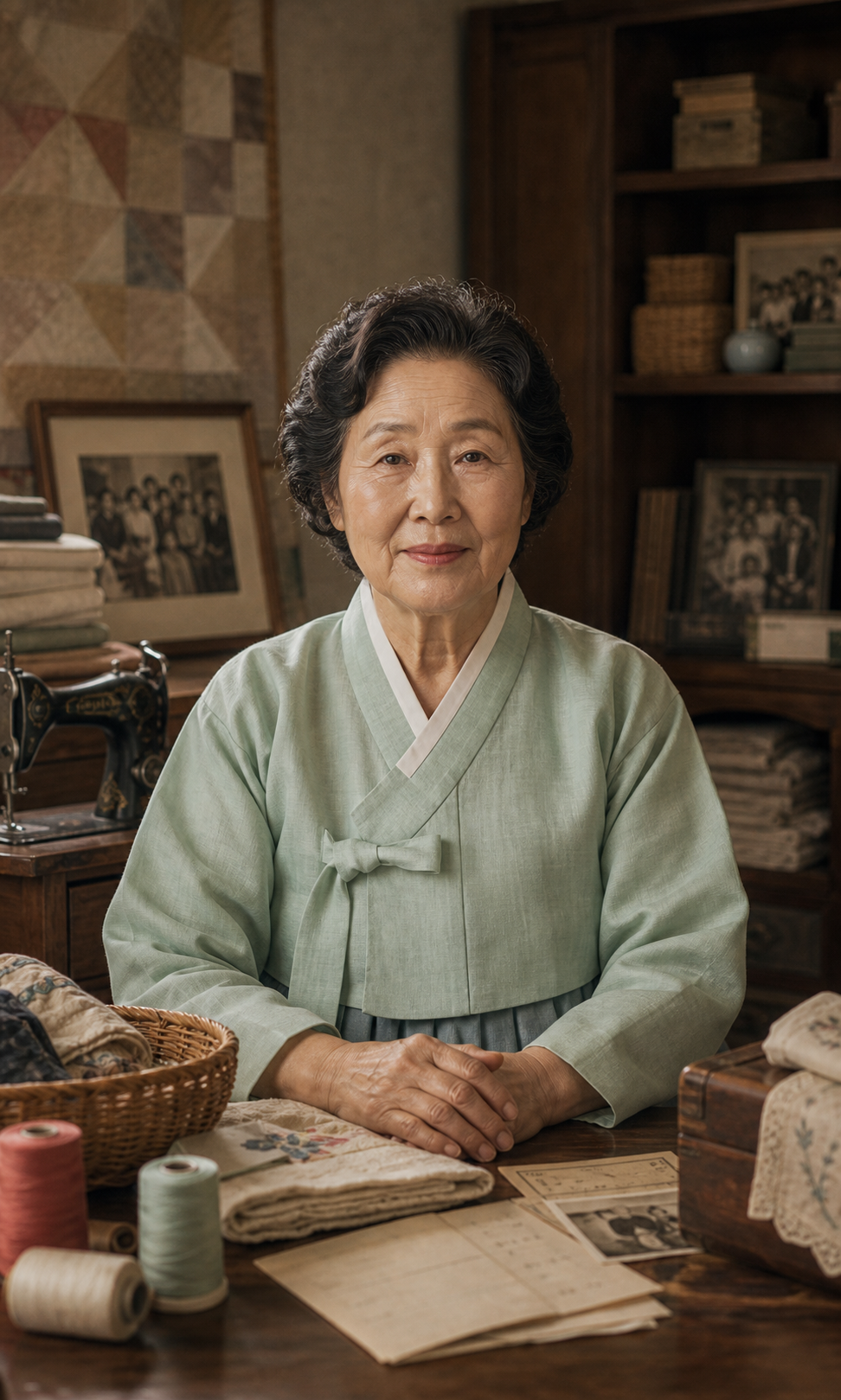
A life remembered
USC catalogs Sun Hee Shinn as Lee, Sun Hee (1889-1979), and her memories follow family, faith, migration, work, and children across the early Korean diaspora. She remembered family, Christian faith, migration, marriage, language study, restaurant work, children, and the daily labor that made immigrant family life possible.
Exact dates are sometimes unavailable, especially in the most fragmented passages. Its strongest life phases move from a northern Korean childhood and a father's wish that she study, through Hawaii and California, to home childbirth, farm and restaurant work, church and association life, Korean language education, children, housing, stability, and schooling.
Based on interviews held by the USC Digital Library.
1889-Early 1900s
A Daughter Sent Toward Study
The USC record identifies Sun Hee Shinn with the lifespan 1889-1979, placing her childhood in the generation that came of age as Korea entered the era of Japanese domination. The account points to northern Korean roots, with references that suggest the Pyongyang region, and to a family world of parents, siblings, Christian influence, and social ties that later helped make migration possible.
Her father appears in the account as someone who wanted her to study. In the fragmented account, that wish is one of the clearest emotional threads: a parent looking beyond the limits of the immediate household and imagining that America might offer a daughter more schooling than Korea could safely or easily provide. Education, before it became her own goal for her children, was first a hope placed upon her.
Her family appears to have known reform-minded and church-linked people in the Korean community in America. A young woman crossing the Pacific depended on such networks of trust, introductions, family arrangements, and community leaders to know where to go and whom to rely on.
The exact itinerary remains unclear, but the intention is steady: a daughter was sent into uncertainty because study, faith, and overseas community seemed to promise a wider future.
Early Immigration Years
Through Hawaii to California
Shinn's recollections place her Pacific route through Hawaii and then California, with San Francisco and Los Angeles appearing as early anchors in the immigrant geography. The movement was bound up with family arrangement and marriage, but it was also part of a broader Korean migration in which church contacts, acquaintances from Korea, and established community members helped newcomers find their first footing.
Arrival did not mean immediate belonging. She remembered the strangeness of English, the difficulty of answering people, and the shock of living among Western customs she did not yet know how to interpret. Simple public encounters could become moments of humiliation when a person could not understand a question or respond with confidence. Language made the new country both necessary and difficult, and it left many early immigrant women dependent on children, husbands, or community acquaintances for translation.
The migration also carried a painful change in status. In Korea, some families had education, property, or standing; in America, those markers could disappear quickly into poverty, rented rooms, and work that had to be done by hand. Shinn remembered that change in status as an emotional reversal. To be Korean could carry pride, but in the early years it could also carry embarrassment when the community was visibly poor, poorly dressed, and struggling to survive.
Community softened the isolation, even when it could not remove hardship. A familiar surname, a church connection, or an older Korean leader could help interpret housing, work, courtship, and respectability. For immigrant women especially, those circles translated more than language. They helped newcomers find housing, work, and people who spoke their language.
Early Adult Years
Language, School, and Household Work
Education remained important after migration, though it had to compete with work, marriage, and children. Shinn referred to English study in evening or elementary classes and later memories connected to City College, including coursework she associated with psychology. The details are not firm, but the desire is clear: American life required study, and she tried to claim some of it for herself.
Household responsibility came quickly. Shinn raised six children and remembered births at home, with Korean women coming to help in the absence of hospital routines that later generations would take for granted. Childbirth, nursing, cooking, washing, translation, and childcare belonged to the same daily economy. A mother had to keep the household functioning while the family learned how to live in a new country.
Before a family could become known for church service, business ownership, children's schooling, or a purchased house, someone had to cook, comfort, clean, and keep order through exhaustion. Shinn's memories make that labor visible.
The language barrier sharpened that labor. She could not always answer strangers, and she did not always know what American institutions expected. Yet she continued to study, work, and raise children inside that uncertainty. Her life shows the difference between formal education and daily intelligence: she needed both, and used both, even when the record preserves them unevenly.
Farm and Restaurant Years
Work That Filled the Days
The family's movements carried them through places associated with Korean labor in California, including San Francisco, Los Angeles, Manteca, and Willows. The account links these years to farm work, vegetable crops, rain, uncertain returns, and the constant search for a livelihood stable enough to support children. Farming promised independence, but weather and markets could quickly turn work into loss.
Restaurant work became one of the clearest centers of Shinn's adult memory. The business appears modest and improvised, at times tied to rented space or a house rather than a polished commercial establishment. She helped cook, helped serve, watched children, and worked late into the evening. The restaurant was not separate from family life. It consumed the same rooms, hours, and bodies.
Children were drawn into the labor when they were old enough to help, sometimes washing dishes or doing small tasks because every hand mattered. Shinn's memories of work do not present entrepreneurship as easy uplift. A restaurant could mean debt, exhaustion, unfamiliar American food, customers who needed service, and children waiting nearby. Survival required coordination more than glamour.
The food world also held identity. At home, Korean food remained important even while the restaurant required adjustment to American tastes. Cooking, kimchi, beans, and improvised repairs around the shop and house belonged to a practical immigrant skill set. Work filled the days, but it also preserved a Korean household inside an American economy.
Midcentury Community
Church, Korean School, and Association Life
Korean church and association life gave structure to a community that was often small, poor, and overworked. Shinn described herself as Christian because her parents were Christian, and she remembered Korean gatherings, patriotic songs, and community organizations as part of immigrant life. Faith, nationalism, and sociability were closely linked in a generation shaped by Japanese rule and distance from Korea.
It appears that public commemorations and patriotic feeling were not always easy to sustain. People had little money, little time, and few resources for formal celebration. Even so, songs, church meetings, association work, and remembered names carried the idea that Koreans abroad remained connected to one another and to a homeland that had been politically wounded.
Shinn also recalled Korean-language schooling for children after regular American school. The children attended public school in the morning and afternoon, then sometimes spent additional hours with Korean teachers. Parents contributed money because teachers could not live on goodwill alone. Cultural education had to be organized, scheduled, and paid for by families who were already stretched.
These institutions helped children inherit more than a surname. They gave Korean language, songs, memory, and community discipline a place alongside American schooling. For Shinn, the two forms of education did not cancel each other. Public school could carry children forward in the United States, while Korean school kept them tied to the older world their parents had crossed the ocean to preserve.
Community, 1889-1979
Education as the Measure of Arrival
When Shinn reflected on what she wanted from life in the United States, she returned less to wealth than to children, schooling, a house, and the comforts that made a home stable: electricity, plumbing, graduation, and a place where a family could live with less fear. Her measure of success was domestic and generational. The hard work of parents was justified when children could study and move beyond the insecurity of the early years.
She spoke with longing for Korea and for parents, relatives, and old friends who could not be recovered in the same form. Still, America had become home through the very weight of work. Children, grandchildren, church, school, restaurant labor, and community obligation had rooted her life in California. Home was not a clean replacement of one country by another. It was an accumulation of duties performed over decades.
Her story also carries the emotional complexity of being Korean in a period when Korea itself was poor, colonized, or divided, and Korean immigrants in America were often judged by poverty before they were recognized for endurance. Shinn did not turn that hardship into easy triumph. She remembered embarrassment, fatigue, and not knowing what to say, but she also remembered pride, songs, faith, and the insistence that children learn. That mixture gives the account its force, because dignity appears not as a slogan but as something defended in ordinary rooms and long workdays.
Sun Hee Shinn worked late, bore children at home, studied English when she could, paid teachers when her children needed Korean school, and wanted the next generation educated. Her labor as a mother, worker, believer, and community member supported the institutions and achievements that became more publicly visible.