A life remembered
Stewart Lim's life carried him from Korea to Hawaii, wartime military service, postwar Seoul, San Francisco, USC, and a long career in Los Angeles. Born in Kaesong in 1923 to Methodist minister Do Hwa Lim and Blanche Chang Yul Lim, he grew up in church households shaped by missionaries, education, Korean language, Japanese colonial rule, and the transpacific networks that brought the family to Honolulu in 1933. The interview also shows how a minister's son became a careful keeper of family photographs and institutional memory.
Language runs through Stewart's memories. As a child in Hawaii, Japanese helped him bridge the first days of English-language school for himself and his sister Pearl. During World War II and the U.S. occupation of Korea, Korean made him useful to the Army's language and counterintelligence work. Later, accounting and insurance work at Occidental gave him a stable civilian career, while Korean Methodist church life, family, music, and USC ties kept his public and personal worlds connected. His life links the Korean Methodist Pacific, U.S. military occupation, midcentury professional discrimination, and the quieter satisfactions of family and church service.
Based on interviews held by the USC Digital Library.
1923-1933
From Kaesong to Honolulu
Stewart Lim was born in Kaesong, Korea, in 1923. His father, Do Hwa Lim, was a Methodist minister and had also served as a church-related educator; his mother, Blanche Chang Yul Lim, belonged to the same world of Korean Christianity and missionary connection. Stewart remembered living in Kaesong, Chinnampo, and Seoul before the family crossed the Pacific.
The Korea of his childhood was under Japanese rule. In elementary school he learned Korean at first and then increasingly Japanese, and he remembered strict teachers, shaved heads, and an education system that demanded serious work even from young children. He also knew that later colonial policies would press Koreans harder.
In 1933, when Stewart was about ten, his father was transferred to the First Korean Methodist Church in Honolulu. The family traveled from Busan to Yokohama and then by ocean liner to Hawaii, a rough voyage that left him seasick. The move placed him in one of the larger Korean church communities in the Pacific.
Those early photographs and place names also reveal the world that made him. Kaesong and Chinnampo were not merely childhood backdrops; they connected the Lim family to Korean Christianity, missionary education, and a professional ministerial network. By the time Stewart left Korea, he had already experienced language as layered identity: Korean at home and school, Japanese under colonial authority, and soon English in Hawaii. His father's ministry also meant family life was never only private. Church appointments determined geography, and congregational duty taught Stewart to live identity through service.
1933-1942
English, School Leadership, and Church Life
Stewart and his younger sister Pearl entered Royal Elementary School speaking no English. A Japanese American teacher who knew some Japanese became their first bridge; Stewart translated what he could from Japanese into Korean for Pearl. Because he had already studied through fourth grade in Korea, he soon moved ahead in math and higher-grade work.
He adapted quickly. Within a year or so, English was no longer a major obstacle, and he became active in school life. At Central Intermediate School he served as class president for several years, entered speech-related activities, and later attended McKinley High School, where student government, clubs, and service organizations became part of his education.
Honolulu's Korean Methodist church remained central. Stewart remembered hundreds of members, choir leaders, nurses, engineers, business owners, and families who made the church a social as well as religious institution. His father avoided nationalist politics, preferring church work, but the community itself still connected Stewart to Korean names and histories.
His school career in Hawaii complicates any simple immigrant-child story. Stewart began behind in English but ahead in academic content, especially arithmetic, and teachers adjusted when they saw it. Leadership in intermediate and high school then gave him a public confidence that later appears in the Army, at USC, and at work. Teachers recognized Stewart's effort and adjusted to his academic strengths. Pearl's presence sharpens the story. Stewart was learning English while interpreting for a younger sister, so responsibility, language, and achievement developed together.
1942-1945
War Work and a Language Assignment
World War II arrived during Stewart's senior year of high school. He first worked for the Army PX service, then in 1944 received notice that, as an alien, he did not have to serve but could consent to induction and apply for citizenship. He agreed and entered the Army in January 1945.
Because he spoke Korean, Stewart was held in Hawaii for language-related assignment rather than being sent through the ordinary replacement route. He joined a language team made up mostly of Japanese American Nisei interpreters, with himself as the only Korean. The assignment marked him as someone whose languages mattered to the war and its aftermath.
The team traveled through the Philippines and Okinawa after Japan's surrender. Stewart remembered transport planes, typhoon seas, crowded ship conditions, saltwater showers, and the relief of finally landing in Incheon. What had begun as military service in Hawaii brought him back to Korea as a U.S. soldier in the land where he had been born.
The language team also placed him in a racially unusual military position. Surrounded mostly by Japanese American interpreters and non-Asian officers, Stewart occupied a role that depended on specialized knowledge rather than rank alone. Even small details, such as the issue of pistols to the interpreter team, stayed in his memory because they signaled that language could carry authority in wartime bureaucracy. The contrast between waiting and usefulness runs through his military memories. When language was needed, he moved from the margins to the center of action.
1945-1947
Seoul, CIC, and Citizenship
In Seoul, Stewart served with the Counter Intelligence Corps, where Korean language ability shaped much of his work. He investigated political activities, attended rallies, worked around police training, and moved through the city with the unusual mobility of a soldier who could speak directly to Koreans. His childhood memories of Seoul helped him find family friends.
In 1946, he heard over Armed Forces radio that an immigration officer was conducting naturalization. He hurried to the ceremony, arrived late, and received a private oath to make the matter official. His certificate recorded Seoul, Korea, as the place of naturalization, a fact he regarded as extraordinary.
One of his clearest occupation stories involved angry Seoul firemen after a dispute with a doctor over payment for treatment. Stewart addressed them in Korean, restored order, and persuaded the men involved to meet privately while the rest returned to their stations. The episode shows his skill in reading a crowd and translating more than words.
His return to Korea also had an emotional dimension. Stewart was not simply assigned to a foreign country; he was moving through streets where a ten-year-old's memory still worked. Reconnecting with his mother's friends and Korean educators showed him a Seoul altered by war and liberation yet still legible through childhood landmarks, family networks, and the Korean language he had carried across the Pacific. The naturalization scene folded migration back on itself: Stewart left Korea as a colonial subject and became a U.S. citizen in a city that held his earliest memories.
1947-1980s
USC, Accounting, and Occidental
Stewart left Korea in 1947 and returned to a family now in the San Francisco area. After his father's death in 1948, the family abandoned a troubled Berkeley real estate transaction and moved to Los Angeles, where the Korean community was larger. Stewart transferred from City College of San Francisco to USC and studied accounting on the GI Bill.
Professional life brought racial boundaries. Stewart recalled a national accounting firm that would not hire him as a traveling auditor because clients supposedly would not accept a nonwhite auditor, even though the office was decorated in Chinese modern style. He refused a back-office alternative and soon found a better path at Occidental.
Occidental hired him on the strength of his qualifications, and he stayed for thirty-six years. He began in accounting, later moved into underwriting staff work, interviewed potential underwriters, joined company clubs, and remembered the firm as a place where he was treated fairly.
The move into accounting and insurance gave Stewart a different arena for the same steadiness. He encountered discrimination in public accounting, but he did not let that account define his career. Occidental mattered because it turned his qualifications into a durable profession, and because the company had room for Asian agents and employees in ways many midcentury firms still resisted. His account also shows how discrimination could be polite and still decisive. The accounting firm's representative was cordial, but the result was exclusion. Stewart's response was not dramatic; he simply refused diminished work and moved toward an institution that would use his abilities.
Later Years
Family, Church, and a Life in Photographs
In Los Angeles, Stewart remained active in Korean Methodist church life. He sang in the choir, served on music-related committees, helped with dinners and church functions, and participated in a social world where worship, music, holiday programs, and Korean community overlapped.
He married Susie Lee in 1955 at University Methodist Church and built a family life with two children, Michael and Carolyn, and a grandson. His sister Pearl's music, his parents' ministry, and his own church service appear throughout the interview as a continuous family pattern rather than a separate religious category.
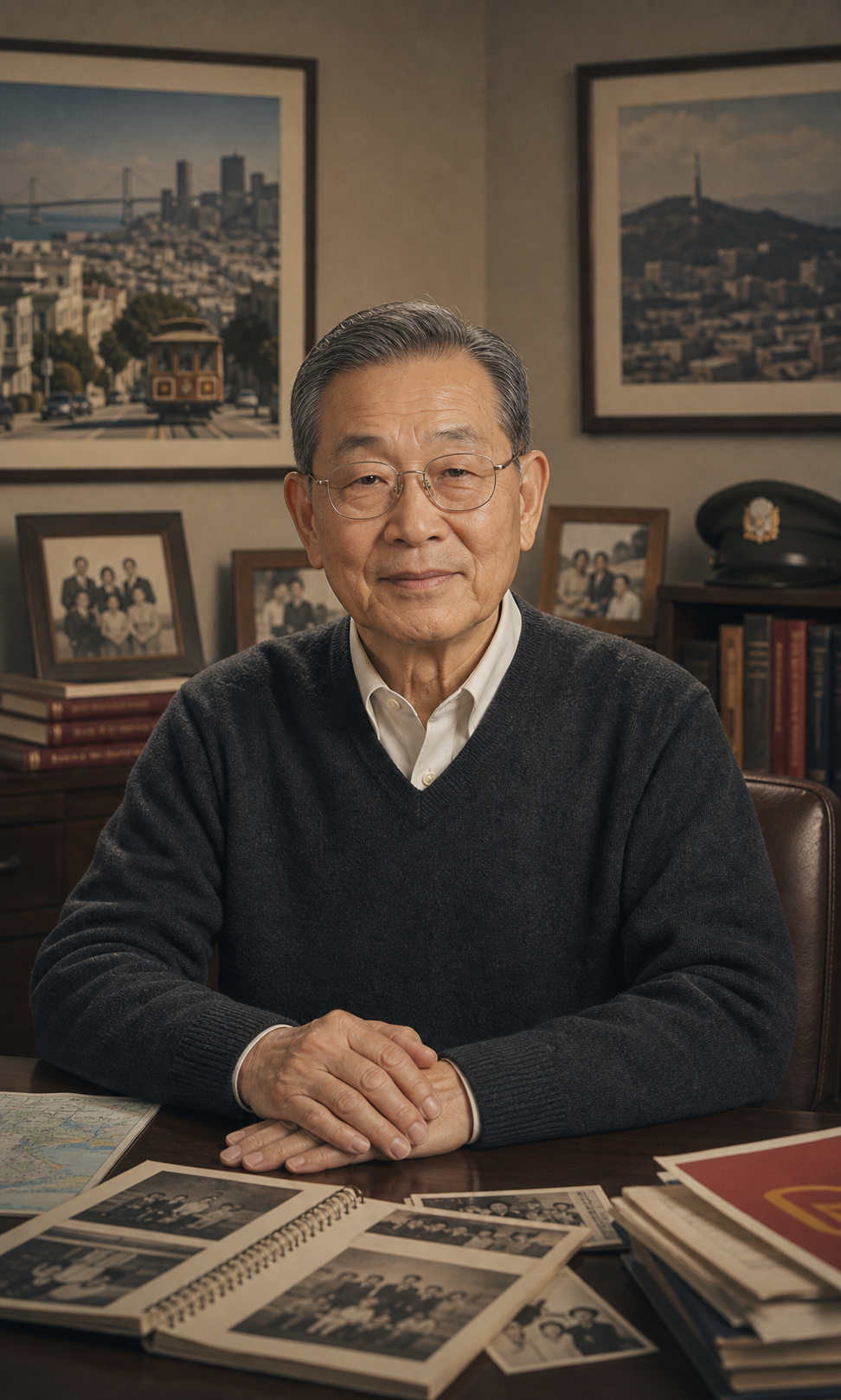
The later part of the account moves through photographs: his parents' wedding, missionary friends, Kaesong childhood portraits, Honolulu family images, police academy scenes in Seoul, USC graduation, and wedding pictures. Stewart's life story reads as a life arranged through images and explanations.
Stewart used the photograph section as a family archive. He identified people, supplied dates and places, and connected his parents and their missionary circles to Honolulu, wartime service, marriage, and USC. The care he took with each image matched the care he brought to the interview. He wanted later listeners to know how one family had moved through empires, islands, schools, armies, and professions.