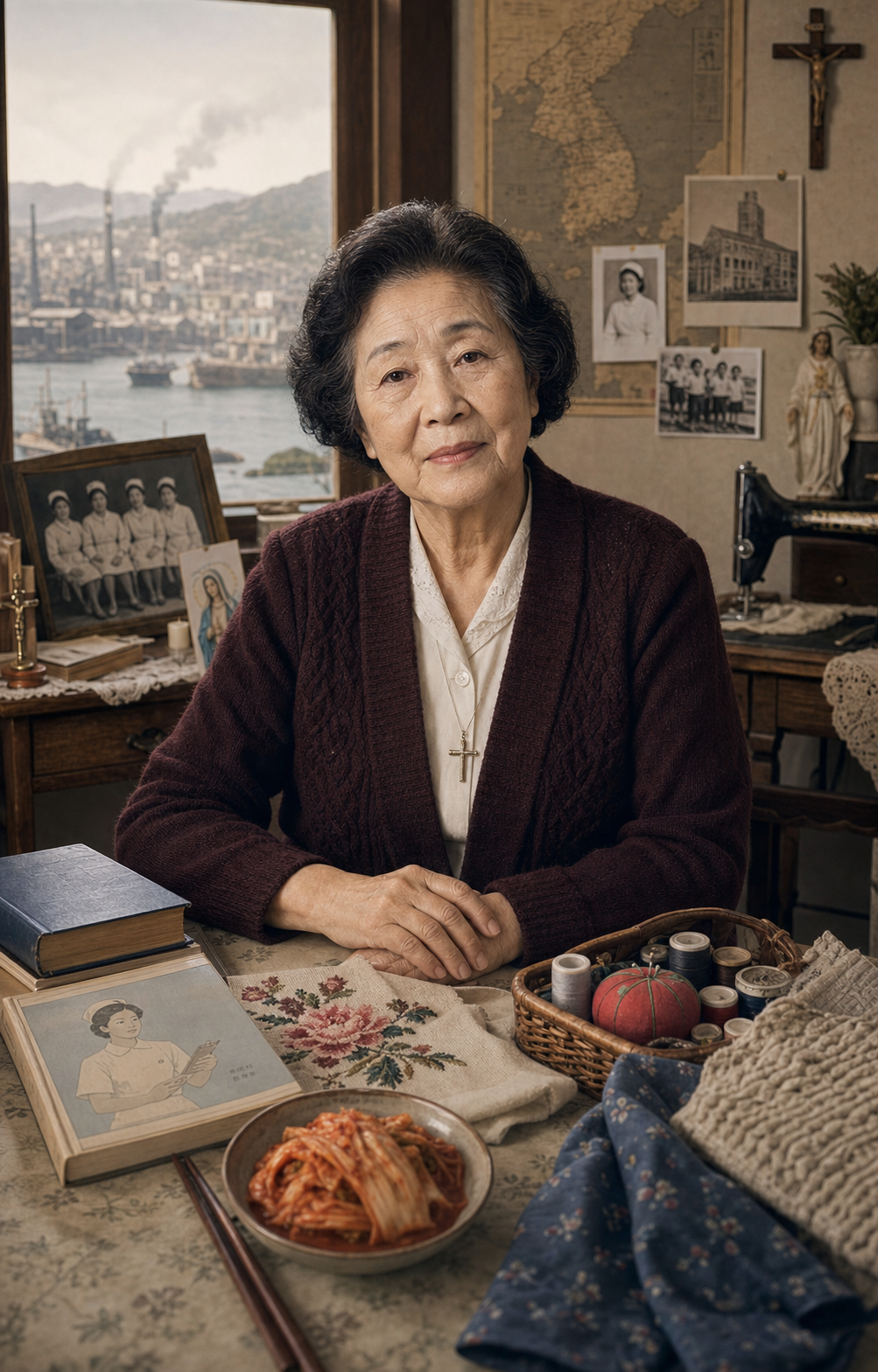
A life remembered
Colonial rule, national division, war, labor migration, and family separation repeatedly redirected Soon Sil Kim's life. She remembered growing up in Chinnampo in present-day North Korea, in a household that moved between modest stability and deep poverty after her father's death. Her memories return to Catholic schooling, Japanese-language rules, hunger, nursing study in Pyongyang, and the danger that arrived with Soviet-backed communist rule. Its strength lies in the way private memory opens onto larger histories of colonial schooling, North Korean state formation, refugee movement, gendered labor, and family reunification.
The account becomes most powerful when Soon Sil describes survival as a sequence of hard choices. She fled south by small wooden boat with her husband, mother-in-law, and young daughter, lived as a refugee in Incheon and Gunsan, and later left Korea for domestic work abroad so she could support children she had to leave behind. After Malaysia, Thailand, and an exploitative restaurant job in the United States, she built a Los Angeles life through factory work, dry cleaning, Catholic faith, forgiveness, and the daily memory of children, hometown, and northern foodways. Soon Sil spoke without sentimentality about what she had to do, give up, and carry forward.
Based on interviews held by the USC Digital Library.
Childhood
A Northern Childhood Near the Sea
Soon Sil Kim located her childhood in Chinnampo, a port city in Pyongan Province near Pyongyang. She remembered entering elementary school around age eight and growing up among small houses, steep paths, public water, markets, and winter cold. The city gave her enduring images: the road to church, the schoolyard, the bathhouse, seafood in the market, and kimchi preserved for the long northern season.
Her family knew poverty early. Her parents had once run a traditional bath or sauna business, but after her father died, her mother had to manage with children still at home. Soon Sil spoke of straw-roofed houses, barley and greens, cheap fish, and the effort required to obtain even small amounts of rice.
Religion and schooling formed another part of that world. Soon Sil described herself as Catholic and remembered learning from sisters at school. Still, she recalled Japanese colonial pressure: Japanese language in school, punishment for speaking Korean, and enforced Japanese-style names.
Soon Sil remembered Chinnampo at a child's scale: the walk between school, church, market, and bathhouse; familiar foods; the weather; and daily gestures. Those details remained vivid decades after exile. She also remembered poverty deepening after a parent's death, under colonial rules and shortages, until schooling gave way to survival.
1940s
Nursing Study and Political Pressure
Because the family could not afford an ordinary educational path, Soon Sil's chance to study came through a nursing program connected with Kim Il Sung University and a medical school in Pyongyang. She remembered that poor daughters could be recruited and educated without tuition, with dormitory life and simple food. For someone who had wanted schooling but lacked money, the opportunity was meaningful even when the conditions were hard.
The program also placed her inside the new political order. She recalled lessons in Lenin, Marxism, and communist ideology, along with pressure to serve the state after training. Frightened by what such training might make of her future, she arranged to leave by claiming that her mother was gravely ill.
That decision mattered because the political climate around her had become dangerous. Soon Sil spoke bitterly of communists, Soviet influence, confiscations, propaganda, and executions of people suspected of siding with the South or with religion. Her memories include a brother taken away, churches seized, foreign priests killed, goods removed, and neighbors made vulnerable by accusation.
The nursing-school episode shows how education and coercion could arrive together. Soon Sil valued learning and had tested well enough to enter, yet she also recognized that the institution was training poor young people for a political system she distrusted. Her escape from that track was not framed as ambition defeated, but as self-preservation in a world where school, work, and ideology had become inseparable. The experience taught her to judge political systems by their effects on families, churches, and ordinary speech.
War
Marriage, Boat, and Refuge
Soon Sil married in a period when war and forced labor had already scattered many young men. She described her husband as two years younger and, in later recollection, as unable to provide stable work and often drinking. The marriage placed her within a household that included her mother-in-law and, eventually, children whose survival depended heavily on Soon Sil's own labor.
When she fled the North, she did not leave with a secure plan so much as with a desperate hope of reaching safety and perhaps returning soon. She remembered traveling by a small wooden boat rather than a large American vessel, crossing rough water with her husband, mother-in-law, young daughter, and herself. The landing in Incheon brought no peace; the city was a battlefield of empty houses, shelling, movement, and improvised shelter.
The family moved on to Gunsan, where South Korean authorities gave refugees rice, small amounts of money, and help for food. Still, Soon Sil kept thinking of home and moved back toward Incheon, believing separation might last days or weeks rather than decades. She sold carried belongings and American goods such as socks, blankets, and jackets, turning whatever remained into rice and survival.
Her refugee memories also show how quickly wartime categories changed. People who had fled the North were aided in the South, but they were still poor, frightened, and unsure where they belonged. Gratitude for rice and money did not end homesickness. The urge to return northward reveals how refugees could understand displacement as temporary after history had made it permanent.
Family
A Mother Forced to Leave Children Behind
Soon Sil's account of motherhood is marked by decisions no parent would choose under ordinary conditions. She had a daughter born in Chinnampo and sons born later in the South, and she repeatedly returned to the difficulty of feeding and protecting them when her husband had no steady work. Her nursing training helped her give injections, assist babies, and earn small amounts, but it could not support a household of six.
She eventually concluded that she had to leave Korea to earn money abroad. The interview makes clear how painful and practical that decision was. She brought her daughter out first because a girl entering adolescence seemed especially vulnerable without her mother, while the younger boys remained with family because Soon Sil had no money to place all the children safely.
Years later, the children's reunion with her in the United States remained both joy and sorrow. She remembered leaving a three-year-old, a nine-year-old, and a twelve-year-old, then seeing them arrive after years had passed and the youngest had become a teenager. Even after they settled, she cried at meals or during ordinary moments because memory returned with force.
The interview makes that separation feel less like one event than a long condition. Soon Sil measured time through the ages of the children she had left and the ages at which they returned. In that arithmetic, migration was never simply progress. It was a bargain made under pressure, with wages and immigration papers on one side and missed childhoods on the other.
1960s-1970s
Domestic Work, Factories, and a Green Card
Soon Sil's path to the United States passed first through Southeast Asia. She worked as a domestic helper in Malaysia and Thailand, remembering one family with deep gratitude because they treated her kindly enough to hire additional help when she struggled. When that household's situation changed, she sought another placement rather than return to Korea.
She arrived in the United States at the end of 1969 to work in a restaurant, expecting that a year of labor would lead to a green card and family reunion. Instead, she found the employer controlling her documents and paying very little. After keeping her year-long promise, she insisted on leaving and recovered her papers with help.
Her American working life included restaurant labor, crochet work, sewing factories, her own small factory for a time, dry cleaning with her daughter and son-in-law, and later service work. She learned machines because factories needed workers, sent money, and slowly brought her children over. The work became the bridge between refugee life and a family rooted in Los Angeles.
Her labor story is also an immigrant legal story. She learned that promises about papers, family sponsorship, and wages could be used to control workers who did not yet know the system. What made the difference was not a single rescue, but her insistence that she had fulfilled her obligation and her ability to reach helpers who could force the return of her documents. Her later independence was built from practical resistance: leaving a bad job, learning a machine, and refusing to let an employer decide her future.
Later Years
Faith, Forgiveness, and the Taste of Home
In later life, Soon Sil described a shift from anger toward forgiveness. The pain of separation, her husband's failings, communist violence, and years of hard labor did not disappear, but she spoke of becoming less bitter and more able to think in terms of mercy. Catholic prayer, church community, visits to elderly people, and small acts of service gave her a way to live with what could not be repaired.
Her memory of North Korea remained vivid and complicated. She wanted to see the neighborhood of her childhood, yet she worried that searching openly for relatives might endanger them. She knew the grief of divided families shown on television and imagined she would weep the same way, but she doubted she could live in Korea again.
Food carried home most safely. Soon Sil gave extended descriptions of northern kimchi, winter crocks buried in the ground, crab and seafood from Chinnampo markets, cucumber pickles, dongchimi, and the differences between northern and southern seasoning. In a life where photographs, houses, and people were lost, recipes and tastes became a portable archive.
The food passages are especially valuable because they preserve women's knowledge as historical evidence. Her descriptions of winter kimchi, brined cucumbers, seafood, and regional seasoning record climate, class, household cooperation, and local taste. They also show how cultural memory can survive without artifacts: a woman who lost houses and photographs could still reconstruct home through the order of ingredients. Her voice gives those practices historical dignity: kimchi, prayer, work, and memory became ways to survive displacement and remain herself.