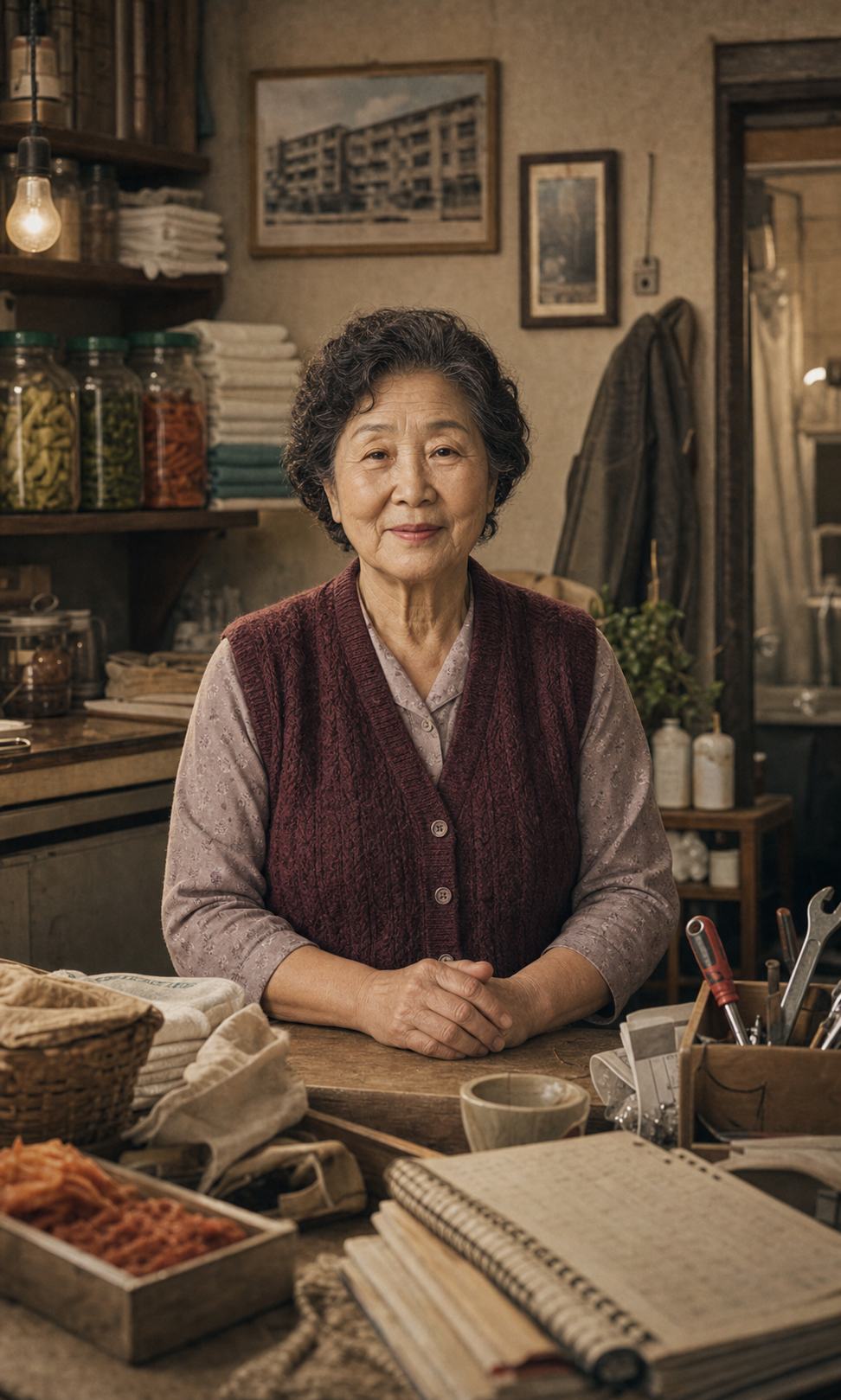
A life remembered
Sentai Roh remembered rent, food, work, migration, housing, and small business with a practical attention to the details of daily survival. She spoke about apartments, hotels or bathhouse-like businesses, cooking, rent, repairs, and the practical management of everyday survival.
Exact dates and some names remain uncertain. The stable pattern is a Korean immigrant woman adapting through food and work, learning systems of rent and payment, maintaining kin and community ties, and comparing the older immigrant generation with later arrivals.
Based on interviews held by the USC Digital Library.
1990
A Visit With Family
The interview was less a formal chronology than a conversation with an elder in her apartment, apparently in Berkeley around 1990. Food, kitchen activity, and shared memory filled the visit before structured questions resumed.
That setting matters. Sentai Roh's story comes through in the rhythms of a visit: preparing food, remembering people, shifting between business details and family names, and speaking from a lifetime of practical knowledge. It is a domestic oral history in the fullest sense.
Unrelated language fragments and repeated phrases make exact wording unreliable, but work, housing, immigration, and memory recur consistently.
The apartment was the kind of place she had worked to secure. Food, ledgers, errands, and visits filled the material world in which she remembered, while hospitality remained one of the ways she exercised authority in old age.
Migration
Arrival, Language, and Foreignness
Sentai Roh remembered America as strange at first, especially because language limited what she could understand outside Korean circles. It appears that she arrived after marriage or alongside family responsibilities, and that early impressions mixed excitement about America with confusion and loneliness.
Food became one way to remain grounded. She mentions Korean staples such as soybean paste, red pepper paste, tofu, and kimchi-like foods, contrasting the comforts of familiar cooking with the unfamiliar conditions of American life. Cooking for a household was both labor and cultural continuity.
Her memory of foreignness is practical rather than abstract. Not knowing the language affected shopping, work, neighbors, citizenship, and travel. Adaptation meant learning enough to live, relying on Korean networks, and accepting that some parts of American life would remain difficult.
Her memories of arrival suggest both fascination and disappointment. America sounded prosperous from afar, but the America she entered still required rent, work, language learning, and dependence on people who could translate or explain. Familiar food helped soften that foreignness. Soybean paste, pepper paste, tofu, and kimchi-like dishes were not simply tastes from home; they were a practical system of nourishment and identity in a place where everything else could feel difficult to read.
Familiar food was a survival practice that made an unfamiliar country livable. The conveniences she had heard about were not automatically available to immigrant workers, so foreignness was managed through repeated routines, Korean speech, and familiar tastes.
Work
Baths, Hotels, and Service Work
The account repeatedly refers to businesses involving hotels, baths, showers, towels, soap, laundry, and customer charges. The exact business history is hard to reconstruct, but the details point to service work that demanded cleanliness, pricing, stamina, and constant attention to customers.
Sentai Roh remembered the costs of running such work: rent, taxes, repairs, payments, and the need to adjust prices as demand changed. Business was not described in romantic terms. It was daily calculation, physical labor, and the pressure of keeping enough income flowing.
The bathhouse or bath-related business also drew a mixed clientele, with references to Chinese, Filipino, and other customers. In that setting, immigrant work created contact across communities, even when language and social distance remained.
The bath and service-work passages are vivid because they preserve business from the worker's side. Prices, towels, soap, laundry, water, and customer habits all mattered. A bathhouse, hotel, or similar service business required the owner to calculate costs while also performing physical work. Sentai Roh remembered how many customers came, what they paid, and how prices rose. Those details are the economic texture of immigrant survival.
It is precisely this attention to small amounts, towels, water, and labor that makes the interview valuable as economic history. These business details also distinguish her from a passive dependent; she remembered the operation from the inside, as someone responsible for whether it worked. The business may have been modest, but the knowledge required to run it was detailed and exacting.
Housing
Apartments, Rent, and Property Responsibility
Housing is another major thread. Sentai Roh speaks about apartments, rent, building purchases, payments, and the fear of being alone or unable to manage property. It appears that she lived in her own apartment for many years, with 1968 appearing as a possible anchor date.
Property ownership or management carried both pride and strain. She remembered monthly payments, rent that could not always be raised, taxes, repairs, and the practical difficulty of deciding whether to sell. These details reveal a life organized around responsibility rather than leisure.
The housing passages also show aging. Children or relatives worried about an elder living alone, while she weighed independence against safety. The apartment becomes a symbol of survival: small, familiar, and hard-won.
Numbers recur whenever Roh discussed housing. An apartment meant payments, taxes, repairs, tenants, advice from relatives, and the possibility of living alone. She remembered what could be charged, what needed fixing, and when independence might become unsafe in old age. Every repair or missed payment could affect the family's security, so the apartment remained both shelter and an ongoing job. Even years later, she could still recall rents and payments because each amount had once shaped a household decision.
Community
Women, Community, and Changing Generations
Sentai Roh reflected on the limited public presence of women in earlier years and the greater visibility of women in later community life. Her memories suggest that older immigrant women often worked intensely but were less visible in formal organizations or public storytelling.
She also compared older and newer Korean immigrants. Later arrivals seemed more educated, more mobile, more comfortable driving, and more able to move through American systems. Rather than resentment, the comparison carries the perspective of someone who knew how difficult the earlier path had been.
Community for her meant recognizing names, family relations, churches, and regional ties. The interview moves through acquaintances quickly because the oral-history partners and subject share a web of remembered people. That web itself is part of the history.
Sentai Roh's comments on changing generations are historically useful because they come from comparison, not theory. She saw newer Korean immigrants arriving with more education, mobility, and confidence in American systems. She also remembered a time when women had fewer public roles and older immigrants depended more heavily on kin networks. Her story marks a transition from survival migration to a more institutionally visible Korean America.
These comparisons give the account a generational perspective that would be hard to find in official records. Her comments make the older generation visible as people who measured change through driving, schooling, women's independence, and the confidence of newcomers. These observations make her a witness to change inside Korean American everyday life, especially for women.
Later Years
Food, Work, and a Hard-Won Home
By the end of the account, Sentai Roh's life appears through practical arts: cooking, washing, pricing, renting, repairing, hosting, and remembering. These were not minor tasks. They were how an immigrant household and business survived.
She thought aloud about what things cost, how people behaved, what food tasted like, and how much work lay behind a modest apartment or business.
Sentai Roh made a place for herself through labor, thrift, hospitality, and memory, even when language and public recognition did not come easily.
She knew how to feed people, manage customers, remember kin, judge prices, and remain in her own space for many years. Making a home and livelihood through daily labor was her durable immigrant achievement.
Her practical memory connects the costs and routines of one household to the broader history of Korean immigrant settlement.