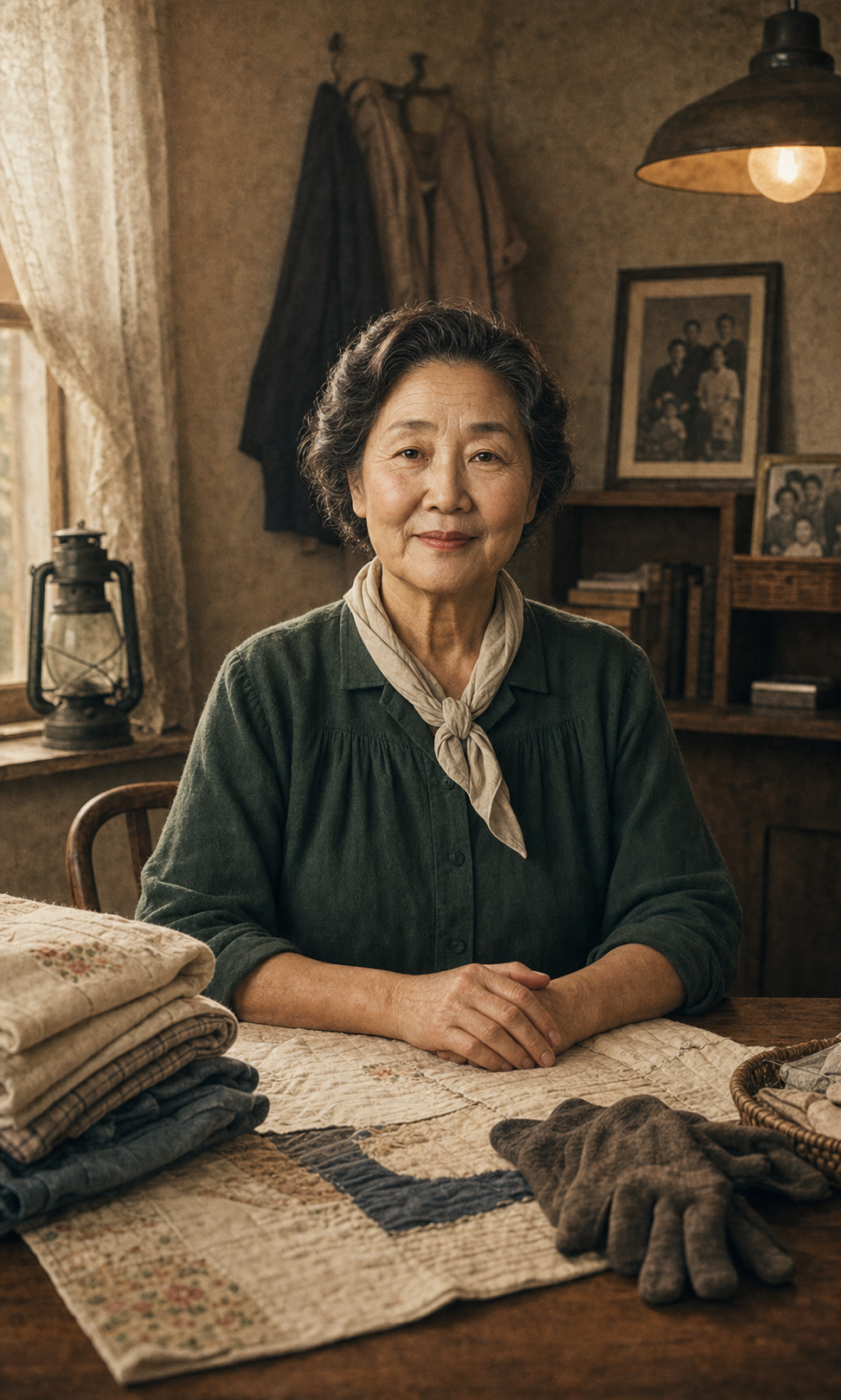
A life remembered
Only part of Sang Ok Har's recollections survives clearly; a damaged section once contained her discussion of Depression hardship. The recoverable material centers on marriage, wartime anxiety, children, clothing, education, and the emotional labor of motherhood as the family endured scarcity.
A precise chronology is not recoverable, but Mrs. Har consistently remembered family care: raising children, sending them toward school, music, and marriage, making or sending clothes when money was short, and finding pride in her children's safety and character.
Based on interviews held by the USC Digital Library.
Later Years
Family Questions and Shared Memory
Sang Ok Har spoke in a familiar, conversational setting, with family or community members encouraging her in Korean. It begins less like a formal life chronology than a visit with an elder whose memories are already shared by the people around her.
Cross-talk and damaged sections make some names and dates in the surviving recording difficult to separate. The strongest material is thematic: hardship in America, wartime worry, children growing up, and the quiet authority of a mother who had lived through scarcity.
The conversation preserves family memory rather than a complete archival record. Its strongest evidence is domestic: an older Korean American woman explaining what mattered after a long life.
Family and community members asked Mrs. Har questions, corrected her gently, and encouraged her to speak about feelings as much as dates. Her identity as mother and elder emerges through those relationships rather than in isolation.
Hard Times
Depression Hardship and Making Do
A narrator's note in the interview indicates that a jammed tape erased an important central section in which Mrs. Har discussed hardships and struggles during the Depression period. That loss matters, because the surrounding conversation suggests that economic difficulty shaped the family deeply.
References to clothing, sewing, sending items, and not being able to buy what others had point toward a household where resources were stretched. Mrs. Har seems to measure hardship through what could or could not be provided for children, especially when education or social expectations required money.
The missing section cannot be reconstructed, but what survives shows the discipline of making do: repairing, sewing, waiting, and accepting personal limits so that children could have a better chance.
Clothing, money, schooling, and daily provisioning were the concrete forms through which the Depression entered the family. The tape failure leaves the details incomplete, not the importance of the hardship she described.
The surrounding conversation shows a mother measuring scarcity through the children: what they could wear, whether they could study, and which opportunities required money the household did not have. Sewing and repair were not minor chores. They were ways of protecting the children's confidence while the family made do with less.
War Years
War, Service, and Anxiety
The account includes fragmented references to World War II, military service, and an intelligence or ordnance-related role. The exact person and unit are not clear in the interview, but the emotional content is plain: war brought worry into the household.
Mrs. Har's recollections focus less on military detail than on waiting, fear, and the strain of not knowing what might happen next. Her memories of war sit alongside memories of children, marriage, and daily obligations, as they often did for families whose lives continued at home while loved ones served elsewhere.
The surviving interview records public events through private anxiety. Har remembered war from inside the ordinary labor of keeping a family going, as a mother and wife rather than as a witness to the battlefield.
The fragments do not supply a clean military record, but they preserve the emotional field around one. Mrs. Har's concern was whether a loved one would come home and whether family life could resume, while children still needed food, clothing, comfort, and steady adults.
Family
Motherhood, Discipline, and Love
The clearest passages concern children. Mrs. Har reflects on who held authority in the household, how children responded to father and mother, and how discipline could be carried through silence as much as through raised voices. The details reveal a family culture where respect, restraint, and emotional control mattered.
She remembered joy when children were safe, grew well, avoided destructive paths, and reached milestones such as marriage or engagement. Her words suggest both pride and the bittersweet feeling of seeing a child's love move outward into another household.
The account's most enduring theme is parental love. Even when children disappoint, the parent still loves; even when they leave, the parent is glad for their life and sad at their absence. Mrs. Har's life story is grounded in that ordinary but powerful truth.
Her reflections on discipline are unusually intimate. Silence, disappointment, and delayed reconciliation could be stronger than physical punishment, and children understood that. Mrs. Har remembered a household where emotion was managed carefully, perhaps because hardship left little room for disorder. Still, she speaks with deep tenderness about children growing well. The discipline was tied to hope: children should avoid destructive paths, honor family effort, and live safely beyond their parents' struggles.
The emotional intelligence in these passages is considerable, because Mrs. Har can describe both strictness and love without pretending they were opposites. Her account also suggests that immigrant parenting required emotional strategy: deciding when to speak, when to withhold approval, and when love should be shown through restraint. For Har, that restraint was a form of care.
Children
Education, Clothing, and Aspiration
Several passages connect children's futures to schooling, music, and clothing. The interview mentions an eldest daughter at a music school back east, and it returns to the difficulty and pride involved in supporting children whose opportunities carried them beyond the immediate household.
Clothing appears as both practical necessity and symbol. Mrs. Har remembered making or sending clothes when buying them was difficult, and feeling the strain of wanting children to appear properly cared for. In immigrant family life, fabric and fashion could carry the weight of aspiration.
Ambition did not always arrive as a speech about success; sometimes it appeared as a mother sewing, saving, or doing without so a child could study, perform, marry, or stand confidently among others.
Education and clothing both appear as ways a mother tried to place children in the world. A daughter studying music far away, a child needing proper clothes, or a marriage approaching all required resources and emotional preparation. Mrs. Har's pride is inseparable from the labor behind it. She remembered not simply that children achieved things, but that a parent had to help make those achievements possible through sewing, saving, and accepting personal sacrifice. These memories show how aspiration was stitched into daily life, not announced only in public achievements. A garment, a tuition payment, or a letter from school could stand for a future the parents had worked to make possible. In that way, material sacrifice became emotional inheritance.
Family
An Elder's Measure of Success
By the end of the surviving account, Mrs. Har measures life through gratitude for children and family. She expresses pride that children grew into good people and thanks those who endured difficult years with her. The tone is not triumphant so much as relieved and tender.
Because part of the tape is damaged, some events cannot be recovered. Har was nevertheless clear about what mattered to her: hardship and joy belonged to the same life, and success meant children living safely, loving one another, and remembering what their parents had carried.
Sang Ok Har's surviving recollections center on domestic endurance: a mother's labor shaping the education and confidence of the next generation.
Her final measure of success was moral and relational. The children survived, grew, married, studied, and remained loved. In a life shaped by Depression hardship, war anxiety, and immigrant labor, that ordinary safety was a major achievement.
She did not separate achievement from the work that enabled it. Music school, proper clothing, marriage, and a child's confidence all carried traces of sewing, saving, waiting, and restraint at home. Her gratitude in old age was relief after long responsibility, not a claim that the years had been easy.