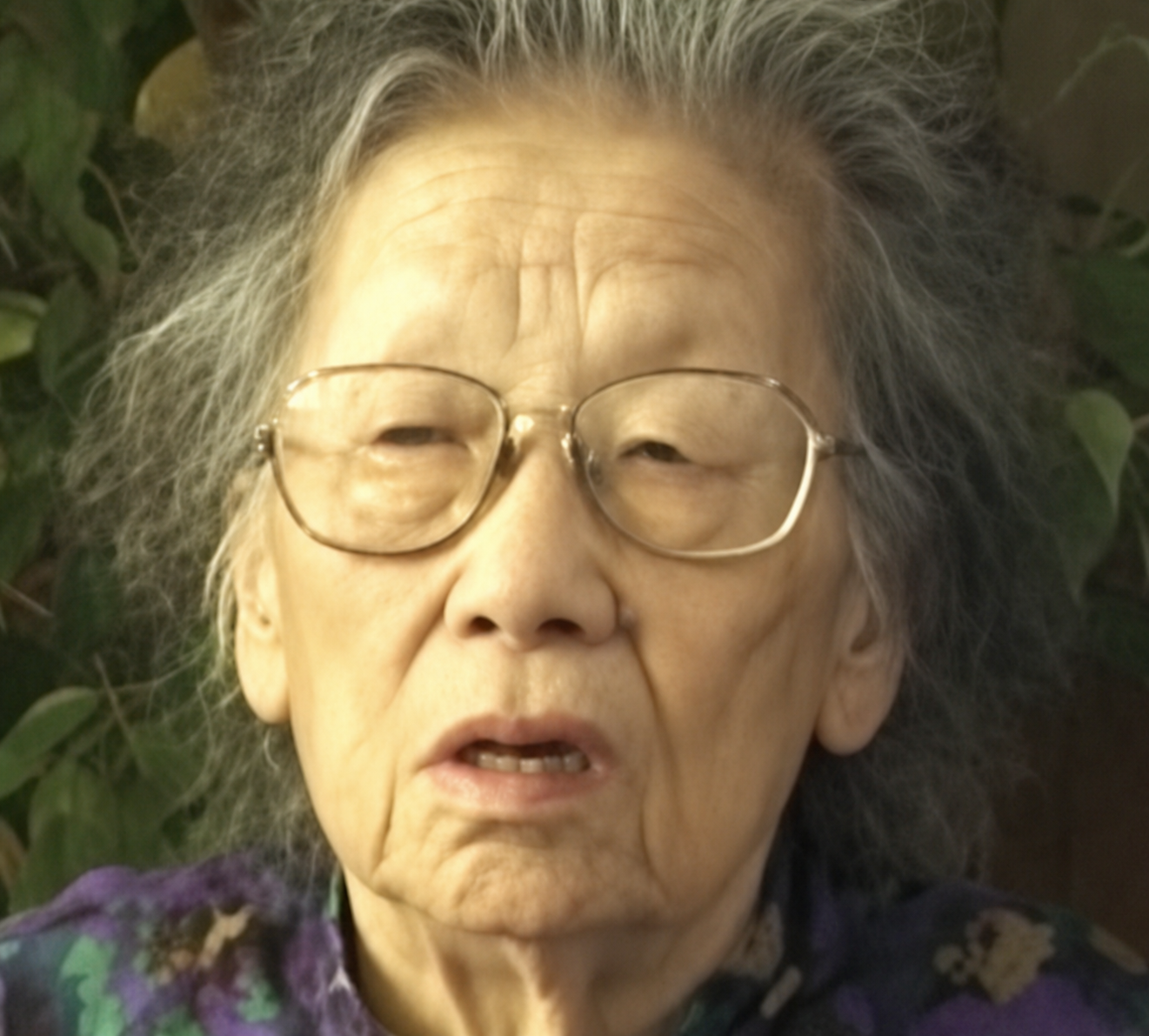
A life remembered
Rose Park crossed the Pacific as a small child, grew up in isolated farm country, married through community letters, and raised six children. Born in Seoul in 1911, she came to the United States in 1914 with her mother and older half siblings to join her father in Mountain Home, Idaho. Her memories move from a Japanese colonial-era passport and family photographs to Oregon strawberries, Idaho winters, Utah sugar beets, Delano grapes, Los Angeles noodle work, Korean church, and the quieter pleasures of painting and craft.
Rose spoke with humor, understatement, and a practical sense of what families endured. She remembered poverty, farm labor, her mother's early death, the absence of nearby Koreans, simple church potlucks, and the difficulty of passing language and culture to children in America. Still, she resisted reducing her life to hardship. She found beauty in cherry blossoms, spring water, horses, Christmas trees, family photographs, and the relief of finally living near a Korean community in California. Her candid, observant voice stays close to work, family, faith, and the domestic details she remembered best.
Based on interviews held by the USC Digital Library.
1911-1916
Seoul, Passport, and Idaho Arrival
Rose Park was born in Seoul in 1911, in a Korea already under Japanese colonial rule. In the account, her birthplace is remembered as a hillside area near Seoul's South Gate, a place she later found transformed by modern buildings. That detail gives her origin story a vivid oral-history quality: the hill of birth survived in memory even after the landscape itself had changed.
Her father, remembered in the 1977 account as Park Kyung Soo, left Korea before Rose knew him well. The family connected his departure to the pressures of Japanese rule and the need to find work abroad. He spent time in Hawaii and then made his way to Mountain Home, Idaho, where he took practical work wherever he could find it, including work associated with a bar or saloon.
In 1914, Rose's mother, Im So Sa, also remembered through the passport as Anna Lim, traveled with Rose and older half siblings to join him. The family came under a Japanese passport, a reminder of the political circumstances of Korean migration at that time. Rose was not yet three, and the crossing survived in family memory more than in her own clear recollection.
Mountain Home left a child's impressions: a small frame house, water collecting outside after rain, a neighbor named Josephine, and the loneliness of a place with few if any Koreans nearby. The family soon moved again, this time toward Oregon farm country. Rose's earliest American life was already marked by movement, improvisation, and the search for work in places where Korean families were rare.
1916-1925
Oregon Farm Childhood
In Oregon, near Fairview and surrounding farm areas, Rose's family became vegetable and berry farmers. They raised strawberries, cabbage, corn, peppers, and other produce, with fruit trees adding cherries, plums, and apples to the family's memory of the land. Her father worked long days and then hauled produce to market at night by horse and wagon, later with a Model T truck that seemed enormous at the time.
The children were expected to help because farm families needed every available pair of hands. Rose remembered picking strawberries, beans, potatoes, corn, and raspberries, and she recalled that earnings went back into the household rather than becoming personal spending money. She preferred field work to indoor chores and described herself as a tomboy, the kind of child who climbed, ran, rode horses, and found adventure in barns and woods.
Yet the farm was not only labor. Rose remembered spring quiet, bees in cherry blossoms, wildflowers in the woods, clear water from a ram pump, and the feel of weather on the walk from school. Those memories complicate the family's hardship. The farm could be cold, poorly equipped, and physically demanding, but it also gave her space, beauty, and a language for remembering childhood with affection.
Her mother's work was less visible but constant. Im So Sa raised many children, cooked, kept the household moving, and helped when she could. Immigrant farm households depended on women's domestic labor as much as on market crops. Food, laundry, childbirth, child care, and the management of scarcity formed the hidden structure beneath the family's public work in the fields.
1920s
Loss, School, and Rural Belonging
In 1925, Rose's mother died after complications surrounding childbirth and illness, and the infant born in that period died soon afterward. Rose remembered the event through the color of the day, the shock carried by her father, and the practical consequences for the children. The story treats these memories gently because the interview itself is painful and fragmented, returning often to grief, responsibility, and survival.
After her mother's death, the family had to redistribute care. Rose and her siblings helped with cooking, washing, farm work, and younger children, while one very young brother spent time in a children's home until the family could manage his care again. Her father did not remarry, and the family eventually left the Oregon farm partly because the place held too many memories of their mother.
School gave Rose both relief and challenge. She began formal schooling later than many children because of distance, language, and farm logistics, but she remembered doing well in the early grades. Lunch might be plain, the walk could be icy or windy, and English had to be learned, yet school offered a break from the endless demands of field and house work.
Social belonging was more complicated. Rose attended American churches, especially Methodist and Presbyterian congregations, because there were no Korean churches nearby. She enjoyed occasional potlucks and remembered small pleasures such as potato salad, but she also understood that her family could be left outside local parties and social circles. In rural Oregon and Idaho, being Korean often meant being visible, misunderstood, and lonely, even when neighbors were not openly hostile.
1929-1941
Letters, Marriage, and Utah Farm Life
Rose married Munsan Pak in Eagle, Idaho, on February 27, 1929. Their marriage came through letters, family networks, and intermediaries, a pattern familiar in small Korean immigrant communities where eligible Korean partners were scattered across farms and towns. Rose was still a teenager, and she later described the arrangement with the matter-of-fact tone of someone shaped by the expectations of her time.
The wedding itself was simple and memorable. A Methodist minister performed the ceremony, schoolchildren and townspeople gathered, and Rose and her husband walked together without the elaborate attendants or rehearsals she later saw at her daughters' weddings. The scene was both Korean and rural American: a marriage made by Korean networks, witnessed by curious and friendly neighbors near the edge of a farm.
After marriage, Rose moved into her husband's family farm life in Utah. The household was extended, with older parents, younger siblings, and shared work around sugar beets, hay, animals, and rented or sharecropped land. Rose learned another version of farm responsibility: cooking, helping, raising children, and living in a household where everyone's labor was tied to everyone else's survival.
Most of Rose's children were born during the Utah years, before the family eventually moved to California. She remembered school wagons, children growing up around fields, and the ordinary rhythms of birthdays, meals, and household improvisation. Her reflections on motherhood were practical rather than sentimental: children needed food, steadiness, and example, and parents often had to make do with what was available.
1940s
Delano, Los Angeles, and Korean Community
California changed the scale of Rose's world. The family spent time in agricultural communities such as Delano, McFarland, and the Bakersfield area, where grape work, heat, Korean boarding houses, and a small Korean church community entered her memory. Compared with rural Oregon and Idaho, even a modest Korean gathering felt significant because it offered language, recognition, and shared experience.
Around 1941, shortly before the United States entered World War II, the family came to Los Angeles. Work connected them to a Korean food business near Forty-First Street and Broadway, where her husband handled demanding factory tasks involving noodles, soy sauce, bean sprouts, and chow mein. Rose also worked with packaging and food preparation when needed, while the family lived near the workplace and near Wrigley Field.
That job was not remembered as easy, but it brought the family into the Los Angeles Korean community. Rose began attending Korean Presbyterian church circles and knew of Korean institutions such as the Korean National Association. She also recalled women's groups and church-based activities, though she was candid that Korean-language meetings could be difficult for those whose lives had unfolded largely in English-speaking rural settings.
Los Angeles mattered because it gave her children a broader Korean American social world than she had known. Rose connected the move to her husband's desire that the children grow up around Korean people rather than in isolation. For a woman who had spent much of childhood as one of the only Korean children in farm country, the presence of church, organizations, and other families was a major change.
Later Years
Memory, Family, and Later Life
Rose's later reflections were organized around family photographs, names, places, and the objects that carried memory. The interview begins with images: a childhood photograph in Seoul, her parents, the family passport, a wedding portrait, siblings, farm gatherings, and later portraits. Photographs helped her move through time, turning scattered recollection into a public record.
She compared her own youth with her children's lives and saw both continuity and change. Her children had more choice in marriage, more social possibilities, and more access to Korean community than she had as a girl. Still, she sent them to Korean language school when possible, partly because cultural inheritance felt like something a family should try to pass on, even when fluency was difficult to sustain.
Rose also worried that modern comfort could thin family closeness. She remembered letters, cards, cousins, and visits as signs of affection, while later generations seemed more independent and absorbed by private routines. This was not simply complaint; it was the observation of someone who knew how much isolated families once depended on one another for recognition, news, and emotional life.
In later years, Rose enjoyed handwork, knitting, crocheting, crafts, and oil painting. She could speak of hard times without making hardship her whole identity. Her oral history leaves a portrait of a woman who crossed empires, farms, states, churches, and languages, then looked back with humor, candor, and a steady preference for the ordinary ties that make survival meaningful.