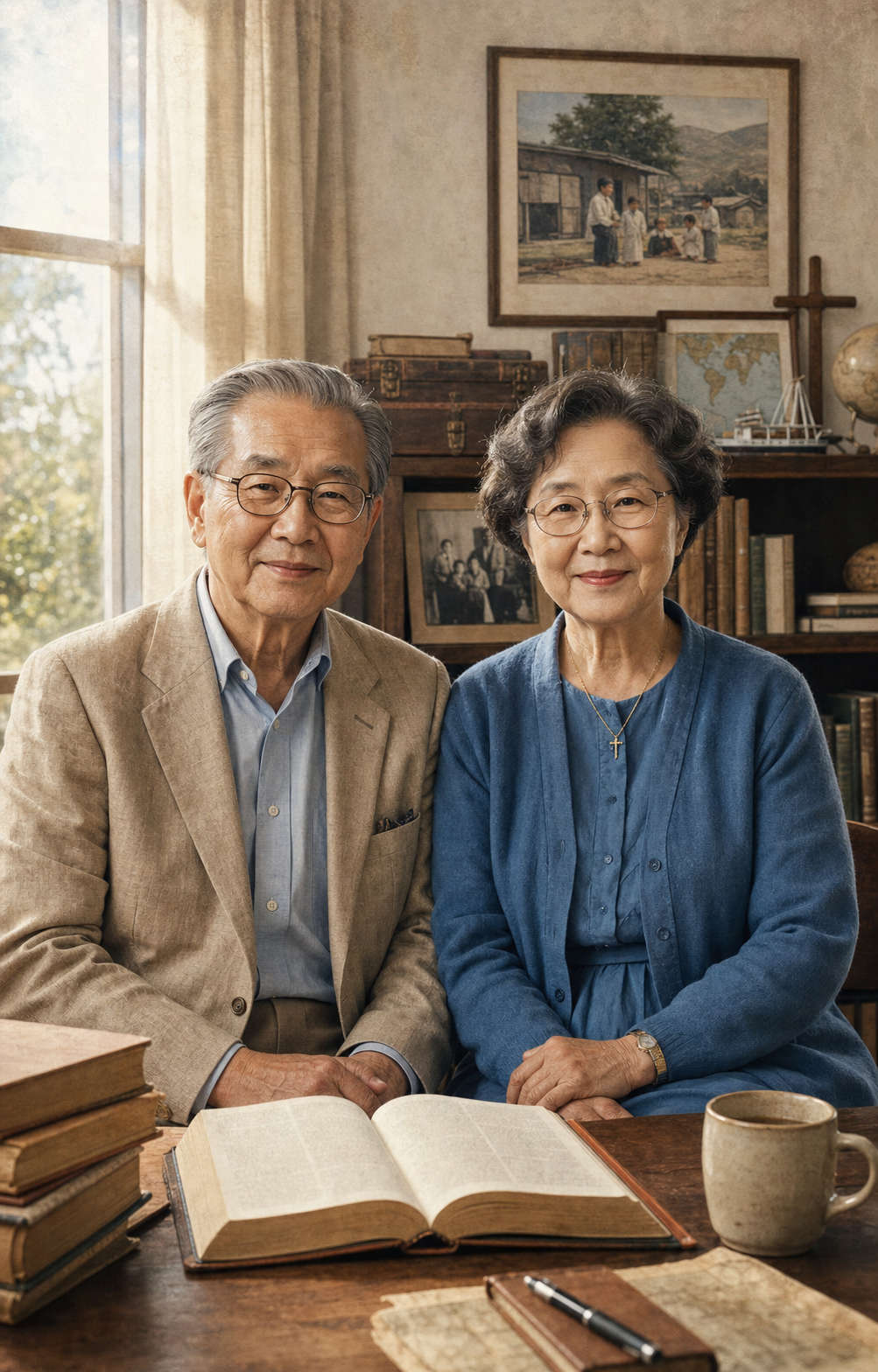
A life remembered
Family inheritance and missionary vocation converged in the life Richard O. Hahn and Julia Kim Hahn built together. Richard's memories begin with a grandfather who came to California in 1903 and later returned to Korea to establish a school for poor boys; Julia's begin in Hawaii, where Korean plantation families built churches, households, and Christian community.
Together, their lives moved through California schooling, mechanics, teaching, Bible training, Korea after the war, orphanage work, adoption, church planting, and educational ministry. Their account is both personal history and testimony, showing how Korean American identity, practical skills, and Christian service became one shared calling.
Based on interviews held by the USC Digital Library.
1903-1930s
Richard's Family Across Korea and California
Richard O. Hahn traced his family to a grandfather who arrived in the United States in 1903 with Richard's father, John Hahn, then a child. The grandfather had been a scholar and teacher in Korea, but in California the family turned to farming around Taft, Selma, and the Central Valley.
Richard was born near Selma in 1922 and later moved with his family to Los Angeles in 1934. He remembered his father not only as a worker but as a musician with a strong tenor voice and skill on saxophone and other instruments. That musical memory stayed with him as something he wished had been recorded.
The family story also reached back to Korea. Richard remembered that his grandfather returned in 1929 to the North and established a school and dormitory for poor boys. The family later lost contact, and Lloyd Hahn's wartime meeting with him in Seoul became one of the last known connections.
Richard's opening memories also emphasize the limits of family knowledge. He could remember some names, places, and stories, but not every motive behind the 1903 migration or the grandfather's later return. Rather than weaken the story, that uncertainty makes it more truthful. Korean American families often inherited fragments: a farm near Taft, a school in North Korea, a song never recorded, a relative last seen in Seoul. Richard's story gathers those fragments into a usable family history. His caution keeps family legend separate from verifiable fact. It also leaves space for Lloyd Hahn's related account to stand beside Richard's without forcing every detail into one perfect family chronology.
1918-1941
Julia's Hawaii Childhood
Julia Kim Hahn remembered a different route into Korean America. Her father, Kim Insik, had gone to Hawaii after a series of losses and disruptions in Korea, and her mother, Son Sonam, came as a bride after hearing that the prospective husband was Christian. The marriage began with disappointment over his age and circumstances, but Julia remembered him as a good father.
Julia was born in Hawaii in 1920 and grew up in a Korean plantation community with enough families to sustain a Korean Methodist church. As the oldest child, she took on household responsibilities early, helping care for siblings and prepare dinner after school.
Hawaii also placed her near World War II history. She remembered being in Honolulu when Pearl Harbor was attacked, seeing planes and living through the shock of war. Her Korean identity, church life, and wartime experience formed the foundation of her later calling.
Julia's Hawaii memories add a gendered and plantation-centered strand to the joint story. Her mother crossed the Pacific expecting a Christian husband and found a much older man who was not wealthy, yet the household became a place of faith and children. Julia remembered chewing cane, helping with dinner, and leaving school early because family responsibilities came first. These details show how the oldest daughter often became an essential worker inside the home long before adulthood. Julia's childhood shows how plantation communities depended on children, churches, and mothers whose labor made religious and family life possible. Her account makes clear that Korean Methodist community in Hawaii was not incidental; it was the structure through which children learned faith, language, and obligation.
1930s-1950s
Schooling, Mechanics, and Teaching
Richard attended Manual Arts High School in Los Angeles after earlier schooling in farming districts near Bakersfield. He was younger than many classmates because he had advanced quickly through grades, and he later felt that losing a year of ordinary schooling had cost him some social and athletic experiences.
His strongest interests were mechanical. He delivered newspapers to buy a bicycle, repaired a Model T, studied auto mechanics at Frank Wiggins Technical Junior College, and later worked in mechanics, aviation, photography, and teaching. These practical skills became important in his missionary life as well as his working life.
Julia pursued Christian education and teaching. After conversion experiences connected to church and Bible school influences in Los Angeles, she trained for service and became an elementary teacher. Teaching was not a fallback from mission; it became one of the tools through which mission work could be done.
Richard's practical training is important because it later served mission work in ways formal theology alone could not. Auto mechanics, aviation work, photography, truck driving, and industrial education all gave him useful competence. He could repair, teach, drive, organize, and solve material problems. The account presents these skills as part of calling, not a detour from it. In Korea, where schools, orphanages, and churches needed practical builders as well as preachers, that background mattered. These skills helped bridge the distance between American training and Korean postwar need. Richard's life story is not a straight line from mechanic to missionary, but a story of practical gifts gradually finding religious purpose.
Community
Language, Church, and Korean Identity
Both Richard and Julia were shaped by Korean churches and language schooling. Richard attended Korean school after public school in Los Angeles because parents and church leaders wanted children to retain the language. He later judged that effort essential, especially when younger generations began losing contact with Korean speech and history.
Julia's Korean identity was always tied to church. In Hawaii and Los Angeles she sang in choirs, taught Sunday school, and imagined Christian service from a young age. Korean American Protestant life gave Julia opportunities to lead through teaching, music, and children's ministry.
For the Hahns, Christianity was not merely inherited culture. Their account repeatedly returns to personal conversion, faith as relationship, and the idea that service should come from gratitude rather than social obligation alone.
Their commitment to language and faith also shaped how they understood Korean American identity. Richard regretted seeing younger families dismiss Korean language as unnecessary, because he knew how much had been preserved through after-school lessons. Julia's church life gave her another route to identity: choir, Sunday school, Bible training, and teaching. Together, they represent a Korean American Protestant world in which cultural continuity and Christian mission were deeply intertwined. For both of them, heritage was something to be practiced through speech, worship, teaching, and service rather than merely claimed. Their concern over language loss also shows that mission abroad did not replace responsibility to Korean American children at home.
1950s-1970s
Korea, Orphanage Work, and Adopted Children
Richard and Julia went to Korea soon after the Korean War, entering a country crowded with refugees and children in need. They worked in Busan with orphanage and church groups, bringing food, singing, speaking, distributing tracts, and helping build Christian community among displaced people.
Their Korean American status gave their work a distinctive character. They were born outside Korea, yet Korean people received them as returning Koreans, and Julia remembered being able to speak publicly in Korean with surprise and gratitude. They taught English, worked with children, and helped in churches where need was immediate.
The couple adopted two Korean daughters, Rachel and Laura, and brought them to the United States before later returning to Korea. The girls' schooling revealed the difficulty of moving between languages and systems: they could help with English but struggled in Korean schools, eventually attending foreign school in Seoul.
Their early work in postwar Korea must be read against the scale of need. Busan and other southern areas were crowded with refugees, improvised housing, hungry children, and churches trying to respond. The Hahns brought food, music, testimony, English teaching, and organizational help. Julia's surprise at speaking Korean publicly is especially moving: a woman born in Hawaii found herself using inherited language to serve people in a devastated Korea. Their work also shows how Korean Americans abroad could be received as both outsiders and kin, carrying skills learned elsewhere back into a wounded homeland. In those settings, testimony, food, schooling, and adoption were all part of one response to wartime devastation.
Community
Schools, Pioneer Clubs, and a Life Centered on Service
The Hahns' later ministry included church planting, school work, and collaboration with an orphanage that grew into a larger educational institution. Julia described helping begin a school from a single classroom and later seeing it serve many students, while Richard took leadership responsibilities connected to the school and mission work.
Julia also developed Pioneer Girls and later Pioneer Club programs in Korea, adapting materials and gathering women and students into mentoring relationships. The work joined education, faith, leadership, and care for young people, extending the same values that had shaped her own childhood church life.
By 1999, Richard and Julia understood their lives as still connected to Korea even after formal mission structures had changed hands. Their life story is a partnership story: mechanics and teaching, preaching and administration, adoption and schooling, all organized around the belief that service in Korea remained their life's work.
The school and Pioneer Club work show their ministry becoming institutional without losing its personal roots. A single classroom could become a larger school; girls' clubs could become broader youth programs; former orphans could become leaders. By the time of the account, the Hahns were looking back on decades of work that had passed increasingly into Korean hands. That transition allowed the work to continue without depending forever on their control. Their work remained in students, clubs, churches, and institutions sturdy enough to continue after the missionaries stepped back. Their final reflections make the story less about retirement than about stewardship: what had been started needed to keep serving young people.