A life remembered
Phil Kwon Kim worked, raised a family, taught younger people, and kept Korean cultural practices alive with the materials available to him. The Korean-language account is uneven, but it repeatedly returns to a boyhood in Korea, early migration through Hawaii and California, hotel and farm work, settlement in Stockton and Los Angeles, and a lifelong commitment to Korean dance, music, language, and home instruction.
Phil preserved culture informally, without waiting for established classrooms or well-funded institutions. Phil Kwon Kim appears not as an institution builder with abundant resources, but as a resourceful elder who made instruments when none were available, taught children Korean movement and words, and insisted that American-born children could grow up in English without surrendering Korean memory.
Based on interviews held by the USC Digital Library.
Childhood
A Practical Education in Korea
Phil Kwon Kim's account reaches back to childhood in Korea, with references that appear to place family roots around Gyeongju or the surrounding region. The interview describes a father involved in trade or practical business, and a son who learned by following, carrying, watching, and absorbing the habits of negotiation and work.
Formal schooling was limited in the account, but the account does not treat that as absence of education. Phil's knowledge came through apprenticeship: seeing how adults handled goods, money, customers, and social rank. Later interpreters in the account frame him as someone with rich practical intelligence rather than classroom credentials.
This early formation matters because it shaped the rest of his life. He learned to improvise, to read people, and to make things with his hands. Those skills later served him in labor, business, teaching, and cultural performance.
The childhood passages also help explain why later oral-history partners admired Phil's practical intelligence. He learned in a world where adults expected children to observe carefully and contribute early. Market knowledge, respect for elders, and the ability to handle objects or money were forms of education. When he later taught Korean culture in America, he drew on this embodied learning. He did not approach culture as something stored in books alone, but as something carried in hands, posture, rhythm, and speech. This helps explain why his later cultural teaching felt practical rather than ornamental: he taught what could be held, sounded, repeated, and corrected. His father's discipline and business habits appear to have taught him that knowledge should be demonstrated, not merely explained.
Migration
From Korea to Hawaii and San Francisco
It appears that Phil came to the United States young, possibly through Hawaii before reaching San Francisco. The details are difficult to stabilize because speakers move between Korean and English while an interpreter asks questions, but the emotional outline is clear: migration began early, and the new country required immediate adaptation.
In San Francisco he is remembered as working in hotel settings and as being one of very few Koreans, sometimes described in the account as the only Korean or one of the first Koreans in a particular workplace. Whether the exact claim can be verified or not, the memory conveys isolation and visibility.
The first American years were marked by language difficulty and the experience of being watched as foreign. Phil's response, as the account presents it, was not retreat. He learned tasks, observed social rules, and developed the resilient self-possession that later made him a teacher to others.
The migration story is marked by visibility. To be one of very few Koreans in a hotel or worksite meant that mistakes could feel public and successes could become community memory. Phil's early American life seems to have required constant adjustment to language, racial categorization, and labor expectations. The oral-history partners' interest in whether he was the only Korean suggests that his presence itself became memorable to others, especially in workplaces where Asians were often grouped together without regard to nationality.
The memory of being watched also helps explain his later pride in Korean performance, where visibility could become dignity rather than embarrassment. That reversal of visibility is central to his story: the immigrant once marked as unusual later became someone people sought out precisely because he carried Korean knowledge.
1930s
Stockton, Los Angeles, and Work That Changed Shape
After San Francisco and Manteca, the account places Phil in Stockton and then Los Angeles, with 1935 named as an important year for arrival in Los Angeles. He is associated with peddling, farming, and other work that required mobility and persistence.
Stockton appears as a family place where children were raised and where his wife died, according to the remembered conversation. These passages are intimate and sometimes fragmentary, but they show a man whose public life cannot be separated from family loss and responsibility.
His work history resists a single occupational label. He moved through available jobs, adapted to changing circumstances, and carried the practical lessons of his father into California. That flexibility became part of his authority as an elder.
His movements through Stockton and Los Angeles also show the restless geography of Korean immigrant work. Men and families followed jobs, crops, customers, and community contacts. Peddling, farming, and service work required bodily endurance and social confidence, both of which appear repeatedly in the account.
The references to family life in Stockton keep the story grounded: cultural leadership later in Los Angeles did not erase the years of ordinary labor, bereavement, and responsibility that preceded it. The same mobility that made work unstable also allowed cultural knowledge to travel, following Korean families from farms and small towns into Los Angeles community life. The family references place his cultural work alongside grief, relocation, and the ordinary burdens of making a living.
Culture
Dance, Instruments, and Korean Performance
The clearest public contribution in the interview is Phil Kwon Kim's work teaching Korean dance and culture in Los Angeles. oral-history partners describe him showing Korean dance, teaching cultural forms, and becoming known by word of mouth at Korean functions. His reputation appears to have grown through repeated invitations and personal demonstration.
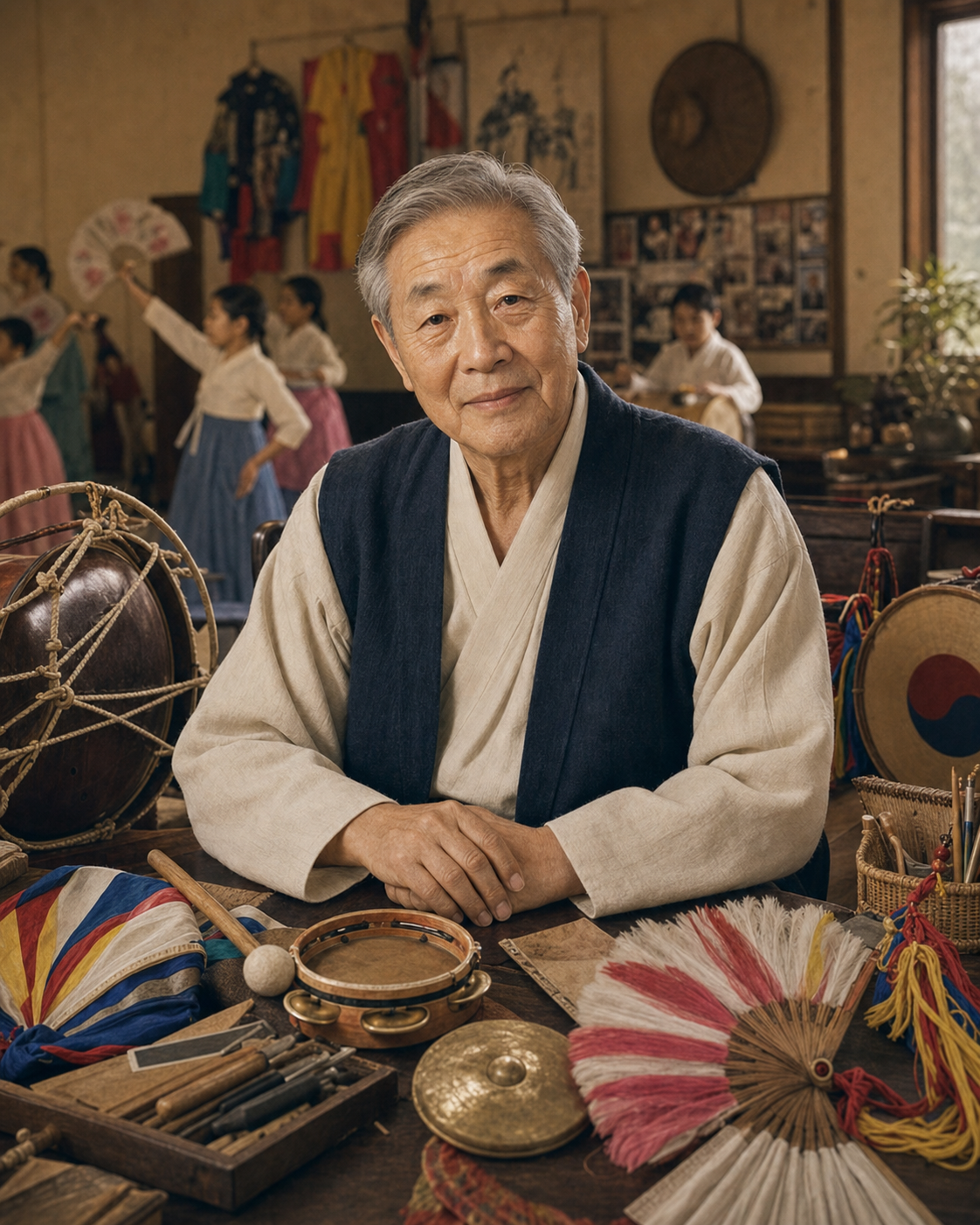
Because instruments and cultural materials were not always available in the United States, Phil made or adapted what he needed. The interview refers to homemade Korean instruments and to the hands-on labor of sustaining performance without institutional support. Cultural preservation, in his case, was literally made by hand.
His teaching was not limited to performance technique. Dance carried language, etiquette, memory, and pride. Children who learned from him encountered Korea through rhythm, movement, objects, and the presence of an elder who treated culture as something living.
Phil's cultural work stands out because it was materially inventive. If Korean instruments could not be bought, he made them; if children had no school program available, he taught where he could; if a performance was requested, he used the knowledge and objects at hand. This preserves culture differently from a museum collection or academic study. It is preservation by use.
Instruments, dances, and gestures survived because someone was willing to practice them repeatedly in community rooms and homes. His practice shows that cultural continuity often begins before funding, classrooms, or official recognition arrive; it begins when one person decides the knowledge should not disappear. The handmade quality of his work also protected Korean culture from becoming remote or ceremonial; children could see that it belonged in ordinary rooms.
Teaching
Korean at Home and in the Next Generation
Phil believed that Korean children in America should hear and use Korean at home. The account repeatedly returns to Hangul, Korean speech, and the difficulty of teaching children who thought and studied in English. He understood the challenge, but he did not accept language loss as inevitable.
His approach was practical. When schools or formal programs were not enough, he taught at home or visited families. The oral-history partners describe him as a rare figure, someone whose dedication filled gaps that institutions could not meet.
The result was a form of cultural mentorship. Phil did not simply tell children to be Korean; he gave them words, gestures, sounds, and stories. His own children, according to the account, retained Korean speech and understanding because he used the language consistently at home.
Kim's insistence on speaking Korean at home went beyond nostalgia. The language carried forms of respect, family relationships, humor, and shades of meaning that English could not replace. He spoke frankly about the difficulty of interesting American-born children and kept looking for methods that worked. Korean, in his view, belonged in daily family life, not only at ceremonies. Teaching it was his way of carrying memory, affection, and respect from one generation to the next.
Later Years
Memory Without Return
The account notes that Phil Kwon Kim had not returned to Korea after leaving, making memory especially powerful. Korea remained present not through travel, but through language, dance, stories, and the repetition of practices he carried into American life.
That distance may have sharpened his commitment. He taught what he remembered because the memories were not easily renewed by visits. In Los Angeles, his home and community gatherings became places where a vanished childhood world could be translated for children born elsewhere.
Phil Kwon Kim kept teaching Korean culture when resources were scarce. With limited formal education, limited materials, and imperfect institutional support, he became a teacher because he had knowledge others needed. He continued that quiet work for years.
The fact that he had not returned to Korea gives his teaching a particular poignancy. Memory had to do the work that travel could not. Korea remained vivid through childhood scenes, old speech forms, cultural techniques, and the desire to pass them on before they faded. Performances alone do not measure Phil Kwon Kim's influence. It is measured by the children and families who encountered Korean identity through his patient, handmade instruction. Talent and duty came together in his teaching: he turned what he remembered of Korea into lessons others could practice. For Phil, performance and teaching were inseparable.