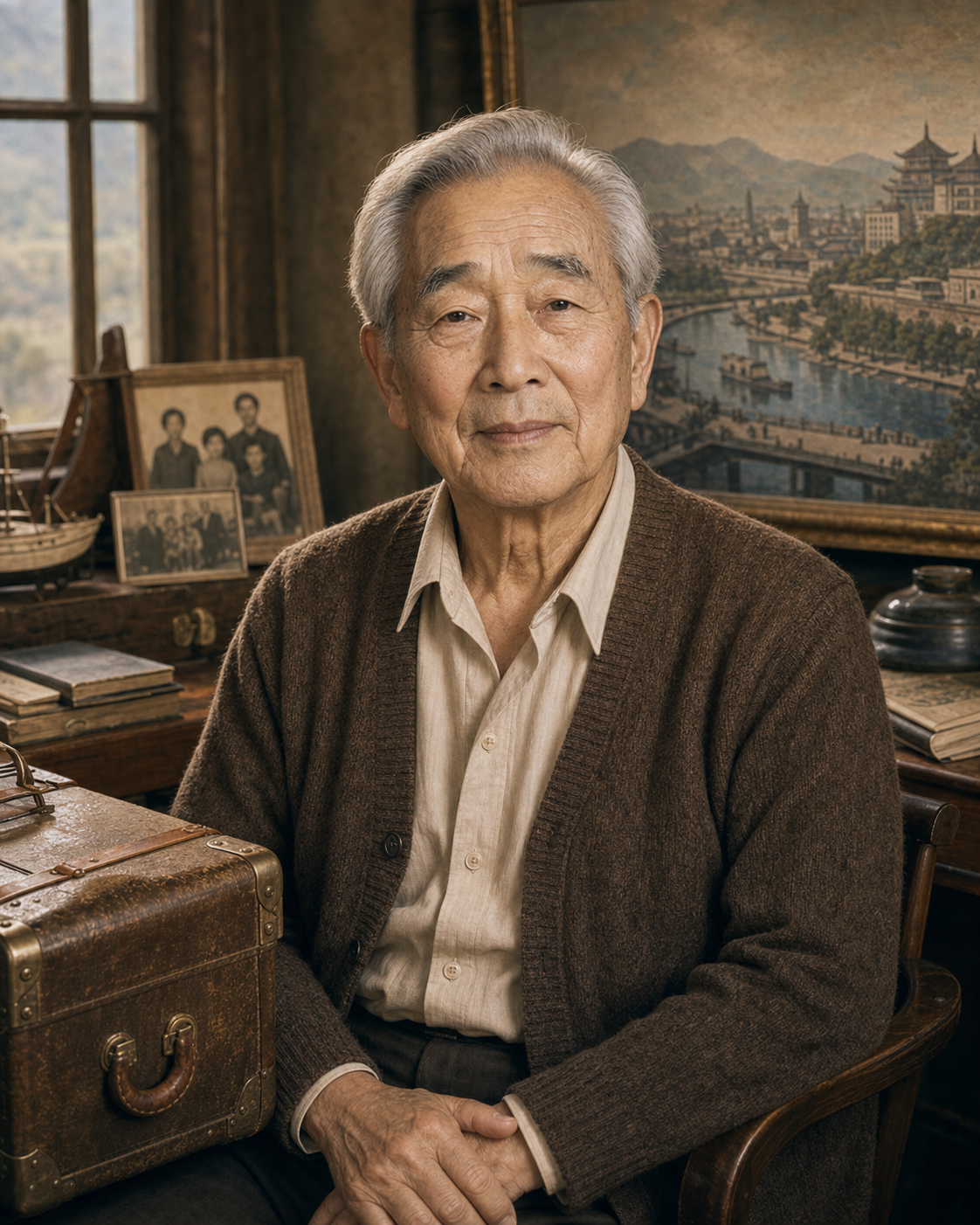
A life remembered
Myong Sun Paik, also remembered by the nickname Jim, was born on November 1, 1897, in the Pyongyang area and left Korea as a child with parents who sought freedom and opportunity under Japanese colonial pressure. His oral history begins before his own memory fully forms, with parents who were Presbyterian Christians, resisted Japanese control, and decided in 1904 or 1905 to take their young son and daughter to the Hawaiian Islands.
Paik's life unfolded across sugar plantations, railroad camps, citrus groves, Korean boarding houses, Washington and Utah farms, smelter work, marriage, and fatherhood in the American West. As the eldest of ten children, he turned practical skill into family service. In later life, he measured success through health, education, music, memory, and the achievements of children who inherited opportunities he had helped build by working early and steadily.
Based on interviews held by the USC Digital Library.
1897-1905
A Pyongyang Childhood and a Parents' Choice
Paik remembered Korea through the small, durable impressions of early childhood: summer heat, winter snow, the presence of grandparents next door, and the pleasure of being cherished as one of two young children. He located the family in northern Korea, near Pyongyang, but he understood the reasons for leaving through the adult history his parents later passed down. Their decision belonged to a generation watching Korea come under foreign military and political control.
His parents had become Presbyterian Christians, part of a village world deeply shaped by missionary contact. Paik recalled that earlier family religious practices changed after conversion, and he took pride in his father's connection to church work and Korean-language instruction for missionaries. His father had enough religious training to be urged toward ordination, but family obligations and the need to earn money kept him from taking that path.
The elder Paik was practical as well as devout. In Korea he had worked as a traveling peddler, carrying goods on foot, and later as a tailor with a hand-operated Singer sewing machine. None of those efforts promised enough security under Japanese rule. To the parents, leaving Korea meant searching for a free country where their children might have a future that politics at home could not protect.
The family left as a unit: father, mother, son, and daughter. Paik was about seven or eight, old enough to remember grandparents and weather, but young enough that migration became the true beginning of his adult identity. The old people stayed behind, reluctant to leave familiar ground, and later could not follow. That separation gave the family's departure both hope and a permanent cost.
1905-1906
Hawaii, Mission Work, and First Schooling
The family first entered American life through Hawaii, where Korean immigrants were drawn into the sugar plantation economy. Paik's parents worked, and he was sent to public school. The stay lasted about eighteen months, long enough for the family to encounter the discipline of plantation labor, the limits of island opportunity, and the sustaining role of Korean Christian networks.
His father also spent time as a traveling missionary among Korean camps, a role that matched the family's Presbyterian formation. Mission work, however, did not remove economic pressure. Hearing that the mainland offered broader prospects, his father arranged a loan for steamship fare, and the family landed in San Francisco in 1906, shortly after the earthquake had reshaped the city.
Paik carried one early school lesson through the rest of his life. A teacher in Hawaii spoke about health and warned against tobacco, alcohol, coffee, and similar habits. The lesson impressed him so deeply that, decades later, he connected his old age and alert mind to habits formed in childhood. In his telling, public school gave him more than English. It gave him rules for caring for the body that had to work, and it showed how quickly a child immigrant could absorb guidance that adults were too occupied to explain.
1906-1912
Railroad Camps and a Riverside Boarding House
California did not provide easy opportunity. After San Francisco, the family made contact with railroad labor near Needles, where Paik's father worked on the tracks and his mother cooked for the crew. The wages were low, the work hard, and the arrangement temporary. Like many immigrant families, they moved toward the next rumor of better pay.
That search led them to the orange and lemon groves around Riverside and Redlands. From 1908 to 1912, Riverside became a more stable base. The family improved its circumstances not through a single breakthrough but through layered labor: field work, household work, shopping, cooking, and the constant adjustment required in a country where English was still new.
The boarding house his parents ran for Korean men became one of Paik's clearest memories. Many Korean laborers in California had come without wives or families, and they needed a place to eat. His parents fed as many as thirty or forty men, and the income helped them repay the money borrowed for passage from Hawaii. Domestic labor became community infrastructure, with his mother cooking at the center of a social world that official labor records rarely describe.
As a child who learned English faster than his mother, Paik became an outside contact for the household. He bought groceries, meat, and vegetables, and helped bridge the family's Korean-speaking home with American shops and streets. His mother, who remained largely inside the domestic world, had few chances to learn English. The boarding house reveals both her centrality and her isolation.
1920-1939
Washington, Utah, and the Eldest Son's Work
By around 1920, the family left California for work in the Pacific Northwest, moving through sawmill labor and farming in Washington before anti-Asian land restrictions closed off possibilities. They moved again to Utah, where from 1922 to 1939 the family worked general farms that raised alfalfa, wheat, sugar beets, pigs, chickens, and milk cows. The geography kept changing, but the work remained collective.
As the eldest of ten children, Paik became a practical second head of household. When his father went ahead to arrange a place in Utah, Paik packed the household and helped bring the family by train, later recalling with pride that even the dishes arrived unbroken. Eldest-son duty was not ceremonial. It meant logistics, discipline, and responsibility for younger siblings before he had much adult freedom of his own.
Farm life also taught him self-command. Paik remembered being quick-tempered as a teenager and learning that shouting did not make younger children work better. To lead others, he concluded, he first had to govern himself. That lesson stayed with him as a moral memory from the fields, as practical as any skill with crops, animals, or tools.
His inventiveness often served his mother. On farms without running water, he dug wells and installed hand pumps so she would not have to carry water from irrigation ditches. He had finished grade school on a Friday and begun working the next morning, a compressed education that he did not sentimentalize. His own schooling narrowed so the family could continue, but that sacrifice sharpened his commitment to schooling for the next generation.
1920s-1929
City Work, Prejudice, and Rosie
When younger siblings were old enough to take over some farm duties, Paik left for city work in Ogden, Utah. He dug drainage ditches, kept a gasoline pump engine running when others could not, and then worked at the Garfield Smelter near the Great Salt Lake. There he lived among Japanese laborers and continued to build a working life through whatever skill was useful in the moment.
He also remembered the plain racial exclusion of the period. In better restaurants, a Korean or Asian worker could sit down and simply not be served until he left. Paik did not pretend that the treatment was fair, but he described accepting it as part of the social order people were too busy and too powerless to fight directly. The memory is quiet, which makes it more severe.
After smelter work, he spent time in Anaheim and Los Angeles, including a period as a salesman for a Korean food business. For a while he made enough money to live on and buy a car, then watched the profits disappear. His working life was not a smooth ascent. It was a sequence of practical moves shaped by wages, family needs, and chances that sometimes lasted only a few months.
In the winter of 1929, his parents sent word of a young woman in Idaho named Rosie. Paik and his father traveled to Boise, he met her, and the marriage was arranged almost immediately. He was about thirty-two, she was young, healthy, and willing, and he remembered the match with evident satisfaction. Marriage joined his long family duty to the beginning of a household of his own.
1930s and After
Raising a Family and Passing on Education
Paik and Rosie raised six children, five daughters and one son. In old age, he spoke of them with concrete pride: work connected to mathematics and engineering support, public utilities, banking, ministry, UCLA study, and film editing. Their lives represented the education he had wanted for himself and the stability his parents had sought when they left Korea.
Education, for Paik, was never abstract. He remembered paying for a son's car insurance during university, buying books and supplies when needed, and purchasing a tape recorder because it might help with drama studies. Such expenses strained savings, but he accepted them as the cost of making opportunity real. American public education mattered deeply to him because it made possible what immigrant labor alone could not.
He never returned to Korea, partly because money was limited and partly because, by late life, Korea felt like a foreign country to him. Yet his identity remained shaped by Korean family obligation, Presbyterian memory, and the ethic that siblings helped when their turn came. He stressed that he had not supported the family alone forever; younger brothers and sisters also carried responsibility as they became able.
His later pleasures were modest and revealing: notes to aid memory, television when his eyes allowed, radio, classical records, romantic duets, and memories of photography before marriage redirected his energy toward raising people rather than taking pictures. Asked for advice, he emphasized health, purpose, and education. The arc of his life made those values practical, not rhetorical: care for the body, know what you are aiming toward, and get the best education you can. He looked back without bitterness, saying in effect that he would be willing to retrace the steps because duty had given the life coherence in public and private.