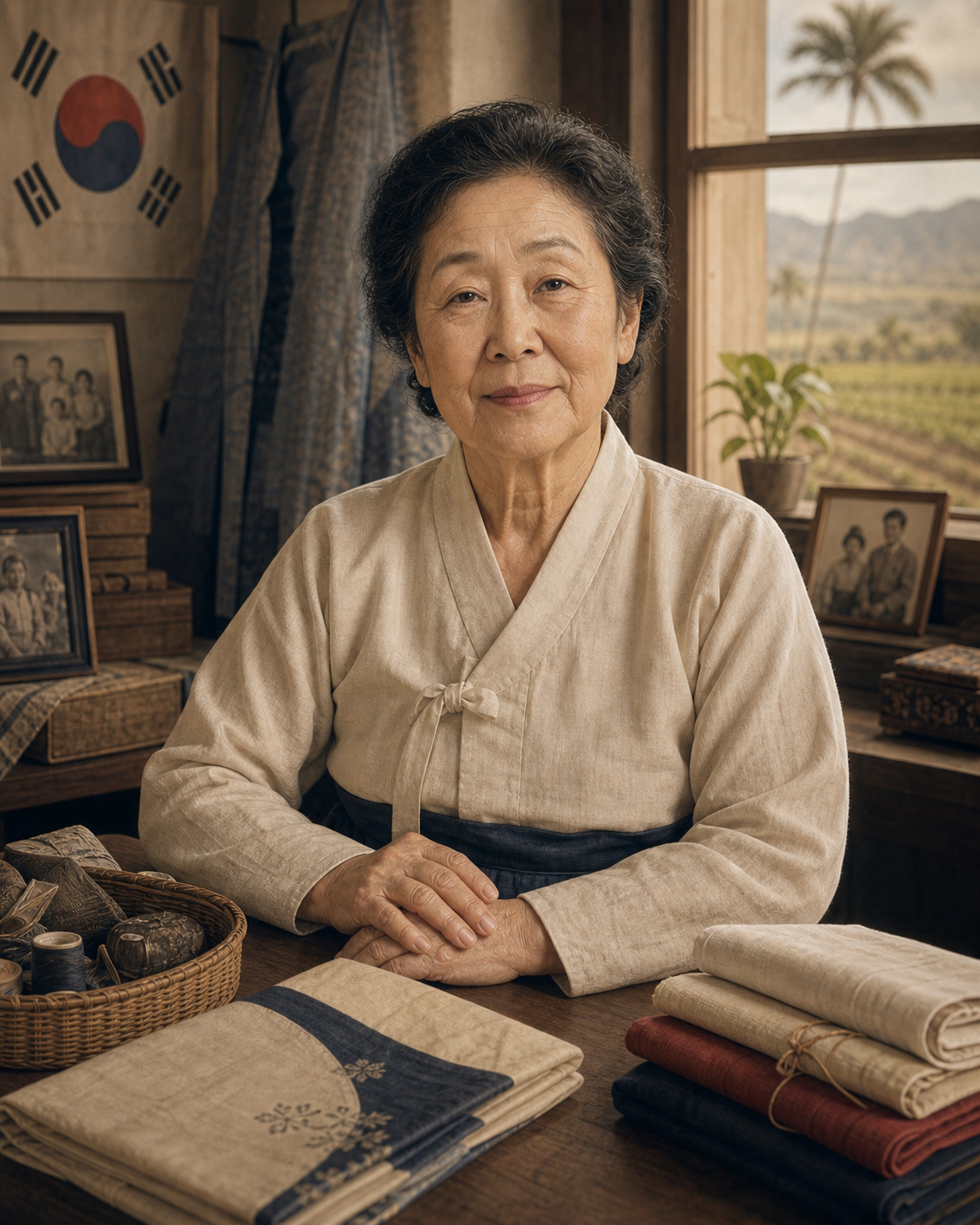
A life remembered
Mrs. Choon Ha Kim remembered early migration, farm and household labor, language barriers, marriage, family endurance, and Korean independence work. Several passages are difficult to parse, so uncertain routes, dates, and names remain qualified.
What remains vivid is the emotional pattern of the account: leaving Korea young, confronting America as a strange and difficult place, learning work by doing it, remembering political danger in Korea, and measuring later life through family, church, survival, and the relief of being able to speak after many years of silence.
Based on interviews held by the USC Digital Library.
Early Life
Leaving Korea at a Young Age
The account appears to place Mrs. Choon Ha Kim's migration in youth, with references to Hawaii, San Francisco, and a period of adjustment before longer settlement in California. Her recollections repeatedly suggest that she was very young when she came, and that adults around her made decisions she could only partly understand at the time.
Her memories describe foreignness as both hope and bewilderment. America had been imagined from Korea as a place of possibility, but arrival meant unfamiliar language, unfamiliar people, and a need to work before she had the confidence or education to move freely in the new setting.
The young immigrant learned by watching, following instructions, and enduring mistakes. Her memories arrive through questions, repetitions, and corrections rather than a settled chronology.
Her youth and dependence on older people's decisions are clear even where the route and dates are not. The gaps also reflect how often immigrant women's movements were recorded less carefully than men's public roles, even when women's labor made migration possible.
What she does remember is the scale of dependence: adults chose the route, Korean acquaintances explained the next step, and work began before she had enough English to act independently. Her early American life was built from observation and borrowed knowledge until repeated tasks became skills of her own.
Work
Work, Language, and First Impressions
The account links her early American life to agricultural labor and related household work. References to vineyards, fields, food preparation, and difficult physical tasks suggest a world where immigrants were expected to adapt quickly and rarely had the luxury of formal training.
Language was one of the most persistent barriers. Interpreters in the account ask about the difficulties of arriving without English, and the answers point toward embarrassment, dependence, and the need to read white Americans' expectations without always understanding their words.
Yet the interview also shows competence growing from repetition. Farm work, cooking, cleaning, and family responsibilities became forms of knowledge. Mrs. Kim's public story is not one of formal credentials, but of practical endurance under conditions that demanded constant learning.
Work and language were inseparable. She had to understand instructions, gestures, and the expectations of people who judged immigrant workers quickly. Skill grew under pressure, along with the judgment to know when to obey, stay quiet, keep working, or rely on other Koreans who understood the same conditions.
Family
Marriage, Family, and Settlement
The conversation turns at several points to marriage, children, and settlement in California towns such as Stockton and Los Angeles. Some details blend her recollections with references to Mr. Kim or other family members, so they establish family context rather than a precise chronology.
What is clear is that family life required shared sacrifice. The account repeatedly returns to household labor, discipline, worry over children, and the effort to keep a family steady while work and money remained uncertain. Her memories honor survival more than comfort.
In later reflections, the value of family is measured through children growing up, marriages, visits, and the continuing ache of separation when loved ones leave again. The emotional center of the account is a parent's attachment, both proud and tender.
Settlement was a series of adaptations rather than a single homecoming. Stockton, Los Angeles, farming, peddling, household labor, children, funerals, illness, and relocation all belonged to the same long effort to remain stable. Men's paid work and women's domestic labor were intertwined in that shared immigrant economy.
Children and spouse give those scattered memories continuity. Worry over illness, discipline, money, travel, and later visits all return to the same question: whether the household could remain together as work and migration pulled people in different directions. Family was not background to settlement; it was the reason stability mattered.
Korea
Independence Memory and Political Danger
Some of the most historically charged passages concern Korean independence activity under Japanese rule. Mrs. Kim recalls, or relays, stories of hiding people, making or carrying flags, and the danger faced by those connected to nationalist work. Some details remain difficult to hear, but the fear and seriousness of these memories are unmistakable.
The account describes police surveillance, arrests, beatings, and the need to protect names or locations. Women appear not as spectators but as participants in support work: preparing food, sheltering people, sewing, carrying messages, or making possible the actions that men later narrated publicly.
The details do not establish every event independently, but they consistently show that independence work depended on households, kin networks, and women whose labor often remained unnamed.
The independence memories are especially important because they widen the story beyond American settlement. Mrs. Kim's references to flags, police, hidden activists, and dangerous households suggest how colonial Korea shaped even those who later lived in the United States. Women in these stories are not decorative patriots. They are people who handled cloth, food, messages, shelter, and secrecy.
The precise sequence remains unclear, but the pattern is recognizable: anti-colonial activity depended on ordinary households willing to take risks. Her guarded memory also reflects a time when speaking about resistance carried real consequences for families.
Later Life
Church, Neighbors, and Old Age
Later sections of the account move through church acquaintances, older Korean friends, widows, couples, and the fragile dignity of aging. Mrs. Kim speaks from within a network of people who know one another through church, family, local visits, and shared migration history.
Health, memory, and the body enter the story directly. She recalls injury, weakness, and the strange feeling of surviving after hardships that once seemed overwhelming. These reflections give the account a conversational intimacy; it sounds like an elder taking stock among people who understand the names and places she mentions.
The church setting matters because it gives older immigrants a way to remain visible. It offers rides, visits, worship, and recognition at a stage of life when mobility and memory may narrow. For Mrs. Kim, community is not abstract. It is made of people who still come by, still remember, and still listen.
Mrs. Kim measured survival through the presence or absence of people. Church friends, widows, couples, daughters, and acquaintances from earlier Korean settlements formed a social map held in visits, church rides, shared meals, and remembered surnames.
Later Years
Speaking After Long Silence
One of the most moving themes is the sense that many things could not be said for years. Mrs. Kim refers to caution, fear, and the habit of not speaking too freely, especially about dangerous political experiences. The account itself becomes a late-life opening.
Her late testimony is interrupted and associative, emotionally precise even where chronology is blurred.
Mrs. Choon Ha Kim's story, as preserved here, is a record of migration, labor, political memory, and family love held in a voice that had reason to be careful. The interview cannot settle every detail, but it respects the life that carried those memories.
Political fear, family caution, and immigrant vulnerability had taught her not to speak too freely, even within the household. In old age, surrounded by listeners, she revisited what had been painful or dangerous and insisted that the difficult parts of life not disappear. The fact that she finally spoke is part of the record's value.
The church and family setting made that speech possible. Listeners supplied names, asked again when a passage was unclear, and stayed with memories that moved between Korea and California. Mrs. Kim's late testimony thus preserves not only isolated events, but the relationships through which an elder woman was finally able to place fear, work, and family endurance into words.