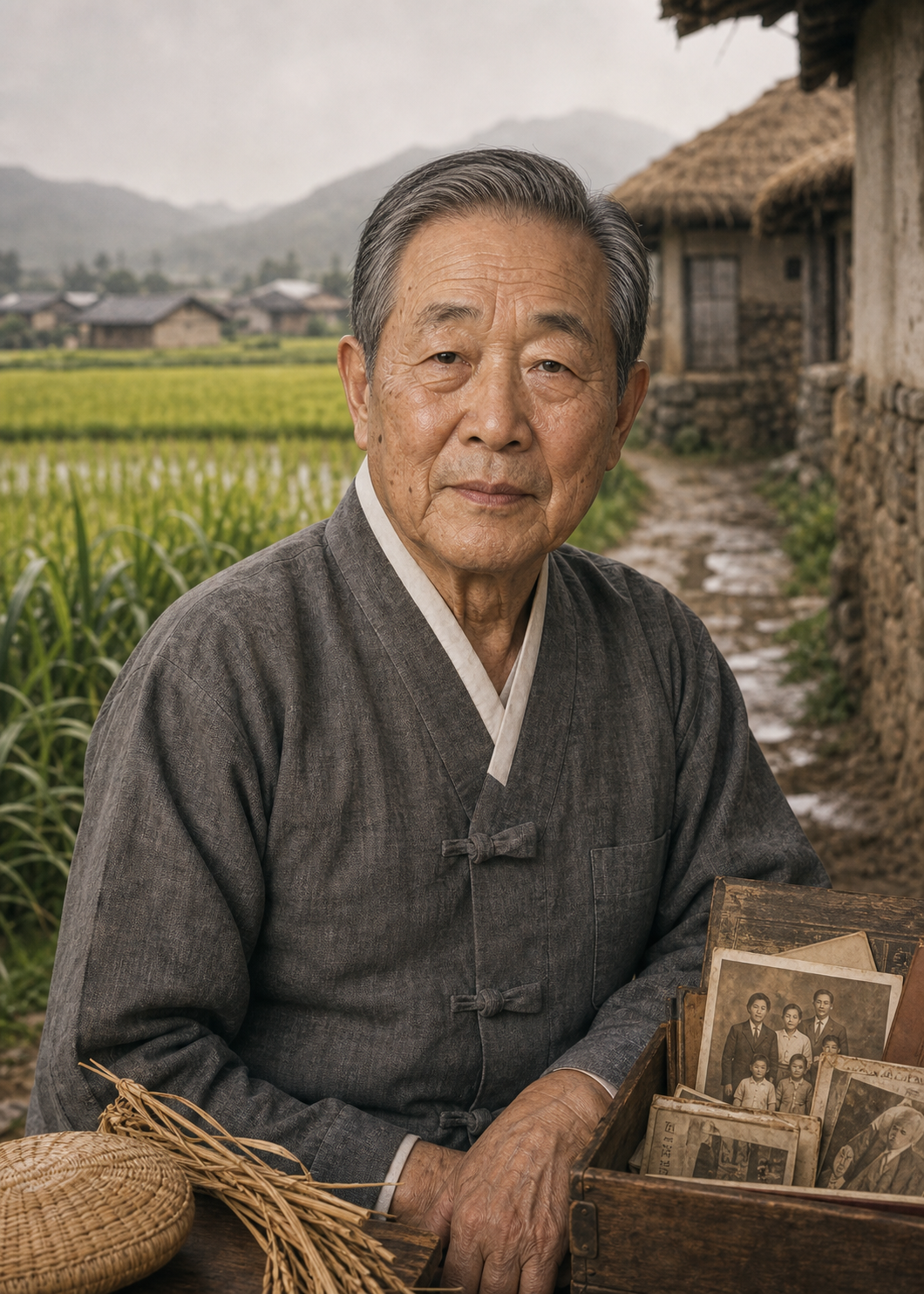
A life remembered
Mr. Choi, identified in the account as Cheung Tae Choi, was born in April 1926 in Tachan, in the Pakchun area of Pyeonganbuk-do, northern Korea. His oral history begins in a rice-growing district between Pyongyang and Sinuiju, where his father and grandfather were connected to a large rice mill and where education, family standing, and colonial surveillance shaped a young student's sense of possibility.
After liberation in 1945, the world that had seemed to open for Korean youth quickly narrowed again under Soviet occupation and the emerging political order in the North. Choi left for Seoul in April 1947 to pursue English language and literature, then lived through illness, the Korean War, refugee movement, years of teaching, and finally Korea's early export-promotion work in Los Angeles. His story joins private memory to the larger history of division, reconstruction, and transpacific exchange.
Based on interviews held by the USC Digital Library.
1926-1945
A Rice-Mill Family Under Occupation
Choi placed his childhood in Tachan, a rice-producing part of northern Korea that he associated with fields, local prosperity, and the authority of families who owned or managed mills. His grandfather, he understood, had been one of the wealthier men in the area, and the family rice mill tied their household to the everyday economy of the surrounding villages. The setting was rural, but it was not cut off from the wider peninsula. Pyongyang, Sinuiju, and the route toward Japan were all part of the mental map of ambitious families.
As a student, Choi attended a leading high school in Sinuiju, a city near the northern border and an important educational center in Pyeonganbuk-do. Under Japanese rule, serious higher education often meant looking beyond Korea, and he remembered that families with means sent sons to Japan when they could. A cousin at Hosei University in Tokyo showed him what education could offer and warned him about the demands of empire.
The final years of World War II made those demands painfully immediate. Choi recalled the shock of seeing Korean university students drafted into the Japanese army under the name of volunteering, even when the pressure was effectively compulsory. Had the war continued longer, he believed he might have been next. The forced sendoff of his cousin left him with the feeling that his own future could be taken from him before it had properly begun.
Even before military recruitment reached him, colonial rule entered his life through suspicion. Japanese police and detectives watched Korean students, questioned what they read on trains, and worried that books might carry independence thought or communist ideas. For a young man drawn to study, that surveillance taught a double lesson: education opened the world, but under occupation it also made a Korean student visible to power.
1945-1946
Liberation and the Question of Study
Liberation in August 1945 arrived when Choi was nineteen. In his memory, it was not an abstract political event but an emotional release for young people who had grown up inside the limits of Japanese authority. The disappearance of formal colonial rule suggested that a Korean student might finally choose his own path, perhaps toward diplomacy, literature, or public service.
That first excitement soon met the realities of occupation and division. Soviet forces controlled the North, the Communist Party became stronger, and Pyongyang's new political order began to define which kinds of education mattered. Choi considered university study there, but the major new institution did not offer the English literature and language program he wanted. Its emphasis, as he remembered it, lay elsewhere: ideology, technical training, and subjects more closely aligned with the new regime.
English literature represented more to him than a school major. It suggested access to a world beyond occupation and civil conflict, and it carried the possibility of diplomatic or intellectual work in a Korea that might stand among other nations. When that course of study seemed unavailable in the North, his educational decision became a political and personal one at the same time.
The question of where to study became a question of what kind of future could still be imagined. Choi did not describe himself as leaving home in order to abandon the North forever. Like many Koreans in the immediate post-liberation years, he believed the 38th parallel might one day disappear or at least become passable. The decision to go south began as a student's search for education, not yet as the permanent separation it would become.
April 1947
Crossing the 38th Parallel
In April 1947, Choi left home with one piece of luggage. The crossing required a mixture of ordinary travel and clandestine movement: trucks for parts of the route, walking at night near the border, and the help of a paid guide who knew how to avoid soldiers and patrols. Russian troops and North Korean security forces guarded the line, and the passage was already becoming more dangerous with each month.
He was not carrying much money, only enough to imagine tuition and a beginning. Friends and acquaintances who tried similar crossings could be caught, taken back, and imprisoned for weeks or months. Choi's own successful arrival in Seoul depended on timing, caution, and luck as much as on resolve.
Seoul was already filling with refugees from the North, people who had crossed for study, politics, family reasons, or simple fear of the tightening system above the parallel. Choi had only a distant contact to rely on and no secure household waiting for him. Still, he entered university life and began the work he had come to do, studying English literature and nineteenth-century poetry while trying to live on limited funds.
The crossing changed the meaning of home. What his family had treated as a temporary departure hardened over time into a lasting separation, first through the closing of the border and then through war. In retrospect, his journey foreshadowed a wider Korean experience: a line drawn across territory slowly becoming a line through families, language, memory, and the practical choices of young people.
1949-1953
Illness, War, and Displacement
By late 1949, illness had interrupted Choi's studies and placed him in a hospital in Incheon. The Korean War began on June 25, 1950, while his life was already physically precarious. His account of the war does not begin with generals or front lines. It begins with patients being forced out of a hospital and a sick young man having to walk back toward Seoul because transportation had collapsed.
The vulnerability of illness may also have protected him. Choi remembered that a patient identification card helped him avoid being taken into North Korean military service when forces entered Seoul. Without that evidence of sickness, he believed he could have been swept up with others. In his telling, survival turned on small documents, brief judgments, and the ability to appear unusable to armed men.
After United Nations forces retook Seoul, he joined the southward movement of civilians and spent time as a refugee in Busan and then in Masan, where he entered a hospital again. His wartime path was one of displacement more than battle. He was a student without a stable school, a patient without a secure hospital, and a northerner whose return home was becoming more impossible.
These memories give his war story a stark human scale. He recalled bodies moved out of wards, long walks, fear of recruitment, and the uncertainty of where a sick refugee could eat or recover. The Korean War, in his life story, was not only a national catastrophe. It was also the interruption of youth, education, health, and the fragile plans that liberation had briefly seemed to restore.
1950s
English Classrooms in a Rebuilding Country
After hospitalization and wartime flight, Choi rebuilt his working life through English teaching. He found employment at Geochang High School in Gyeongsangnam-do, where he taught for roughly three years, and later returned to Seoul to teach at Kyungdong High School for about two more. The work gave his education immediate use in a country where schools had to reopen even while ruins, shortages, and family separations remained everywhere.
Teaching also kept alive the literary ambition that had led him south in the first place. English grammar and poetry were no longer only private interests or university subjects; they became tools for students in a postwar Korea trying to rejoin a wider world. Choi stood before classrooms as someone who had crossed a border for books, survived war as a patient and refugee, and still believed that language could widen a life.
Yet he did not see high school teaching as his final profession. The classroom was a bridge between survival and a broader public role, one that would connect his English training to national reconstruction. Postwar Korea was rebuilding not only roads and schools but also its imagination of what the country could sell, say, and represent abroad. Choi's next work would draw him into that larger project.
1961-1962 and After
Trade Promotion and Los Angeles
After Park Chung Hee came to power in 1961, export promotion became a central priority of the South Korean government. Choi remembered the early 1960s as a moment when Korea, still poor and recovering, was being told that survival required overseas markets. In 1962 he left teaching, sat for the examination to enter a new government trade-promotion organization, and passed into a career that joined language, discipline, and national economic strategy.
The organization was small by later standards, but its ambitions were outward-looking from the start. Choi recalled that there were only a few overseas offices, including New York, Los Angeles, Hong Kong, and Bangkok. Soon after joining, he was assigned to Los Angeles as a senior staff member, carrying with him the English he had once wanted to study for literature and diplomacy.
Los Angeles gave the arc of his life a final transpacific geography. The young man who had grown up under Japanese rule in a northern rice district, crossed the 38th parallel with one bag, and taught English after the war now represented a South Korea trying to enter global trade. His personal movement and Korea's economic movement did not simply mirror each other, but they met in the daily work of offices, markets, correspondence, and public explanation.
Choi's memories add one more record to Korean American community history. Choi's memories were being gathered in a setting concerned with diaspora, immigrant stories, and how Korean lives might be interpreted for younger generations in Los Angeles. His story closes not with a single arrival, but with a chain of translations: North to South, student to teacher, refugee to trade officer, and private memory to community record.