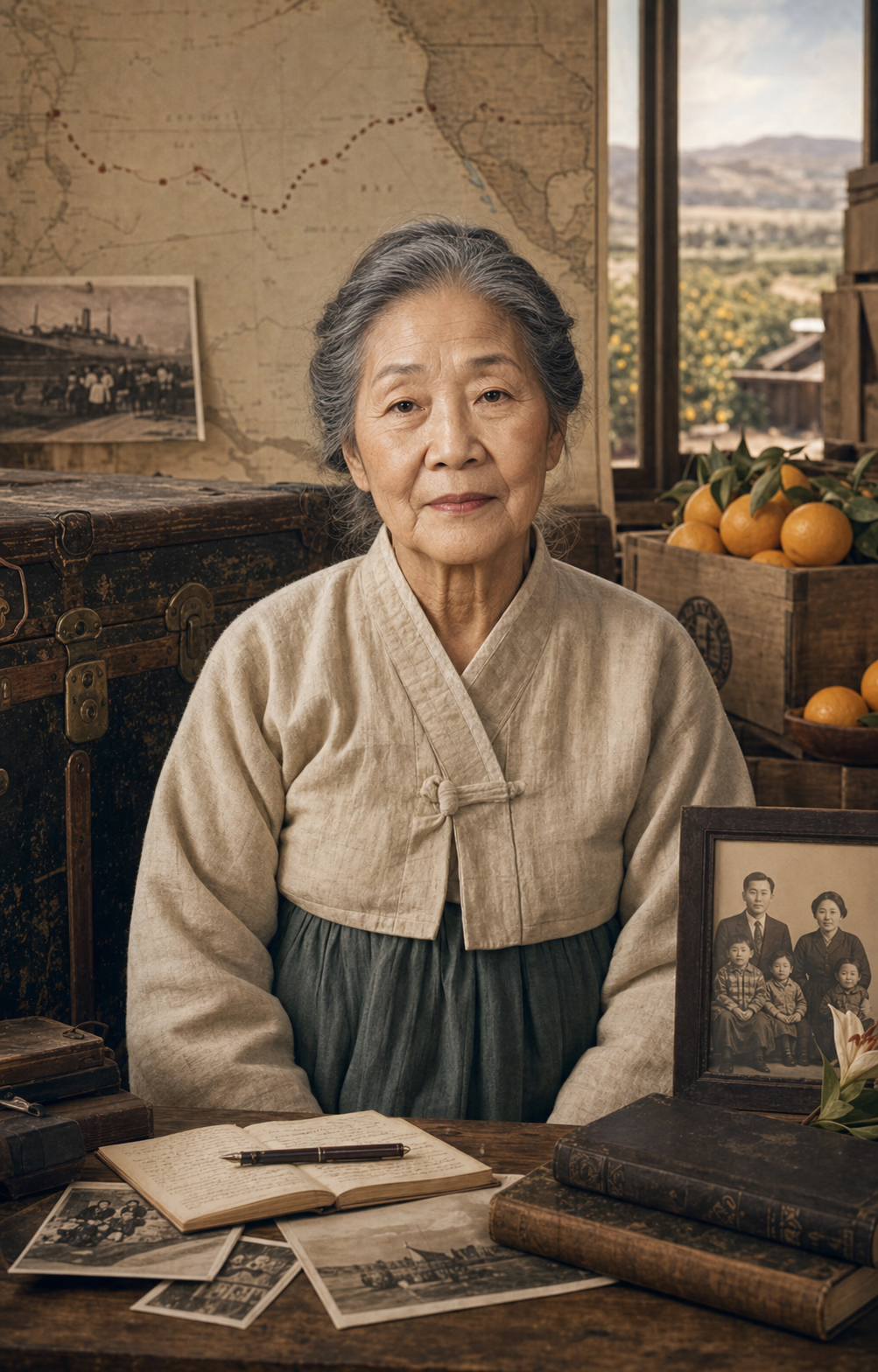
A life remembered
Mary Paik Lee belonged to one of the earliest Korean immigrant families on the American mainland and remembered the practical details of how they endured. Born Kwang Son Paik near Pyongyang around 1900, she came from a Presbyterian family shaped by education, faith, and Korea's struggle under Japanese pressure. Her family left Korea in 1905 after soldiers entered their village, traveled through Hawaii under a sugar plantation labor contract, and reached San Francisco in December 1906 before joining other Korean families in Riverside.
Lee remembered poverty, racial exclusion, farm labor, hand laundry, mining towns, rice fields, Korean churches, independence organizing, marriage, business, motherhood, and later return travel to Korea with extraordinary detail. Her voice is candid but rarely narrow: she described hunger and prejudice alongside humor, practical skill, parental wisdom, Korean language teaching, and the obligations that bound families together. Mary Paik Lee's life also charts early Korean America through work, food, faith, and memory.
Based on interviews held by the USC Digital Library.
1900-1906
From Pyongyang to the Mainland
Mary Paik Lee was born Kwang Son Paik in the Pyongyang region, in a family that understood education and Christianity as public responsibilities. Her grandparents had been influenced by early Presbyterian missionaries, and family memory placed her grandmother among women who taught other women to read and helped begin a girls' school. Lee's earliest recollections of Korea were fragmentary, but they carried the feeling of a household where faith, literacy, and service mattered.
The family's departure began in fear and disruption. Lee remembered adults saying that Japanese soldiers had come to use the family property, and that neighbors left quickly with little more than what they could carry. The village moved toward Incheon, where recruiters for Hawaiian sugar plantations were seeking laborers. For Lee's parents, the contract was less an adventure than a narrow opening when home, safety, and livelihood had all become uncertain.
In Hawaii, her father worked in sugarcane fields for low wages and long hours, while the family remained close to other Asian laborers and saw few of the opportunities they associated with the American mainland. After about a year, he saved and borrowed enough to move the family onward. They landed in San Francisco in late 1906, only months after the earthquake, and quickly continued by train to Southern California.
Lee's first memory of the mainland included hostility from strangers at the landing, but her father refused to let that become the family's moral center. He taught his children that people often fear what is unfamiliar, and that dignity would come through learning, discipline, and conduct. That lesson became one of the deepest patterns in Lee's telling: she did not deny injury, but she also remembered a father determined not to train his children in hatred.
1906-1912
Riverside, Claremont, and a Childhood of Work
The Paik family first lived in Riverside among other Korean families and bachelors who worked in citrus groves and walnut orchards. Housing was segregated and rough, often in old labor shacks left from earlier railroad work. Lee remembered her father turning scraps into furniture, shelves, sleeping platforms, a kitchen lean-to, and a small wagon. The household began with almost nothing, but he made a livable order out of whatever could be found.
Her mother cooked for dozens of Korean workers before dawn, and the children helped pack and collect lunch pails. Lee's memories of this period include hunger and labor, but also small flashes of comedy: workers bringing fruit from the groves, children making do, and a crowded household learning to survive together. Food was never merely food in her account. It was economy, ingenuity, community, and sometimes the difference between endurance and collapse.
School introduced Lee to English and to public racism at the same time. She began in Riverside without knowing the language and remembered being surrounded by children who mocked what they did not understand. Her father urged her to keep studying because education was the reason the family had come. Outside school, segregation shaped ordinary movements through restrooms, theaters, swimming places, neighborhoods, and public accommodations.
In Claremont, the family turned to hand laundry because other work was closed to them. Lee and her brother helped solicit laundry from teachers, carry it home, and return it after washing and ironing. The work was exhausting and paid little, but it placed the children inside the family economy. Lee's childhood was not separated from adult responsibility; she grew up by helping the household stay alive.
1913-1918
Stockton, Sacramento, and Idria
The family continued to move wherever work seemed possible. In Stockton, Lee remembered her father partnering in potato farming on Robert's Island with C. L. Kim, only to see a beautiful crop become nearly worthless during a market collapse. The river country also left a happier memory: for the first time, there were wild greens, fish, and enough food to fill stomachs that had known long stretches of want.
Movement also shaped family birth and care. Several younger siblings were born in different towns as the family followed work across California and beyond. Lee and her older brother Myong Sun helped with diapers, bathing, feeding, and household labor. She told these stories without sentimentality, but they show how older immigrant children often became second parents before they were fully grown themselves.
In Idria, a quicksilver mining town in San Benito County, her father found wages that looked promising but came with dangerous conditions. Lee described the mine, the company store, the isolated road, and the toxic work that damaged his health. The town had only a small Korean presence, mostly bachelors and a few families, yet it became another stop in the family's map of survival.
These years also preserved Korean practice inside difficult circumstances. Lee learned to make Korean foods from scratch because there were no nearby stores that carried what the family needed and little money for imported goods. She remembered soy sauce, tofu, bean starch, and other labor-intensive foods as knowledge passed through hands. Korean language, family records, and household teaching remained part of the family's structure even as English names and American schools entered daily life.
1918-1922
Willows, Rice, Church, and Independence
The move to Willows placed Lee inside one of the most important early Korean farming communities in Northern California. Rice prices rose during World War I, and Korean workers, families, and bachelors gathered around the opportunity. Lee's future husband, H. M. Lee, helped arrange a share system in which he furnished labor and management while a landowner provided capital and equipment. For a brief period, rice farming brought money that earlier years had never allowed.
Willows also connected the family to Korean political life. Lee remembered the March First independence movement of 1919 and the way Korean immigrants, even those with very little, contributed to the cause. She spoke about the Korean National Association as a practical institution that helped Korean nationals with language, legal, and community needs. She also recalled factional tensions among Korean organizations, while admiring her father's insistence that a small immigrant community should not divide itself by status.
At school in Willows, Lee encountered some of the harshest prejudice of her youth. She remembered teachers and classmates who spoke ignorantly about Asians, and she also remembered moments when she defended her Korean identity with force and intelligence. One church incident became a turning point: after a minister refused to welcome Lee and her siblings, a classmate's father, a local judge, intervened. A new minister later welcomed the family, reminding Lee that individual Americans could be both cruel and deeply fair.
Lee married H. M. Lee in the Willows Presbyterian church in 1919. The wedding mattered because it was surrounded by a congregation that had chosen to welcome them, and because it joined her life to a man whose own migration had passed through Mexico before California. After the rice boom faded, her parents moved on to Washington and Utah, while Lee and her husband remained tied to them through financial support and family responsibility.
1920s-1970s
Business, Family, and Return
After Willows, Lee and her husband built a life through business and farming in Southern California. In Anaheim they ran a fruit stand for about ten years, serving many American customers and learning how public names could affect everyday business. Friends knew her Korean name, but she used Mary Paik Lee in public life and later formalized that name when she became a citizen in 1960.
Economic security remained fragile. The couple helped Lee's parents through failed farming efforts in Washington and Utah, and later helped bring the family back to Southern California when they could no longer make a living there. Their own savings suffered during the 1929 stock market crash, and they turned again to vegetable farming around Anaheim and La Habra. In Lee's telling, family duty did not wait until people were comfortable; it came due precisely when everyone was stretched.
Lee raised three sons and tried to pass on Korean language, courtesy, and cultural habits even after long workdays. She remembered sitting with children at night to teach reading and speech, much as her father had taught her generation after exhausting labor. One son entered international finance work, which later made it possible for her to travel through Hawaii, Japan, Korea, and the Philippines after her husband's death.
Her return to Korea came late in life and only briefly. She saw a modernizing Seoul, understood that the country had changed beyond the Korea she left as a child, and did not imagine living there permanently because her children and life were in the United States. Still, the trip mattered. It closed a circle between the country of her earliest memories and the American life that had demanded so much adaptation.
Later Years
Memory, Food, and a Public Record
Lee moved easily between large events and ordinary domestic knowledge. She spoke of Japanese colonial pressure, Hawaii labor recruitment, California racial segregation, the Korean National Association, and the March First movement. She also lingered over lunch pails, homemade furniture, laundry bundles, fruit stands, school clothes, bath water, bean starch, and the work of keeping babies, elders, and laborers fed.
One extended portion of the oral-history material preserves Lee teaching how to prepare a traditional bean-starch dish using an old stone mill, careful washing, straining, settling, and cooking. The demonstration is more than a recipe. It shows her as a carrier of embodied knowledge, someone who understood that culture survived through sequence, cleanliness, timing, tools, and the patience to teach a younger generation what could not be learned from a package.
Her public voice is striking for its combination of candor and restraint. She described hunger, exclusion, and family strain without turning the account into bitterness. Again and again, she returned to her parents' example: gratitude without denial, education without arrogance, and Korean identity without contempt for others. That moral framework did not erase suffering, but it gave her a way to narrate it with perspective.
Mary Paik Lee's life stands as a foundational account of early Korean America from a woman's point of view. Her memories connect Pyongyang, Incheon, Hawaii, San Francisco, Riverside, Claremont, Stockton, Idria, Willows, Anaheim, Whittier, and Los Angeles into one continuous family geography. Through her, the history of migration becomes visible not only in political organizations and labor contracts, but in kitchens, classrooms, fields, churches, and the stories a family chooses to preserve.