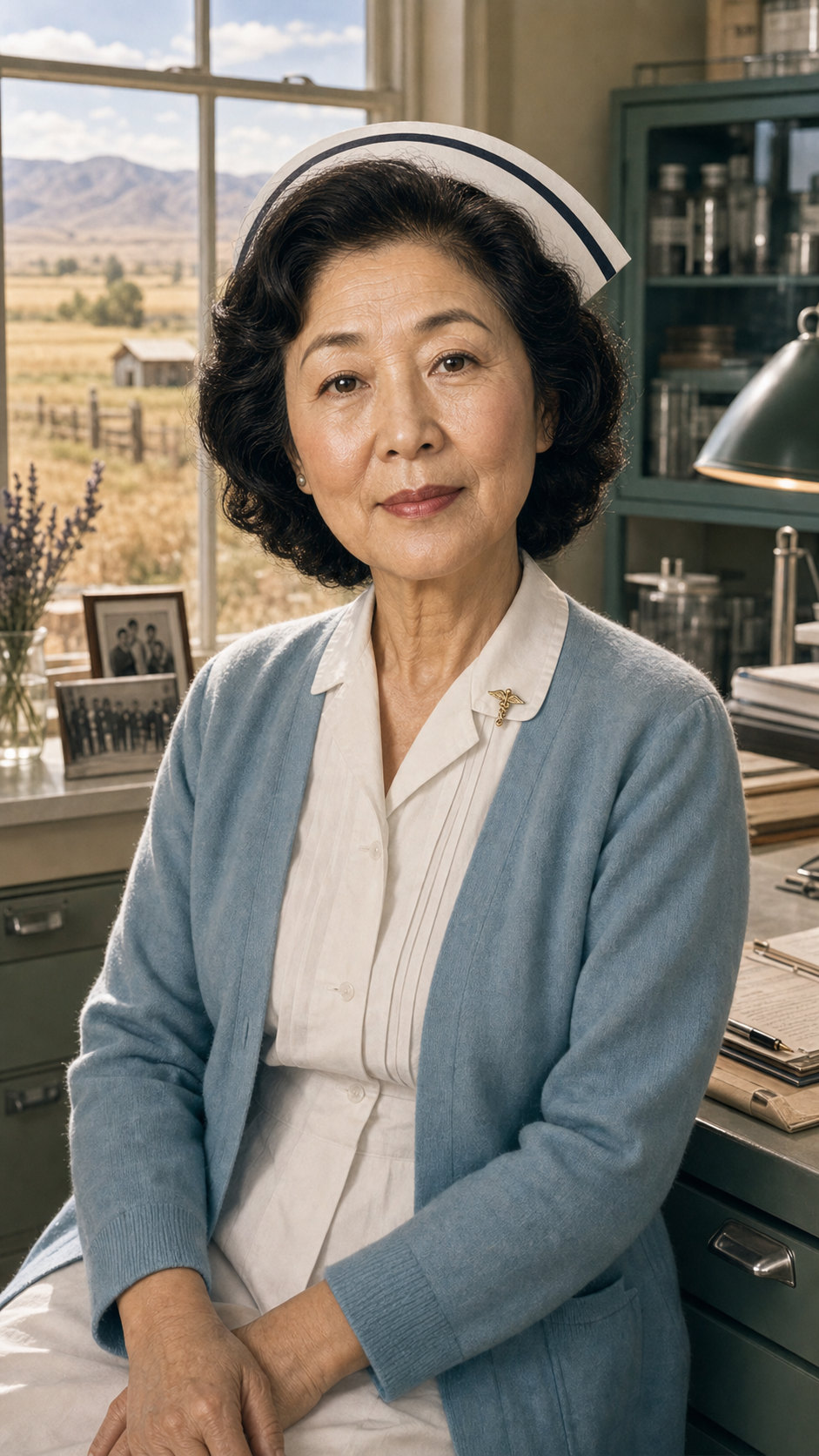
A life remembered
Farm work, sibling bonds, nursing, and Hawaii remained vivid in Marie Park Fujii's memory of the discipline that held her family together. Born in 1919 and raised in Eagle, Idaho, among a small cluster of Korean families, she remembered a life where work came first and leisure had to be negotiated almost like a family emergency. Her account moves with the patience of someone honoring both the hardship and the grace inside family memory.
Two vivid arcs give the story its shape: the dream of Hawaii inspired by Peter Kim, a young Korean student from Honolulu, and a Fourth of July picnic that revealed how rare a day away from labor could be. Through those memories, Marie reflects on ambition, nursing, wartime Honolulu, parental authority, gratitude, forgiveness, and the lasting importance of remaining close to siblings and honoring parents without pretending they were easy to know.
Based on interviews held by the USC Digital Library.
1919-1930s
Growing Up on an Idaho Farm
Marie Park Fujii grew up in Eagle, Idaho, in a small farmhouse organized around work. The house she remembered had a combined kitchen and dining space, a wood cooking stove at one end, a water pump near the center of domestic life, a large sleeping room for her father and brothers, and a smaller room for the girls. The details are modest, but they carry the weight of a childhood in which every room served labor, meals, sleep, and survival.
The family was not entirely alone, but Korean community nearby was small. Marie remembered three Korean families in the Eagle area: her own family, her older sister Wanda's family, and the Hong family, all living within a few miles of one another on farms. They knew of one another and had ties of kinship or familiarity, yet farm work limited ordinary visiting. Proximity did not mean ease.
That combination of closeness and isolation shaped Marie's childhood imagination. She and her siblings understood that there were other Koreans nearby, but daily life centered on chores, crops, cooking, and the authority of parents who rarely explained themselves. Work came before recreation, and children learned responsibility early. Only later could Marie look back and see how much strength and constraint had been carried in that pattern.
Her childhood home was both shelter and workplace. The same kitchen where meals were prepared became the place where visitors sat, where sisters listened to stories, and where children measured the mood of adults. Marie's later gentleness toward the past does not soften the labor. It shows how fully farm work shaped family feeling, discipline, and the meaning of rest.
Early 1930s
Peter Kim and the Dream of Hawaii
When Marie was about twelve, a young Korean student named Peter Kim began visiting from Caldwell, Idaho, where he was attending school. He had come from Honolulu under unusual circumstances: Marie remembered hearing that, as a boy, he had dived for coins near arriving ships and eventually came under the care of a visitor from Caldwell who helped bring him to Idaho. However exact the details, his presence connected the Park sisters to a world far beyond the farm.
Peter visited only several times a year, but each visit carried power. He spoke of Hawaii as beautiful and full of Asian and Korean community, a place where Korean children from Idaho might not feel so few. The Park family could not entertain him elaborately because the girls were busy cooking and working, so they sat in the kitchen and talked. The conversations were brief, but they gave Marie and her sister Louie a destination.
The dream attached itself to music as well as memory. Marie recalled that she and Louie loved the popular song Blue Hawaii and learned to harmonize it while imagining the islands. A song, a visiting student, and a few kitchen conversations became a private map. For two farm girls in Idaho, Hawaii became more than a place; it became a promise that life might widen.
Peter's visits also reveal the importance of Korean contact in an isolated setting. He seemed to come partly because he wanted to be with Korean families, and the Parks received him as best they could within the limits of farm life. The exchange was modest, but it mattered: he found community, and the sisters found a future they could imagine.
Late 1930s
Nursing as a Way Outward
Louie reached Hawaii first through nursing, accepting a registered nurse position at a plantation hospital in Pahala on the island of Hawaii. From there she warned Marie that nurses training was difficult, perhaps hoping to spare her younger sister the strain. Marie listened, but she still wanted to do something meaningful after high school and a small amount of junior college study. Nursing offered discipline, usefulness, and a path beyond the farm.
Marie entered nurses training and later described it as a turning point that saved and shaped her. It gave her professional purpose, lifelong friendships, and an identity beyond daughter, sister, and farm worker. The training was demanding, but she remembered it with gratitude because it made independence possible without severing the values of work and responsibility she had learned at home.
The profession also made Hawaii possible. By the time Marie graduated, World War II had begun and civilian travel to Hawaii was restricted. Nurses, however, were needed. Queen's Hospital in Honolulu offered her a position, required a contract for a term of service, and paid her passage. Without nursing, she believed, she would have had to work for years simply to afford the trip.
nursing joined practicality and longing. It was a respectable profession, a way to serve, and a ticket across the ocean at a moment when ordinary travel was closed. Marie did not describe independence as rebellion against family. She described it as a form of usefulness that allowed her to move outward while carrying the discipline of home with her.
1941-1942
Queen's Hospital and Wartime Honolulu
Marie reached Honolulu because nursing placed her in essential wartime service. The move fulfilled a childhood dream, but the circumstances were serious. Travel was restricted, hospitals needed trained staff, and Queen's Hospital brought her not as a tourist but as a professional. She arrived with a contract, responsibility, and the knowledge that the island she had imagined through songs and stories was also a wartime workplace.
Honolulu gave Marie a wider Korean and Asian world than the one she had known in Idaho. It also asked her to grow up quickly. Hospital work required steadiness, skill, and service to others far from the small farmhouse where she had learned to work beside siblings. The dream of Hawaii did not cancel discipline; it transformed it into a career.
She later saw Peter Kim again in Honolulu after he had married and returned there. Marie thanked him for visiting the Park family in Idaho and for helping create the dream that had carried her and Louie forward. That moment closes one of the gentlest circles in the account: a young man looking for Korean families in Idaho had unknowingly helped set a young woman's life in motion.
The gratitude she expressed toward Peter was not exaggerated. Marie understood that dreams often begin in small encounters rather than grand plans. A few visits, a description of Honolulu, and the assurance that other Koreans lived there had widened the sisters' sense of possibility. In Honolulu, she could finally name that gift and return thanks.
Farm Years
The Fourth of July Picnic
Marie also preserved a vivid story from the Idaho farm about a Fourth of July picnic. Her oldest brother John and his wife Rosella came from Spring Canyon, Utah, where John worked in the coal mines. The summer visit offered him cleaner air and a change from underground labor. Rosella saw how hard the Park children and their father worked and suggested that the family take a day off for the holiday.
The suggestion startled the children because leisure was almost unthinkable. Their father resisted, then gave a reluctant form of permission that the family understood as yes, though he would not go himself. For the next days, the children planned carefully and quietly, afraid that too much excitement might cause him to withdraw permission. The anticipation itself became part of the memory.
On the holiday, the family packed fried chicken, potato salad, watermelons, homemade root beer, and other food. Relatives and neighbors joined, and several cars carried the group to a dam area outside Boise rather than a crowded public park. Marie remembered the movement in and out of the house, the bottles cooled in an icebox, and the astonishment of leaving the farm on a summer day for pleasure.
The picnic stayed vivid because every detail felt earned. Root beer had to be mixed, bottled, capped, aged, and cooled with ice. Food had to be prepared before the workday rhythm could reclaim everyone. Even the choice of location mattered; the family wanted space enough to gather freely. A holiday that might have seemed ordinary to others became, for Marie, a rare proof that joy could be organized.
1999
Authority, Gratitude, and Family Memory
The picnic memory remained powerful because Marie's father did not join them. He stayed out in the field, knowing the family was going but not allowing himself to participate. Every year afterward, the family picnic continued when people were home, yet he still stayed away. In later life, Marie wondered whether he felt a loss of control, whether leisure was simply too foreign, or whether survival had taught him never to rest.
Her reflection is generous without becoming sentimental. She wished she had asked her father more about his own life, but she understood the authority structure in which she had been raised. Parents were not approached as friends; children listened, obeyed, and learned only later how much had gone unspoken. Her father could be severe, yet she credited him with keeping the family together.
Marie ended by honoring both parents. Her mother had died when the children were young after years of childbirth and labor, and her father had held the household together through discipline and unrelenting work. The lesson Marie offered later generations was to stay close, communicate, forgive, and give parents the tribute of understanding. They made mistakes, she knew, but they had parented from the only histories they had.
That lesson grew from what she saw among her siblings. In later life, she valued the fact that they still wrote, phoned, visited, and made time for one another when many families did not. The closeness was not accidental. It was one of the gifts, however sternly given, of a household that had required children to depend on each other.