A life remembered
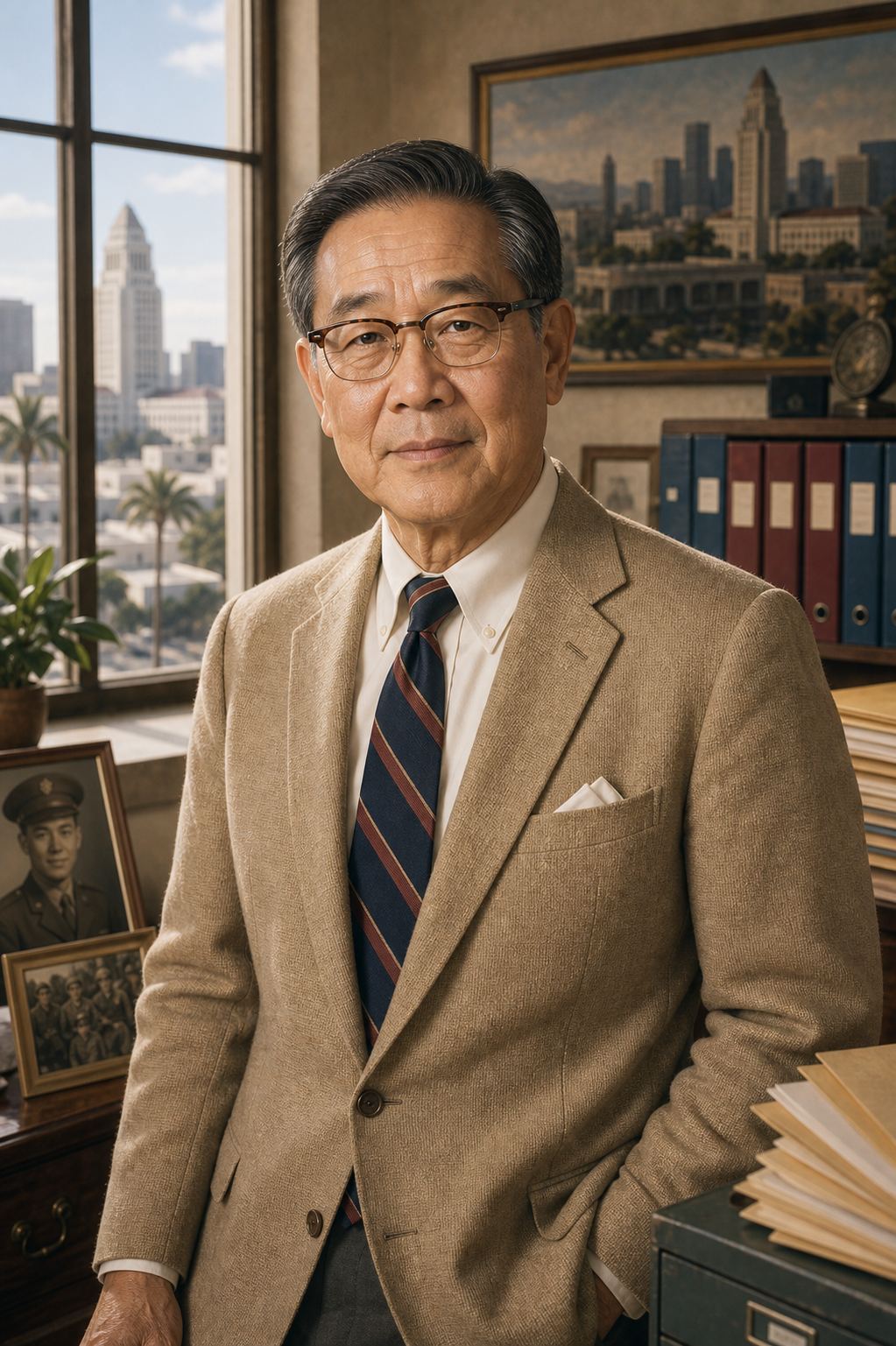
Los Angeles community institutions, military service, professional work, and decades of civic involvement shaped Lloyd Hahn's California life. Born in Stockton in 1927 and raised largely in Los Angeles, he remembered parents who connected Korea, Hawaii, farm labor, restaurant work, and Methodist faith to the everyday routines of a second-generation household.
Lloyd was most vivid when he placed personal memory inside a community map: the Korean National Association building on Jefferson Boulevard, Korean school after regular school, the Monarchs basketball team, bowling alleys, wartime identity buttons, and the Korean American Museum. Language lessons, sports, work, and friendships gave him a durable framework for belonging.
Based on interviews held by the USC Digital Library.
1927-1930s
Stockton Roots and a Korean American Household
Lloyd Hahn was born in Stockton, California, on January 20, 1927. His father, remembered as John Hahn or An Sungul Hahn, had come from Korea by way of Hawaii as a young person and became one of the early Korean immigrants in the family who received American schooling. Lloyd understood his father's English fluency as unusual among first-generation Koreans and as part of the family's adaptation to California life.
His mother, Sungsoo Hahn, came from Pyongyang, and the family carried both northern and southern Korean ties. Lloyd described siblings whose lives opened onto different parts of Korean American history: an older sister who became active in deaf community organizations, a brother who spent decades as a missionary in Korea, and a younger brother who built his own family life in Southern California.
His father's work crossed several worlds. Lloyd remembered him as a skilled chef who cooked in hotels, restaurants, and private settings, and also as someone who had farmed before the family settled in Los Angeles. The household's Korean food, Methodist faith, and stories of relatives in Korea gave Lloyd a sense of ancestry before he could fully understand its political weight.
Those family details also place Lloyd among the American-born children of Korean immigrants who had to interpret their parents' sacrifices without always knowing the full story. His father was a chef, farmworker, houseman, English speaker, church member, and Korean immigrant; his mother preserved Korean food and family discipline while raising children in a changing city. Together, their work and faith formed the household Lloyd remembered.
1930s-1944
Jefferson Boulevard, Korean School, and the Monarchs
After moving to Los Angeles as a child, Lloyd grew up around the Jefferson and Vermont area, then one of the centers of Korean American life in the city. He attended local public schools and remembered the Korean National Association building, next to the Korean Presbyterian Church, as a gathering place for boys his age. The basketball court behind the building became part of the social geography of his youth.
The Monarchs, a Korean American basketball group, gave Lloyd and his friends a name, a routine, and a way to belong together. He remembered teammates and friends from church and neighborhood circles, and described the group as close in adolescence even though adulthood later scattered them into work, marriage, and family responsibilities.
Korean school was less welcome to him as a boy because it took time away from play, but in retrospect he valued it deeply. His mother insisted that he attend, and the language he learned there later became useful in military service. The discipline of after-school Korean study linked a California childhood to an inheritance his parents did not want lost.
The neighborhood he remembered was not only a Korean enclave but a youth world with its own routines. Boys moved between public school, Korean school, church buildings, basketball games, and nearby restaurants or bowling alleys. The KNA building mattered because it gave Korean American teenagers a place where they were not isolated representatives of a small minority. They could be ordinary boys there: competitive, social, restless, and attached to one another before adult responsibilities scattered them. The court and building thus become evidence of how a small community created youth infrastructure before Korean America had many formal institutions.
1945-1946
War Service and a Return Through Language
Lloyd was drafted in 1945, shortly after finishing high school. He trained at Camp Roberts and was assigned to the Signal Corps after earlier exposure to telegraphy. The end of World War II found him in occupation service in Japan, including a posting in Sapporo, whose cold and snow remained vivid in his memory.
Because he could speak enough Korean to interpret, Lloyd requested a transfer to Korea and became an interpreter attached to a commanding general. The assignment gave him an unexpected opportunity to see Korea not as an abstract homeland but as a place of military occupation, family searching, and personal encounter.
With help from Korean church contacts, Lloyd met his grandfather in Seoul. He later believed he may have been the last family member from the United States to see him before the Korean War cut off contact. In the account, that meeting stands as one of the most meaningful consequences of the language lessons he had once resisted.
Lloyd's Korean service also complicates any simple idea of return. He went as a U.S. soldier, not as a visitor with family freedom, and he served inside the tense aftermath of Japanese surrender and Allied occupation. Yet the encounter with his grandfather turned military assignment into family history. The later silence after the Korean War made that meeting even more significant, because it became one of the last solid points in a family story otherwise shaped by separation and uncertainty. It also explains why Lloyd's later memories of Korea are bound to gratitude, grief, and historical timing rather than simple heritage tourism.
Late 1940s-1960s
Accounting, Work, and Starting Over After Service
After returning from service, Lloyd chose Woodbury College because its year-round program allowed him to complete an accounting course quickly. He studied with close Korean American friends and began looking for work at a time when Asian Americans were still uncommon in accounting offices.
He believed that racial prejudice shaped some of his early job searches, especially when he was qualified but did not receive callbacks. He eventually began with a small Beverly Hills CPA firm, then moved through other accounting positions and into private industry as a controller and accounting manager.
His working years also included jobs and friendships outside Korean circles, including produce-market work and bowling leagues with Japanese American and Korean American players. Those settings widened his world while preserving the familiar texture of Southern California Asian American neighborhoods.
Education did not erase the racial limits Lloyd encountered. He had training, discipline, and a practical major, yet employers could still quietly pass over an Asian American applicant. He eventually built an accounting career through persistence, part-time work, friendships, and community ties. Those barriers made each professional opening matter.
1950s-1990s
Anna, Bowling Alleys, and Family Life
Lloyd met Anna Lee at the Trojan Bowl, one of the places where Korean American young adults gathered. Anna's family had lived in Colorado and visited Los Angeles during holidays, and Lloyd remembered asking for her telephone number after seeing her around the bowling lanes. Their courtship lasted about two years before marriage.
Bowling was more than recreation for Lloyd. He competed seriously, traveled to tournaments, and formed friendships through leagues and teams. Trojan Bowl, Holiday Bowl, and other alleys became part of a Korean American social world that mixed sport, dating, late nights, and long-standing friendships.
Lloyd and Anna raised a son, Michael, and Lloyd compared his son's childhood with his own. He saw Anna's presence at home during their son's early years as a major difference from his own upbringing, when parents' work often left children to manage more of the day themselves.
The bowling stories give the account warmth because they show community after adolescence. Bowling alleys were places of courtship, competition, and informal ethnic mixing, especially among Korean and Japanese American friends. Lloyd's account of meeting Anna is modest, but it preserves the social architecture of the time: families visiting from other states, young people asking where to meet peers, and a Korean American dating world organized around familiar public places where parents, friends, and future spouses overlapped. recreation helped preserve community as surely as churches or formal associations did.
1960s-1997
Civic Service and the Work of Memory
After moving to West Covina, Lloyd became active in the Citrus Valley Optimist Club and served on the West Covina Human Relations Commission. He remembered helping bring a senior citizen center into being as one of the achievements of his public service. Civic work, for him, was not separate from friendship; it was a way to serve youth, seniors, and neighbors.
He also remained attached to Korean American community memory. He served as treasurer of the Camp Pioneer Council connected to the Korean American Museum and took pride in reunions that brought older friends together after many decades. In later life, the Monarchs and other peers resumed monthly lunches in Koreatown, turning memory into an ongoing practice.
Lloyd's oral history closes with a broad view of change: wartime suspicion, buttons identifying Koreans as distinct from Japanese Americans, job and housing discrimination, the growth of Koreatown, and new opportunities for younger generations. Language, food, service, and old friendships stayed with Lloyd throughout his long California life.
His later civic commitments make sense beside those early memories. Lloyd had grown up in institutions built by immigrant Koreans, then spent adulthood helping build institutions for others: a senior center, youth service projects, museum work, and reunions. The monthly lunches after fifty years were more than nostalgia. They were a way for aging Korean American men to preserve a shared city that had changed beyond recognition while affirming that their boyhood community had mattered. Lloyd's account turns ordinary civic participation into a Korean American life lesson: institutions are inherited, but they also have to be maintained.