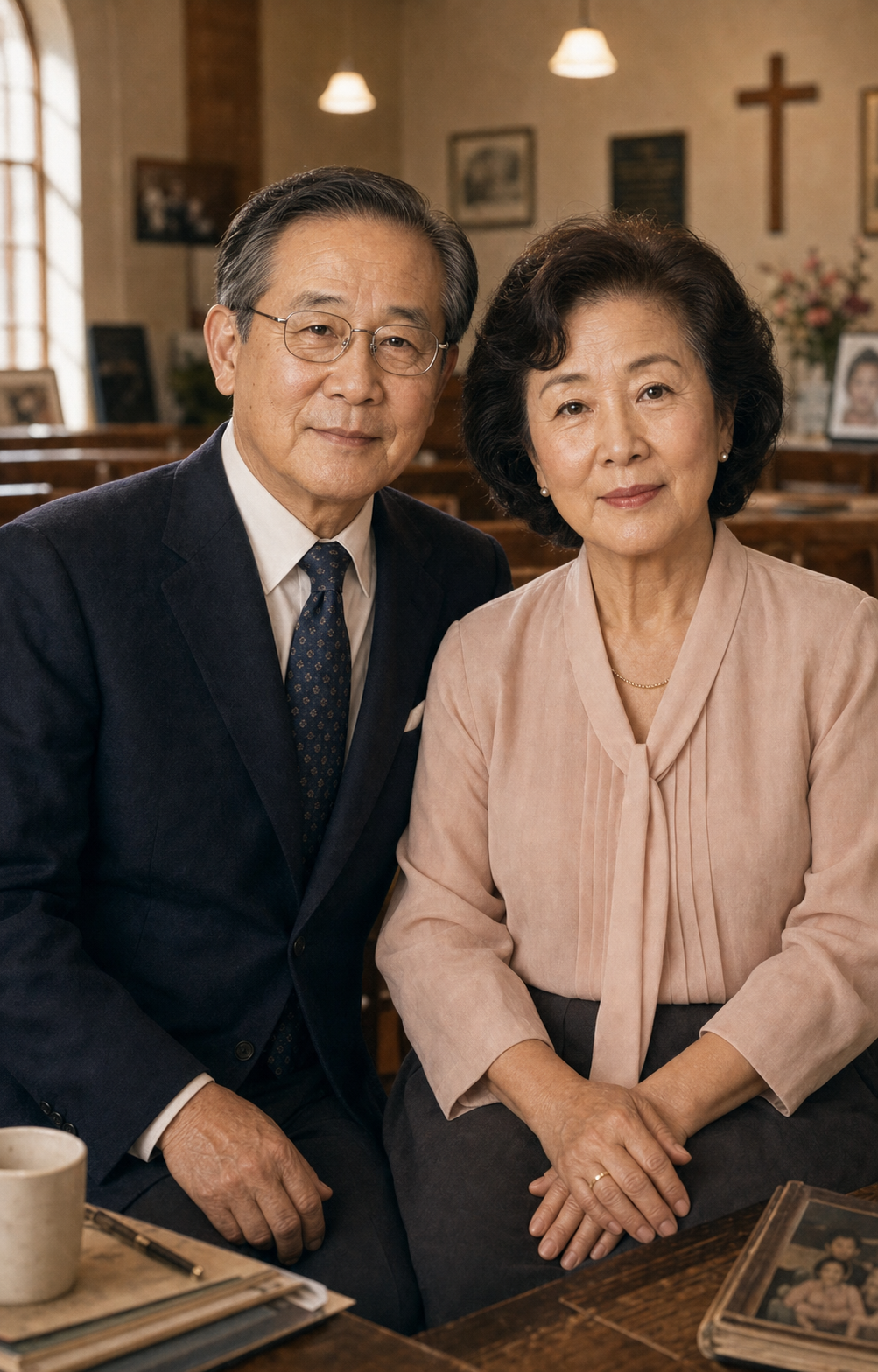
A life remembered
Migration, church work, education, family memory, and public service brought Lester Edward Kim and Pearl Lim Kim along different paths to Southern California. Lester's family story begins with his father, Kim Kyung Bo, who left northern Korea in 1904 for plantation labor in Hawaii, then worked across the American West before building restaurant and community ties in California. Pearl's family story begins with Methodist education, Korea under Japanese rule, and her father, Reverend Du Hwa Lim, whose ministry carried the family from Korea to Honolulu in 1933.
Together, Lester and Pearl remembered youth in Inglewood and Honolulu, wartime service and blackouts, UCLA and the University of the Pacific, Korean church youth networks, seminary, marriage, pastoral counseling, music teaching, fair housing work, and a family that became broadly multicultural in one generation. They moved easily between large events and ordinary objects: passports, marriage certificates, church photographs, restaurant memories, a piano studio, and the family albums that traced their route from Korea to Hawaii, California, and the South Bay.
Based on interviews held by the USC Digital Library.
1904-1933
Two Family Routes to America
Lester Edward Kim's father, Kim Kyung Bo, came from Yangbyon in northern Korea and joined the early Korean labor migration to Hawaii in 1904. Lester remembered him as a young man who had known hunger, had some English from work around mining, and was made a crew leader in the plantation setting. The family history carried uncertainty as well as detail, especially around early marriages, relatives left in Korea, and records that did not always agree.
Kim Kyung Bo's route after Hawaii was wide and restless. He worked in San Francisco, Colorado coal mines, hotel service, farm labor, laundry rooms, cooking, and restaurant ventures in northern California. Lester described him as enterprising and practical, the kind of man who made arrangements, found openings, and kept moving when one plan failed. That memory gave the father's immigrant life a texture of improvisation rather than a single upward path.
Lester's mother came to Hawaii around 1920 after an orphaned childhood connected to Korea, Seoul, and Ganghwa. In the account, Lester tied her story to a later family visit to Korea, when relatives and local memory helped identify the place associated with her childhood. He treated that moment as a powerful recovery of origin, especially because so much of the early migration record had been scattered or remembered indirectly.
Pearl Lim Kim's family reached America through a different but related path. Her father, Reverend Du Hwa Lim, had come to the United States to study, eventually attending Emory University and its school of theology before returning to Korea. Her mother, Blanche Kim Lim, was connected to Ewha and Methodist musical life, including pipe organ traditions in Seoul. Under Japanese colonial rule, the family later left Korea for Honolulu, where Reverend Lim served the Korean Methodist Church.
1927-1945
Childhoods, War, and Belonging
Lester was born in 1927 and grew up as the youngest child in a family whose life moved through Manteca, Los Angeles, and Inglewood. By high school, he was deeply involved in school life and remembered himself as part of the active student circle, even while being one of the few Asian students in that setting. His family's restaurant hospitality made a lasting impression on some of his classmates.
His Korean American world was also organized around church. From Inglewood, he traveled into Los Angeles to Korean Presbyterian Church, where he sang in the choir and watched the youth groups, sports circles, and Sunday gatherings that gave the second generation a social home. He did not understand every Korean sermon, but church still gave him friendships, obligation, and a place to ask what ministry could mean for English-speaking Korean American youth.
Pearl was born in Songdo, also known as Kaesong, in 1927 and came to Honolulu with her mother and brother in 1933 after her father had taken up Methodist work there. Growing up in Hawaii, she did not experience Koreanness as a sharp minority identity in the same way mainland children often did. In her memory, Honolulu was multiethnic and everyday, a place where Asian communities were part of the ordinary social landscape.
World War II changed that childhood landscape. Pearl remembered Pearl Harbor from Honolulu as a day that turned quickly from distant sound to radio reports, blackout rules, school interruption, gas masks, and emergency preparations on a small island. Lester's war years came in Inglewood, where high school, church, and the Korean community overlapped with the service of older brothers and relatives. For both of them, war made identity, citizenship, and public suspicion more visible.
1945-1953
Service, College, and Calling
Lester was drafted near the end of World War II and served from 1945 to 1946. His military experience took him through Texas, Fresno, Hanford, and Greensboro, with training connected to communications and radar. He remembered occasional tension with other servicemen, but also protection, responsibility, and the discovery that people from different backgrounds were not as different as distance had made them seem.
The service also deepened his religious life. During basic training, chapel programs and visits to local churches gave him a setting in which his own testimony began to feel personally urgent. After discharge, veterans' benefits made college possible. He entered UCLA in 1947, moved through pre-med expectations and psychology coursework, and graduated without yet feeling professionally settled.
Pearl's postwar transition was shaped by law as much as education. She graduated from the University of the Pacific in 1949, but because her immigration status still reflected the legal consequences of Japanese rule over Korea and exclusion-era policy, she could not immediately obtain the California teaching credential she hoped for. She worked in Los Angeles and stayed connected to Korean Methodist church life, including choir direction.
Their courtship grew from these church and student networks. Lester heard about Pearl as the new young woman in the Los Angeles Korean Methodist circle, and later their lives converged in the San Francisco area while he was in seminary and she pursued further study. He was thinking seriously about ministry, marriage, and vocation; she brought music, education, and a minister's family background into the partnership they would build together.
1950s-1961
Ministry, Marriage, and Home
Lester entered San Francisco Theological Seminary in 1950 with the encouragement of Korean Presbyterian leadership. A summer chaplaincy at County-USC Hospital in 1951 became the decisive experience of his life. Encountering patients in severe distress, illness, and isolation pushed him toward pastoral counseling rather than a conventional parish path. He later understood that hospital work as the turning point that gave his ministry direction.
After seminary, Lester pursued further study in pastoral psychology and clinical pastoral education. He trained in hospital, mental health, and correctional settings, including work in Norwalk and Washington, D.C. He earned a Ph.D. in pastoral psychology from USC in 1960 and became one of the early Southern California practitioners helping define pastoral counseling as a specialized ministry.
Lester and Pearl married in the early 1950s and began family life during this period of study, training, and professional formation. Their first child, Scott, was born in Washington, D.C.; Grant and Gale followed after the family returned to Southern California. Pearl's role in the story is not limited to support. Her education, music, church experience, and practical steadiness were part of the household that made Lester's demanding vocation possible.
In 1961, the family moved to Rolling Hills Estates after Lester had already been working in the South Bay. Their purchase was met by neighborhood resistance rooted in racial fear, but Lester responded with the habits of a counselor: listening carefully, refusing escalation, and bringing a trusted local friend with him. The family moved in, gathered friends around them, and turned a threatening moment into a beginning rather than an ending.
1960s-1980s
Fair Housing, Music, and Community
The housing incident did not remain only a private family story. In the early 1960s, Lester and a neighbor helped organize the Peninsula Interfaith Committee for Fair Housing, drawing in clergy and community allies during the public debates around California fair housing policy. A large 1964 rally at Palos Verdes Estates High School brought together religious witness, civic concern, and public figures who supported fair housing.
Lester's activism grew from both professional skill and personal experience. He knew how to listen under pressure, but he also knew that polite discrimination could shape where families were allowed to live. The fair housing work connected the Korean American story to the broader civil rights era, including the moral language of human dignity that many religious leaders used in the early 1960s.
Pearl's public work took a quieter but lasting form through music. After raising children, she began teaching piano around 1970 and continued for decades. Her students came from many backgrounds, including Asian, Middle Eastern, European, and mixed-heritage families. She described that variety as one of the pleasures of teaching, and her studio became another small place where changing Southern California could be heard and welcomed.
In the 1980s, as the Palos Verdes Peninsula became home to more families from Asia, Iran, and other parts of the world, Lester again joined efforts to make the community more hospitable. Multicultural programs, school curriculum work, international clubs, dinners, and music events helped residents respond to demographic change with curiosity rather than fear. Lester and Pearl's lives show civic belonging as something practiced in homes, schools, churches, and neighborhood committees.
Later Years
Family Stories and Shared Memory
Lester and Pearl also worked as family archivists. Lester and Pearl moved through photographs, certificates, passports, church programs, anniversary keepsakes, and family portraits, naming people as carefully as memory allowed. Some names remained uncertain, and some stories carried gaps, but the effort itself mattered. They were not only remembering their own lives; they were rescuing fragments of Korean American migration from being lost.
Their 1979 family trip to Korea gave both sides of the family story emotional force. Lester connected with his mother's Ganghwa origins, while Pearl reached only as far as the divided border near the area of her birth. Her reflection on having left Korea as a child was marked by gratitude and sobriety, especially in light of the dangers faced by women and families who remained under colonial and wartime conditions.
Their children and grandchildren represented the world that grew from those migrations. Scott, Grant, and Gale entered professional lives in technology, law, libraries, and community-facing work, while marriages and grandchildren widened the family across Korean, Jewish, German American, and other backgrounds. Pearl described the family as richly mixed, and Lester took pride in the opportunities and commitments that had emerged from one generation's crossings.
By 1999, Lester was retired from full-time practice but still active in developing the Good Samaritan Counseling Center, and he was helping lead Korean American Pioneer Council documentation work. Pearl continued to embody the teacher, musician, minister's daughter, and mother whose life connected Korea, Hawaii, California, and the South Bay. Their work centered on pastoral, musical, and civic care, followed by the patient work of remembering.