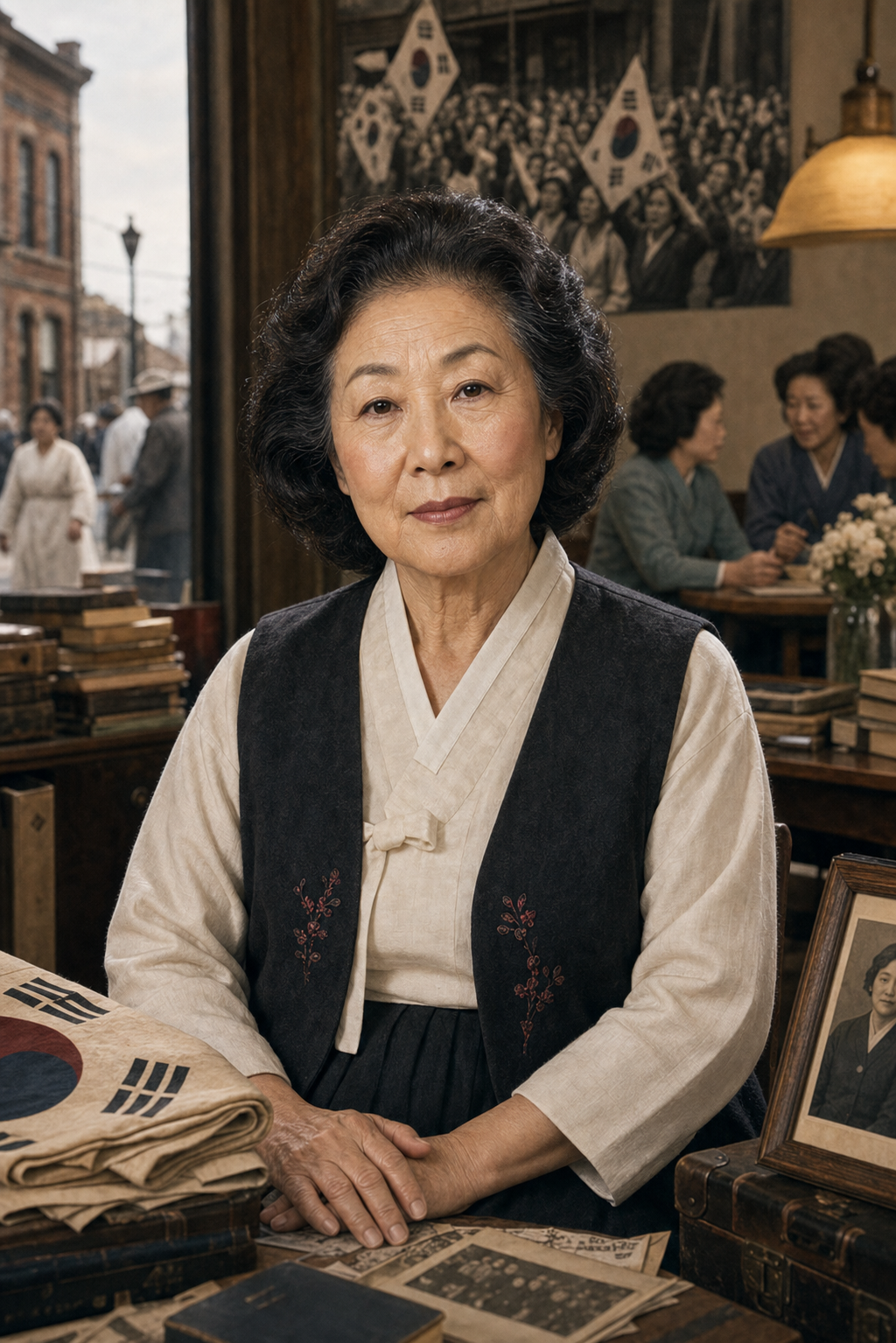
A life remembered
Kyong Sin Park carried messages for March First organizing, fled through northern routes, and later brought the same resolve to work, education, and women's organizing in the United States. She remembered hearing of Japanese trials of Korean students, helping prepare demonstrations, watching police violence, and escaping through northern routes into Chinese border communities and Shanghai.
Recorded in Los Angeles in 1975, the account gives rare attention to women's independence work. Kyong Sin described carrying materials, aiding activists, suffering cold and illness, working as a cook and houseworker in America, attending theological school, supporting Korean language education, and helping lead patriotic women's organizations while remaining clear-eyed about lost records and misused funds.
Based on interviews held by the USC Digital Library.
1919
March First and the Work of Women
Kyong Sin Park connected her activism to the moment when Korean students were being tried by Japanese authorities. She remembered Kim Maria and other women arguing that people in Korea had to be awakened to the reality of Japanese rule.
She helped carry the message into local organizing for the March First demonstrations. On the day itself, she remembered people rushing into the streets with Taegeukgi flags and shouting for independence.
The response was violent. Police and military forces shot, beat, arrested, and injured demonstrators, and Kyong Sin remembered schools, hospitals, and ordinary people trying to care for those who had fallen.
Women carried news, coordinated with schools and churches, prepared flags, helped the injured, and then had to evade arrest. Kyong Sin remembered March First not only as a public cry, but as a chain of risky tasks performed by specific people in specific streets.
Schools, churches, and women students became channels through which information moved. As a theological student representative, Kyong Sin had the access and trust needed to carry urgent messages between institutions.
1919-1920
Flight, Border Work, and Survival
Because authorities identified her as part of the independence movement, Kyong Sin could not remain safely at home. She disguised herself, moved north, and eventually reached communities near the Chinese border where escaped activists gathered.
There, men and women organized communications with the Provisional Government, collected news from different regions, and tried to support military and political work despite having little food, clothing, or shelter.
She remembered hunger, cold, raids, and the constant threat of spies. The hardship left physical consequences, including problems with her feet and legs that she later traced to walking and working in winter without adequate shoes.
The border communities she described were both refuge and danger. Activists could gather, exchange messages, and support military preparation, but they remained vulnerable to Japanese raids and informants. Kyong Sin remembered Chinese houses, mountain paths, fields, and sudden flight. Her body carried that geography long afterward, turning cold ground and inadequate shoes into pain that lasted into old age. Her memories of flight are especially powerful because they include her mother and younger relatives.
Independence work did not endanger only the activist. Japanese searches, household destruction, and forced movement pulled whole families into danger. Kyong Sin understood that her choices brought suffering to loved ones, and she carried that knowledge alongside pride in the cause. The cost of independence work was paid by families as well as organizers. The movement entered kitchens, bedrooms, roads, and family hiding places. Her family memory keeps that cost visible.
Underground Work
Books, Rice Cakes, and Hidden Routes
One vivid episode involved carrying a book or printed material connected to independence work. Kyong Sin worried that she would be searched, so she hid it inside layered rice cakes before crossing a bridge and checkpoint.
Underground work required practical intelligence. What looked like ordinary food could protect information, and a woman carrying provisions could pass where a known activist might be stopped.
Such missions were not abstract politics. They depended on friends, houses, border crossings, and courage under pressure, and they could end in arrest or worse if discovered.
The rice-cake episode also shows how gender could become cover. A woman carrying food might seem ordinary to guards, yet the ordinary object could hold political material. Kyong Sin did not describe the act as theatrical bravery. She described the worry, the improvisation, and the relief of passing through. That plainness makes the danger feel more real, not less. The episode also expands the usual image of resistance. Courage could look like hiding papers in food, inventing explanations at a checkpoint, or deciding which road seemed least likely to lead to arrest.
Kyong Sin's intelligence was tactical and domestic at once. Preparation, concealment, and quick judgment turned ordinary materials into tools of resistance and made danger look ordinary at the checkpoint.
1920s
Illness, Shanghai, and a Passage to America
After raids and dispersal, Kyong Sin made her way to Shanghai, where she became severely ill. A doctor diagnosed pleurisy, and she remembered fever, hospitalization, and survival after a period when death felt close.
Kim Maria, already in America, encouraged her to come because she could earn wages while receiving room and board. Kyong Sin borrowed passage money through family connections and came to the United States intending to repay it.
Her first American work was domestic and difficult. She cooked, cleaned, learned unfamiliar foods through dictionaries and observation, injured herself carrying food, and slowly paid down the debt that had brought her across the Pacific.
Domestic work was another kind of schooling. Kyong Sin learned American food by watching, asking, and looking up words; she made mistakes, negotiated with children in the household, and discovered how exhausting live-in service could be. The wages mattered because passage debt had to be repaid, but the work also forced her to remake herself from activist refugee into immigrant worker. Her American beginning also shows how independence activists entered the immigrant working class.
A woman who had carried messages for a national movement now learned to fry unfamiliar foods, clean rooms, and manage employers' children. Survival required the same discipline, redirected into wages and repayment.
American Life
Marriage, Study, and Korean School
Kyong Sin married Mr. Park after community leaders, including Ahn Chang Ho, encouraged the match. She remembered marriage as both companionship and a practical way to survive in a new country while ill, poor, and alone.
Mr. Park encouraged her to learn English and continue study. She attended theological school, consistent with her stated purpose in coming to America and with her long Presbyterian commitments.
She later helped organize Korean education for children, pressing parents to support language instruction so children could speak and read Korean. Her work linked Christian education, language, and national memory.
Education had been part of Kyong Sin's life before activism, and it remained central afterward. She spoke of school, theological study, Korean classes, Christmas programs, and the difficulty of teaching children who lacked the language needed for performance or worship. Her solution was not nostalgia. She organized parents, raised teacher pay, and treated language as a responsibility the community had to fund. Through Korean school and church work, Kyong Sin transformed private survival back into public service.
She knew that children raised in America could lose language quickly, and she treated that loss as a communal problem. By organizing teachers, parents, and pay, she made Korean education something the community budgeted for rather than merely wished for. Teaching children became a quiet continuation of independence work.
1930s-1975
Aegukdan, Fundraising, and the Burden of Records
Kyong Sin helped lead patriotic women's organizing in Los Angeles after earlier activity shifted there from smaller communities. She named women who helped build the organization and described years of service before resigning over concerns about how funds were being used.
She believed money raised through women's sacrifice should serve the nation and those who fought for it. The loss or disappearance of records, gifts, jewelry, and documents troubled her because it erased evidence of the women's work.
Her final reflections join pride and sorrow. She knew women had done indispensable work, often more than men in fundraising and daily sacrifice, and she wanted that work remembered accurately even as age and illness narrowed her own world.
Records, jewelry, donations, and organizational papers had disappeared or been redirected, making the women's sacrifice harder to document. She insisted that women's work be named, preserved, and evaluated with the seriousness it deserved.
Rings, donations, minutes, certificates, clothing, and food all carried patriotic meaning. When such objects vanished, so did proof of sacrifice; Kyong Sin's spoken testimony preserves part of what institutions failed to keep.