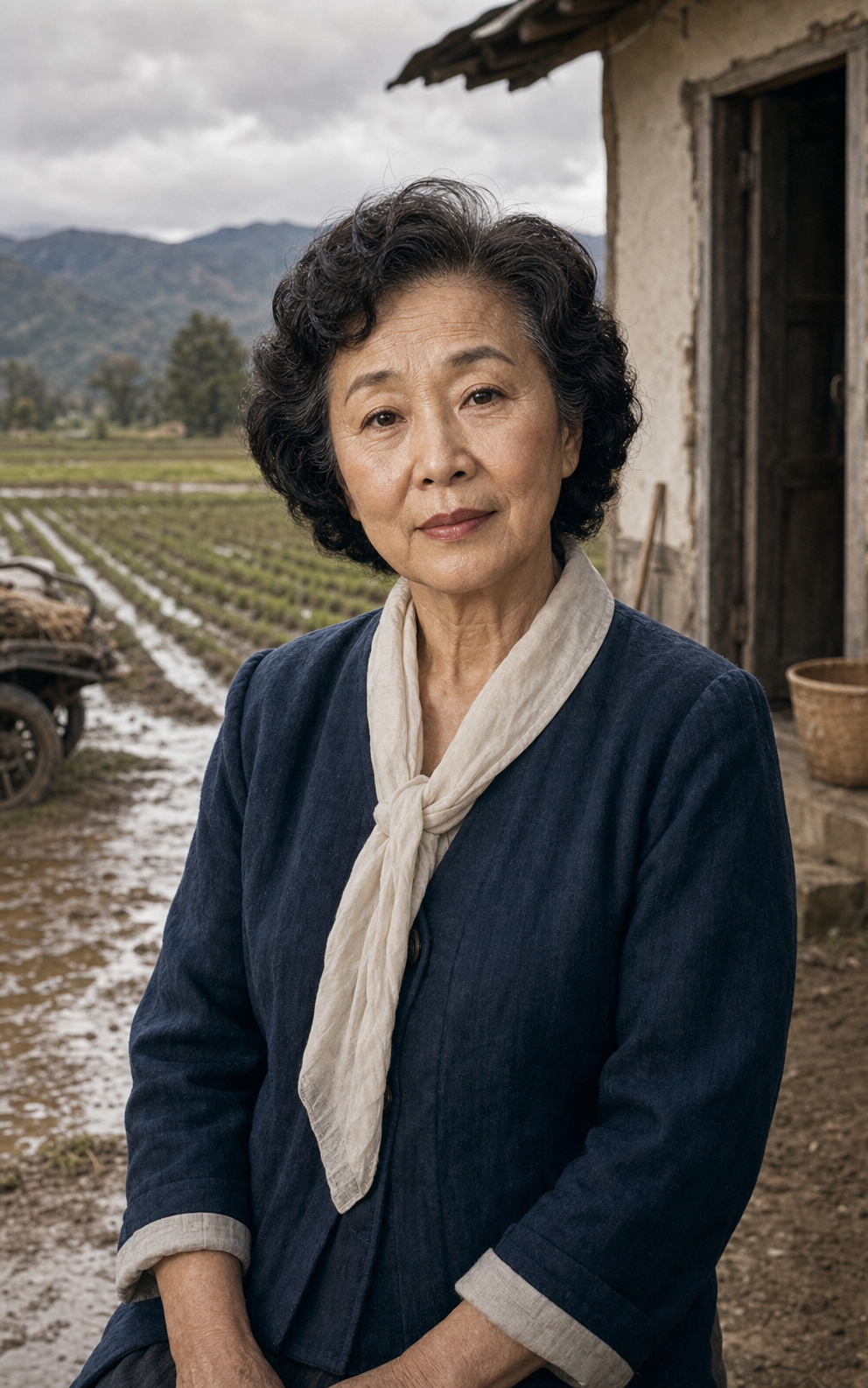
A life remembered
Ke-yul Park first called her life only sorrowful; then the details came: rural Korea, picture marriage, western farm work, motherhood, and survival. She identified her birth family in Gyeongsangnam-do, Dongnae-gun, Sasang-myeon, Mora-ri, remembered her father as the old-style classical teacher Kim Won-do, and described herself as Kim Gyu-yul before marriage made her Park Gyu-yul.
Her story is concrete because it is lived through places and tasks: gathering firewood and bracken as a girl, secretly arranging photographs through Busan and Gupo, leaving for her future husband's family in Jeolla, waiting through mourning before obtaining travel papers, arriving in 1919 through the Pacific Northwest to meet a husband nineteen years older, cooking and farm-working in Spokane, moving through a Wyoming coal-mining stop, and spending decades in Montana vegetable farming while raising ten children.
Based on interviews held by the USC Digital Library.
Korea
A Poor Childhood and the Duty to Help
Park located her childhood with unusual precision: Gyeongsangnam-do, Dongnae-gun, Sasang-myeon, Mora-ri, near Gupo and Busan. Her household had five children, though by the time she began telling the migration story the older sisters had married and the children left at home were mainly her older brother and herself. Their father, Kim Won-do, also known by the courtesy name Baek-cheol, was a teacher of old Chinese classics who was paid in grain, not cash.
The prestige of classical learning did not protect the family from poverty. Park remembered a household surviving on what her father received from teaching and on her mother's work. As a girl she gathered firewood, cut grasses, collected bracken, and found small foods from fields and water so there would be side dishes or something to sell. The work began when she was still barely in her teens, and she remembered the cost of every little item because every little item mattered.
Her older brother represented another path. He studied in Busan, then in Japan, and returned with the conviction that Korean young women should not live like frogs trapped in a well. Park said she did not fully understand his talk of new women, foreign lands, languages, and customs, but his willingness to help mattered. When she finally asked whether he would support her desire to go to America, he told her that if she truly wished to go, he would help.
This childhood makes clear why America could become an idea before it became a place. Park heard rumors that America was rich and that a daughter who went there might help her parents. She also heard more sober accounts from women connected to Hawaii who spoke of sugar-cane work, insects, and hardship. Hope and warning entered her imagination together.
Picture marriage
Photographs, Arrangement, and Departure
Park's migration began through the picture-bride network. She learned from a woman in her village and from an acquaintance how to reach intermediaries in Busan. She and a friend went toward Gupo and Busan, saw photographs of men in America, and had several copies of her own photograph made. She chose the picture of Park Su-ri, whose letters said he was originally from Daegu, had family in Jeolla, had spent three years under a labor arrangement in Hawaii, and was then doing vegetable farming around Spokane.
The arrangement unfolded in secrecy because a young woman seeking a husband overseas could bring shame on a family in that period. Letters crossed the Pacific for months, then stopped, then resumed. Park remembered one letter in which the man said farm failure meant he could not return to Korea and that she should not waste her youth waiting for him. Rather than give up, she and her brother wrote to his father, Park Gun-saek, in Jeolla.
The future father-in-law came alone to her family's house from Jeolla, bringing the matter into the open. Park's parents were distressed, but she insisted that she would belong to Park Su-ri's household whether she lived or died. She packed a bundle and left with him. The journey took her from Gupo by train toward Suncheon and then into mountainous Jeolla, with remembered steep passes, stream crossings, and a rural house where a nameboard identified Park Su-ri as the absent householder.
Before she could leave Korea, her father-in-law died. Park remembered the ritual and legal problem with startling clarity: she had been accepted as a daughter-in-law but had not yet lived with the son. Village and township figures helped recognize her place in the household, loosening her long unmarried woman's hair before bowls of water and allowing her to wear mourning clothes. Only after mourning obligations and travel-paper procedures did she obtain a passport, pass physical and eye examinations, and prepare to cross the Pacific.
American West
Seattle, Spokane, Montana, and Farm Labor
Park said she came to America in 1919, after roughly six years of waiting from the early photograph exchange to the actual crossing. She traveled by the Vancouver-Seattle route and was held by immigration until her husband came from Spokane. She remembered that even packages of candy or fruit were opened and inspected. When she finally met him, she recognized him from the photograph, but she also noted that he was nineteen years older.
The first American periods were not the ease she had imagined. In Spokane she found herself in a household tied to Japanese farm employers and was deeply uncomfortable eating with Japanese workers while Korea was under Japanese rule. She cooked, made do, and used what she knew: dandelion greens, wild watercress-like plants, garlic leaves, soy sauce, oil, anchovies, pepper, and improvised kimchi. Those food memories show how Korean habits traveled into western fields even when money and language were scarce.
The family moved on through farm and labor sites. Park remembered a place with more Korean families, work connected to the Song Chul-su household, and then a Wyoming coal-mining stop where her husband worked and a second child was born. From there the family moved to Montana, where they farmed vegetables for many years on rented land. Because Asians could not freely own land, and because landowners later became reluctant to lease to them, the family sometimes had to put arrangements under the names of American-born children.
Montana gave Park a long geography of survival rather than a settled refuge. Korean families were scattered thirty or forty miles apart, weather and crops governed income, and the household had to keep moving with leases and work. Yet she also remembered a Korean farm community of roughly ten to twelve families who knew one another closely, especially in places around Whitehall and other Montana farming areas. In later life she still called Montana one of her real homes because so many years, children, and memories were rooted there.
Motherhood
Children, Responsibility, and Endurance
Motherhood is the center of Park's account because family survival became her life's work. She spoke of ten children and, by the time of the interview, of eight surviving children after the deaths of sons. She also counted twenty-two grandchildren and great-grandchildren. These numbers were not ornamental; they were the measure by which she answered suffering with proof that the family had continued.
Her husband died in the 1930s, when the youngest daughter was still an infant. Park remembered being left with many children and no easy way to support them. When the person asking the questions marveled that she had raised them with limited English and few resources, Park answered with a statement of bodily resolve: her ten children were healthy, she was healthy, and she still had two hands and two feet.
World War II sharpened the family's vulnerability in Montana. Park remembered Korean children being called Japanese at school, children coming home crying, rocks being thrown, and mothers fearing not only for themselves but for their children. She said the Korean National Association helped by sending papers or identification that marked Korean families as Korean at a time when there was no Korean government nearby to protect them. She remembered that support as life-giving.
Her children dispersed into later Korean American life. She mentioned children in Montana, Salt Lake, Hawaii, and near her in Los Angeles, and said one daughter with whom she lived helped care for her. Yet she did not turn the children's lives into a simple victory story. She remembered sons who died, birthdays she continued to mark, church offerings made in their memory, and the loneliness of an old mother who had survived what she sometimes wished she had not had to survive.
Later Years
The Difficulty of Telling a Sorrowful Life
Park resisted the interview because she believed her life contained only suffering and would not provide material for history. The person asking the questions noted that Park had first refused to meet personally, then agreed to speak, and later gave permission for her name and story to be used. That hesitation is part of the evidence: she had lived through migration, labor, widowhood, and motherhood, but she did not assume those experiences deserved public attention.
The sessions themselves are valuable because they preserve names and places that a more polished story might lose. Park gave her old Korean address, her father's name and courtesy name, the names Park Su-ri and Park Gun-saek, the route through Busan and Gupo, the Jeolla village in Muju-gun, the immigration wait in the Pacific Northwest, Spokane, Wyoming, Montana, Salt Lake, Hawaii, and Los Angeles. Her memory works geographically, tying sorrow to roads, rail lines, ports, farms, and kinship houses.
The interview also preserves the emotional logic of decisions that might otherwise look irrational. Park did not leave Korea because a photograph guaranteed happiness. She left because poverty, family duty, her brother's encouragement, and the possibility of supporting her parents made risk seem necessary. She did not remain in America because it fulfilled the dream; she remained because children, work, and circumstances made return nearly impossible.
Her speech repeatedly moves between refusal and generosity. She says there is nothing to tell, then tells everything: the food she cooked, the rituals she endured, the officials she faced, the farms she worked, the children she raised, the prejudice she feared, and the community she remembered. That pattern gives the life story its form. A sorrowful life becomes history not by becoming cheerful, but by becoming specific.
Later Years
Survival, Children, and Later Years
Ke-yul Park's testimony documents first-generation Korean women's labor in places often left out of coastal Korean American history. Her life connects Mora-ri and Busan, Jeolla in-law obligations, the picture-bride system, 1919 immigration, Spokane farm kitchens, a Wyoming coal mine, Montana vegetable leases, wartime anti-Asian danger, Los Angeles old age, and a family spread across the American West and Pacific.
The story also broadens the meaning of achievement. Park did not describe herself through titles, but she crossed an ocean after years of uncertainty, learned how to feed people from wild greens and scarce ingredients, negotiated land and law through her children's citizenship, raised a large family after widowhood, and retained enough strength in old age to say that two hands and two feet were reason to keep going.
Her testimony is especially important because it corrects the quiet erasure of women who stood behind farms, boarding houses, children, and community survival. She remembered Korean families in Montana as siblings, recalled how older immigrants recognized one another through hardship, and contrasted that early mutual dependence with later migrations that arrived with more money and education.
She did not describe her life as a polished triumph. Its dignity lies in the concrete details: a girl gathering bracken, a secret photograph, a long mourning braid, an inspected package at immigration, dandelion greens in Spokane, children frightened at school, association papers arriving when no government could help, and an elder deciding at last that the hard life could be heard.