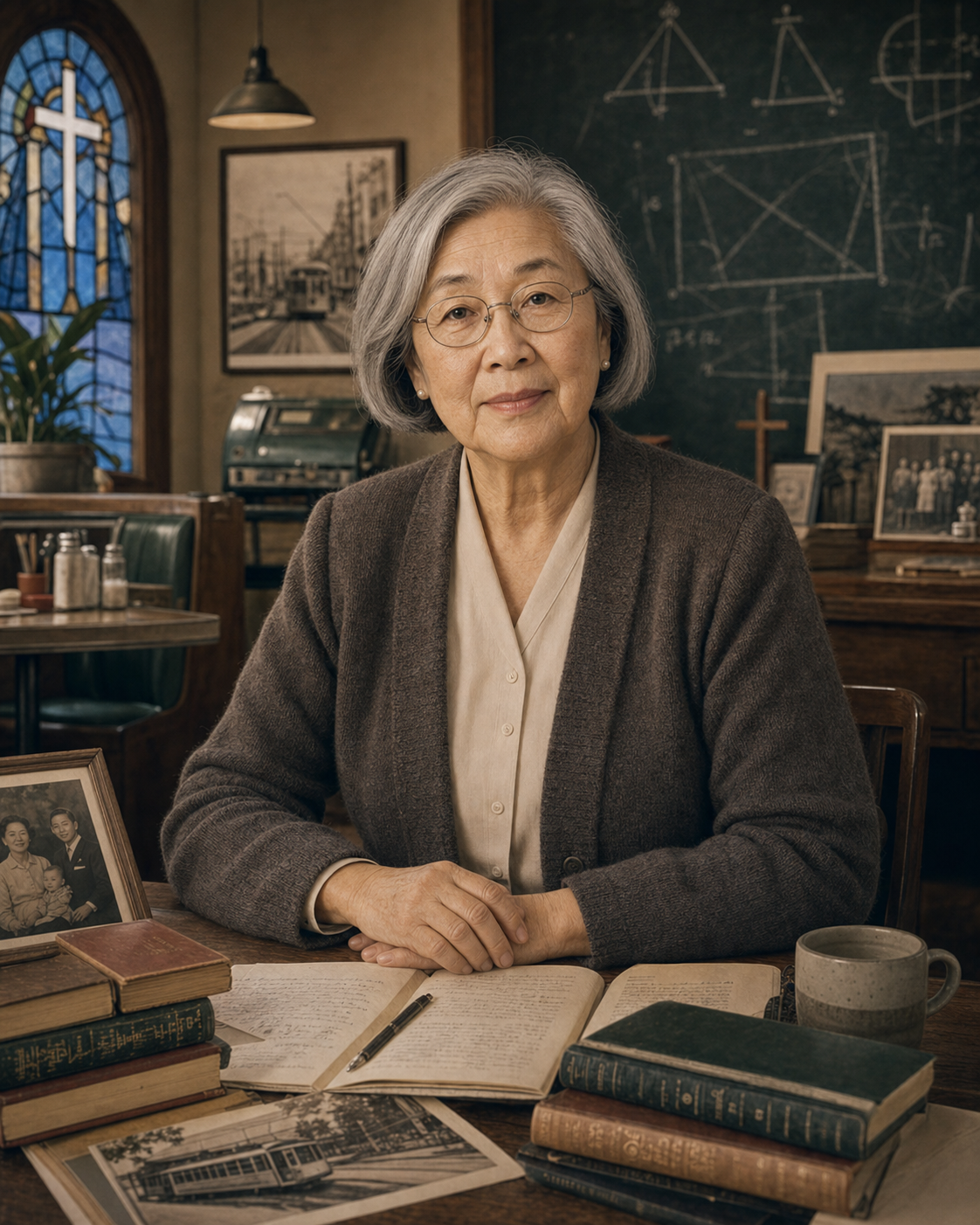
A life remembered
Born in San Francisco, Katherine Yim grew up within Methodist faith and Bay Area Korean community before building family stability in Los Angeles. Born on Laguna Street in 1916, she traced her family story through Hawaii sugar plantation labor, Oakland church life, grocery stores, Korean nationalist memory, and her own marriage to Ed in 1942.
Her testimony becomes most vivid when it stays close to place: Pine Street and Fort Mason in wartime San Francisco, a train ride to segregated Savannah, a home at 2341 West 29th Place in Los Angeles, the Ta Dong restaurant, USC credential study, classrooms near Watts and at Santa Barbara/Martin Luther King, and later language-center work in Sherman Oaks. Across those settings, Yim described obligation, prejudice, business risk, motherhood, teaching, and Christian Korean inheritance with unusual specificity.
Based on interviews held by the USC Digital Library.
Early family
Laguna Street, Oakland Church, and Korean Memory
Katherine Yim placed her own birth inside a longer immigrant story. She said she was born on June 25, 1916, on Laguna Street in San Francisco, in the back of the tailor shop her parents used to support themselves while her father continued school. Her father had come in 1905, at nineteen, on the S.S. Siberia by way of Shanghai and Hawaii, bringing his widowed mother and working under a sugar-plantation labor contract that damaged his health. Her mother came to Oakland in 1913, and her parents married in Los Angeles on December 28, 1914.
Education and ministry were joined in the household. Yim remembered her father as a UC Berkeley graduate in 1917 who later studied at the Pacific School of Religion while preaching in Oakland and running businesses to support the family. Her mother had her own educational background through Ewha’s early normal-school tradition, and Yim understood both parents as people who treated learning as a duty to the Korean community, not simply as private advancement.
Oakland gave that faith a concrete geography. In the early 1920s the family lived near Chinatown at 373 Ninth Street, walked to Lincoln Grammar School, and gathered Korean Methodists in homes and over the family grocery store when the community numbered only a handful of families. Church fellowship extended to picnics at Lake Merritt and Golden Gate Park, where women prepared Korean food such as bibimbap, kimchi, namul, and rice cakes for large joint gatherings with San Francisco Koreans.
Korean memory entered family life through nationalist ritual and painful stories. Yim remembered March First gatherings, cries of mansei, admiration for Ahn Chang-ho, and an uncle who had been imprisoned and physically marked under Japanese rule. Her father bought her a piano when she was about ten so she could play for church and Sunday school; music, Korean speech, Methodist discipline, and anti-colonial memory became one moral education.
Marriage
Marriage, War Work, and a New Household
Yim linked meeting Ed to the small social world of second-generation Koreans. At a Young Korean Nation Association convention in Los Angeles around 1939 or 1940, she represented Oakland with a Korean speech on closing the gap between immigrant parents and the second generation; the New Korea paper publicized her picture. Ed later told her he had noticed that picture, and she met him in person at a San Francisco wedding reception in 1941, when he was stationed at Moffett Field in the Army Air Corps.
Their courtship moved quickly under wartime pressure. They had their first date around Valentine’s Day in February 1942, became engaged after a short courtship, and married on June 21, 1942, at Glide Memorial Methodist Church on Post and Ellis. Yim remembered handmade wedding clothes, relatives serving as attendants, her uncle officiating in Korean, and Ed so nervous that he struggled with the ring and the Korean vows.
War shaped the first household. Ed had been released or reclassified because officials treated Koreans as Japanese, then recalled to service; meanwhile Yim worked at Fort Mason in the Transportation Corps. She lived with her mother in a thirty-dollar-a-month Pine Street apartment in San Francisco, rose at five in the fog to reach her seven o’clock job, and later learned that her mother followed at a distance carrying a hammer because wartime anti-Asian hostility made the early commute feel dangerous.
At Fort Mason, Yim’s work in classified files made her both trusted and suspect. A superior had placed her in a confidential file room, but Colonel Messersmith questioned why an Asian woman was there, and she underwent a character investigation before returning to the job. The episode stayed with her because it exposed how little many officials knew about Koreans and how easily wartime suspicion could humiliate a loyal worker.
After the war, Ed’s mustering-out pay and supply-disposal work helped bring Yim, her mother, and Ed to Los Angeles. With guidance from a Korean realtor, they first rented a small two-story place near 29th Place and Arlington, then bought 2341 West 29th Place, two houses on one lot, so her mother could live close by. Bonnie was born in 1946 and Brenda two years later at St. Vincent’s Hospital, rooting the wartime marriage in a Los Angeles family home.
South
Seeing Segregation Up Close
Yim’s sharpest lesson in American race relations came when she traveled by train to join Ed in Savannah, Georgia, for what she remembered as only a semester or a few months. Looking out from the train, she saw Black families living in shanties and houses without proper windows, a level of poverty she said she had not imagined from the Black communities she knew in the North and West.
In Savannah she rented a six-dollar room in a house where privacy was only a curtain, and she talked with a Black maid who cleaned the rooms. Those conversations, together with the white landlady’s presence, made segregation intimate rather than abstract. Yim was not just passing through the South; she was watching labor, housing, speech, and race rules operate inside a household.
The public signs unsettled her most. At a station she saw restrooms divided between white and colored and could not decide where an Asian woman was supposed to go. She finally walked into the white restroom with what she called a defiant posture. In theaters, she saw Black patrons forced into the highest balcony. At Morris Cafeteria, the only air-conditioned cafeteria she remembered in humid Savannah, she learned the social geography of the town through where people could sit, work, and enter.
Her testimony matters because she narrated Asian American ambiguity within Jim Crow rather than outside it. She had already known anti-Asian prejudice in California, but Georgia forced a different question: how to act when the law divided people into categories that did not even know where to place her. That confusion became part of her moral education.
Los Angeles
The Ta Dong Restaurant and Family Strain
Los Angeles also became the place where Ed’s drive met the risks of small business. After selling restaurant equipment and building contacts, he was persuaded by Mabel Lim to buy the Ta Dong restaurant. Yim opposed the plan because she could see how much greasy, endless labor it would pull into the household, but Ed borrowed six thousand dollars and moved ahead with a cousin, David Huang, helping financially.
For a short time the restaurant looked successful. Yim remembered two Chinese chefs, including Jimmy Wong as the top cook, a professional waitress named Connie, and customers lined up outside. But the work continued after closing, when menus had to be planned and the next day prepared. The business was not an abstract venture to Yim; it entered her body and schedule, especially when she discovered she was pregnant with Brenda.
The restaurant unraveled when the best help left, David was called to language training for military interpreter work, and Yim could no longer work because of pregnancy. Her mother became the cashier, drawing on her own business experience, while Ed began cooking despite lacking the necessary background. The family lost the business, carried debt, and closed after what had begun with crowds and optimism.
The failure did not end Ed’s public energy. Yim remembered him later succeeding in sales, including Western equipment and Litton microwave work, and taking on community roles such as helping promote Miss Korea in 1963 through Los Angeles business contacts. Her account keeps both sides visible: the charisma and hustle that opened doors, and the family strain that women absorbed when a venture collapsed.
Midlife
Returning to School and Teaching Children
Yim’s return to school came from necessity as much as aspiration. When Ed’s health and income became uncertain, she and her mother held what she called a family conference, and her mother agreed to help raise the girls and manage domestic work so Yim could study. In her forties, Yim earned credits at USC and completed an elementary teaching credential, treating it as a sink-or-swim decision.
Her first assignment was a third-grade classroom near Watts around 1960, in an all-Black school. She admitted she was frightened at first because she had never worked with so many Black children, but she stayed late preparing lessons and learned from principal Clara Stutler. After about two years, she moved in 1962 to Santa Barbara School, later called Martin Luther King, where Japanese American principal Mabel Ota trained her to become more detail-conscious.
Teaching also connected back to her daughters’ schooling. Bonnie had attended Sixth Avenue School, and one of Bonnie’s teachers, Lord Hausky, later became a vice principal connected to Yim’s early teaching world. Yim described third grade as a transitional age and took pride in learning how to study again, manage evaluations, and hold a classroom while also coping with hypertension, surgery, and family responsibilities.
Later, after Ed suffered a heart attack and retired, Yim returned to work as a breadwinner. She taught English learners when Korean immigrant children were arriving and a Korean-speaking teacher was needed, then ended her career setting up a language center from scratch in Sherman Oaks for Hispanic children bused from Los Angeles, grouping first through sixth graders by need. Burned out by that final assignment, she retired around age sixty-five, in 1981 or 1982.
Later Years
Faith, Candor, and Cultural Inheritance
By the time of the interview, Yim was speaking after Ed’s death on February 18, 1993, and after more than thirty-five years in their Baldwin Hills home. She remembered him as flamboyant, inventive, and intensely hands-on: the man who fixed plumbing and electricity himself, gardened, saved materials, built tools for trimming eucalyptus trees, and rode a motorcycle in Korean coronation parades as the white-bearded harambajee.
Family conversation carried her memory forward. She compared daughters Bonnie and Brenda, described Brenda’s activism and UCLA years, and remembered her mother’s struggle to accept a granddaughter dating a Japanese American boy who had grown up across the street. Those stories show cultural inheritance changing inside one household rather than remaining fixed.
Yim looked back on Korean ancestry and Christian faith as sources of blessing, but she did not smooth over the costs. Her account includes wartime suspicion, Jim Crow segregation, business failure, debt, marital strain, illness, work stress, and the limits placed on Asian workers in stores and professional life. The result is not a simple success story but a record of how much negotiation one family life required.
Yim brought a Methodist childhood, Korean nationalist memory, music, language, widowhood, and years in public classrooms into her teaching. When she spoke of faith and education, she tied those ideals to streets, schools, jobs, kitchens, and the bargains families made with one another.