A life remembered
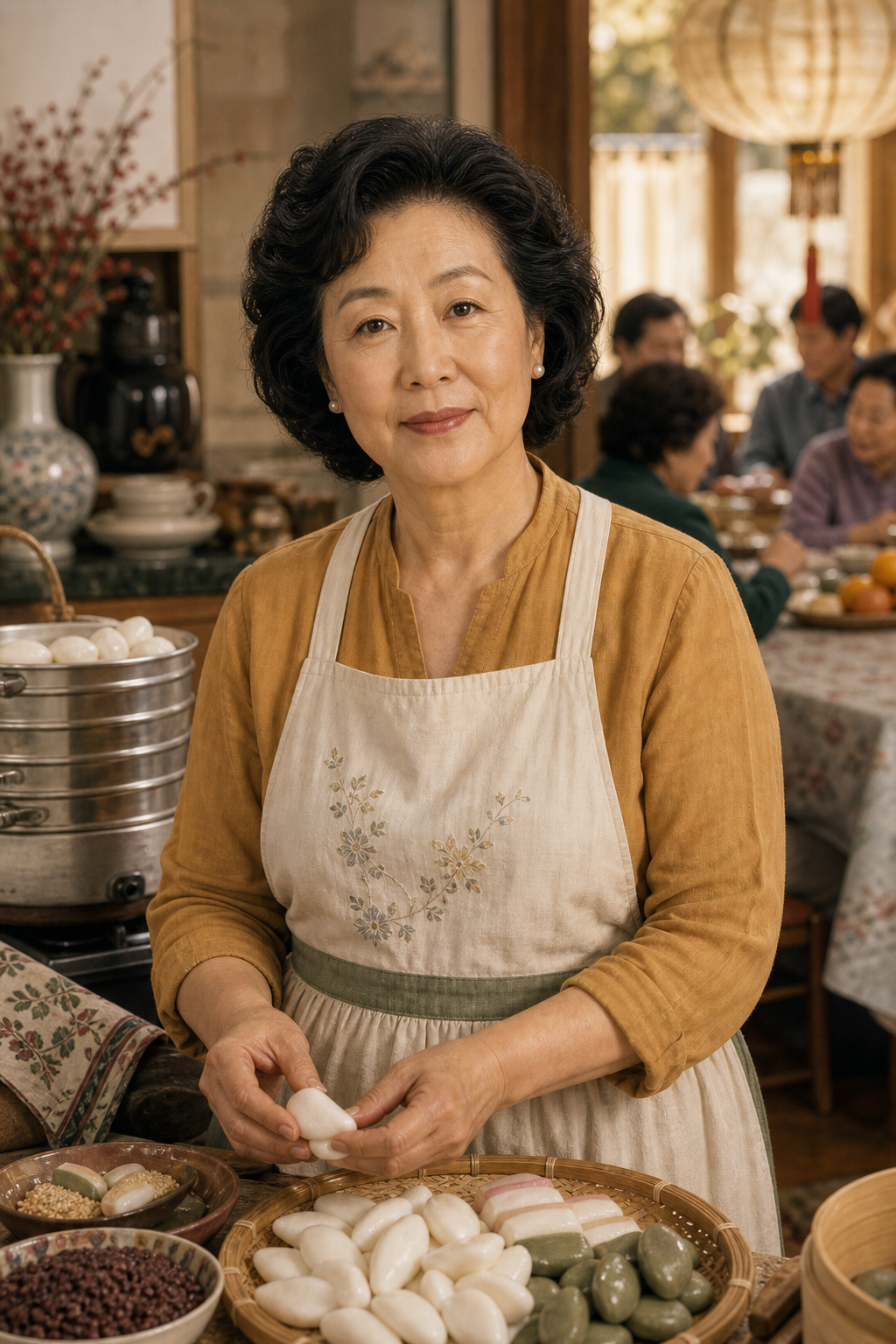
At the kitchen table, Kang-aie Shinn began with detailed instructions for making sirutteok for a Christmas gathering of roughly thirty-five people. From soaked red beans, rice flour, muslin, steam, and chopstick testing, her account opens through the kind of domestic knowledge that held immigrant households and church gatherings together.
The rest of her testimony is equally concrete: leaving Korea in February 1914 at age nineteen, traveling through Yokohama and arriving in San Francisco after a twenty-one-day voyage, learning English from church helpers, raising children in Korean and English, helping family businesses in Sacramento and San Francisco, running a wartime hotel, joining Korean patriotic women’s work, and reflecting on Koreatown, grandchildren, health, and old age in Los Angeles.
Based on interviews held by the USC Digital Library.
Memory
Rice Cakes, Christmas, and the Taste of Home
Shinn’s account opens with Christmas preparation, not with a formal resume. She described making sirutteok for a party of about thirty-five people, beginning the night before by soaking red beans and preparing rice flour. The detail matters: she spoke of sweetening and salting the bean mixture, moistening the flour, lining a steamer with muslin, and building the cake in alternating layers.
The cooking method was precise. A layer of beans went down first, followed by about an inch of rice flour; each layer steamed for ten to fifteen minutes before the next was added. After three layers, the steamer was sealed with a flour-and-water paste so steam would not escape, then cooked for roughly thirty to forty minutes. Doneness was tested with a chopstick, and the rice cake was cut while still warm because it hardened as it cooled.
She also described making chisim, or bean pancakes: soaked soybeans blended to a creamy texture, mixed with ground round, parboiled cabbage or other vegetables, and green onions, then fried into small patties and served with yangnyeomjang. She gave the ingredients along with sequence, texture, and judgment, the kind of knowledge usually passed by watching an elder's hands.
Beginning with food frames the rest of the life story. Shinn’s kitchen work was a form of cultural memory and community service. Rice cakes, bean pancakes, pickled cucumbers, and holiday meals made Korean identity present in American rooms, especially when church members, children, and relatives gathered far from Korea.
1914
Coming to America Under Colonial Shadow
Shinn said she left Korea in February 1914 at age nineteen, traveling with her older brother to Yokohama before boarding a ship for America. She remembered the ship as crowded mainly with Japanese passengers and some Chinese passengers, with herself as the only Korean. Korea was under Japanese rule, and she explained her departure through both hope and pressure: America was said to be good, she wanted schooling, and she did not want to remain under Japanese control.
After twenty-one days, she arrived in San Francisco. A Korean minister and Korean National Association leader came aboard with immigration permission, while the man she would marry waited below on the pier because he could not board. She knew him first from a picture and remembered meeting him without romance or drama, simply deciding he seemed like a decent man.
Her first American household was also a workplace. The family lived behind a small cleaning or tailoring business, and Shinn remembered being frightened when the telephone rang because she did not understand English. She tried night school several times, but children, sickness, housework, and moves repeatedly interrupted her study. Her first child was born in 1915, soon after arrival.
The San Francisco Korean community was small but close. Shinn recalled families such as Mrs. Young, Peter and Frank Choi’s mother, Mrs. Hart, and others connected through church. She also remembered Mrs. Stewart, an American Christian helper who taught English and Bible reading, supported Korean churches at Christmas, and became part of the informal network that helped immigrants learn language and survive.
Early years
Learning English Through Work and Scripture
Shinn described arriving without even the ABCs and learning English after she was already married and raising children. She used night school when she could, but she also relied on practical materials, including an English-learning book by Min Chan-ho that gave Korean explanations for words such as long and thin. Language learning happened in small recognitions rather than in one steady school career.
Scripture and church made English study possible. Mrs. Stewart and other church helpers used Bible reading as a language lesson, and Korean churches in San Francisco, Stockton, Sacramento, and other places formed a network where newcomers could hear English, receive help, and find work. For Shinn, English was learned in the same spaces where faith, mutual aid, and immigrant information circulated.
She also spoke clearly about discrimination in work and housing. She remembered that even college-educated Asians could be denied professional jobs, including teaching, and that many Koreans worked in housework, laundry, cooking, or small businesses because employers would not use them elsewhere. Renting was difficult too, with owners refusing houses or saying places were already taken.
Inside her own home, Shinn kept Korean alive without turning it into punishment. She said the family spoke Korean, sent children to summer and afternoon Korean school, hired students to teach, and relied on her sister as a teacher. Still, she did not panic if children used English or learned Korean history through English books; she wanted continuity, but she rejected harshness.
Family work
Home, Shop, Hotel, and the Labor of Making a Living
Shinn’s family economy moved from one form of work to another. Her husband cooked in Sacramento, including work connected to a soda or candy company and a restaurant dining room, then decided wages were too low and went to barber school in San Francisco. He worked nights in hotels or clubs while learning, started with two barber chairs, and later opened a larger shop in Chinatown on Jackson Street with five chairs.
The barber shop was organized around skill and commission. Shinn remembered her husband as a master barber and explained that barbers working in the shop might keep seventy cents of a dollar while thirty cents went to the owner for towels, space, and shop expenses. She herself stayed home while the children were small, then, after Daniel entered school, worked in a sewing factory near Chinatown that made dresses.
When her husband’s health began to fail, Shinn pushed for a business she could help run. Around 1942, during wartime housing demand, they took on a hotel near Clay Street with roughly thirty to forty rooms. She described it as work she could do even when barbering became too difficult for him. The hotel produced enough income that the family bought a three-story house for about ten thousand dollars cash and later sold it for almost twenty thousand.
Her business memories never separate money from health. She remembered high blood pressure, the absence of Medicare in earlier years, the cost of doctors, and caring for children mostly through home remedies unless illness became serious. The family sold or left the hotel around 1960, and the story of work remained tied to illness, savings, house purchases, and the constant need to adapt.
War years
Church, Korea, and Community Responsibility
Shinn’s Korean politics were rooted in family experience. She remembered the March First Movement of 1919 and described how her sister, unable to get a passport after participating in anti-Japanese activity, escaped at night disguised as an older woman, went to China, studied at a girls’ school in Hohju for three years, and later traveled with Chinese papers through Tokyo and Yokohama. When that sister reached San Francisco, immigration authorities detained her for about a week and required a one-hundred-dollar deposit.
In America, Korean community life remained organized around churches and nationalist associations. Shinn remembered demonstrations against American scrap iron or ammunition going to Japan, young Korean men entering the armed services, and older people training with guns during the frightening early years of World War II in case Japan reached California. She also recalled Korean War-era prayers and the sight of Koreans presenting dress, food, and national feeling to Americans who knew little about Korea.
Her women’s patriotic work was tied to the Korean National Association, which she called Kuminhe. She described the women’s group as a way to help Korean people, but also noted its decline as older immigrants died and younger people did not join in the same numbers. Where there had once been members in San Francisco, Sacramento, Mexico, and Los Angeles, she saw the organization becoming smaller and more local.
Shinn watched later Koreatown growth with hope and caution. She liked the idea of Korean stores, buildings, and a district comparable to Japanese or Chinese towns, but she worried that Koreans did not pool resources as effectively as Chinese businesspeople did. Her community responsibility was practical: cook, give, organize, remember leaders such as Ahn Chang-ho, and ask whether later generations could work together.
Later Years
A Life Built Through Careful Work
Shinn did not describe herself as fully Americanized. She said she still thought of herself as Korean, even while insisting that America had become good for her because of doctors, Medicare, neighbors, and a stable apartment. Her wish for grandchildren was simple and moral: that they be good people and, if possible, believe in God, even when younger relatives explained faith in different language.
Her memory of Korea after migration was mixed. She spent about a year there later in life while her husband was connected to Yonsei College, renting an American-style apartment in a rebuilt area where electricity and water could still fail and a charcoal hibachi was needed for cooking. The visit sharpened her sense that Korea had changed, but also that American comfort, medical care, and predictability mattered in old age.
No single event defines her interview; its force comes from the accumulation of daily details. She left colonial Korea, learned English in fragments, raised children, taught Korean at home and through schools, worked in sewing, helped run shops and a hotel, cooked for gatherings, joined women’s patriotic work, and watched old organizations fade as new Koreatown institutions emerged.
Shinn located Korean American community life in kitchens, churches, barber shops, sewing rooms, hotels, rented apartments, patriotic associations, and family conversations. Heritage survived in the food people steamed, the language they spoke, the wages they earned, and the things they taught and repaired together.