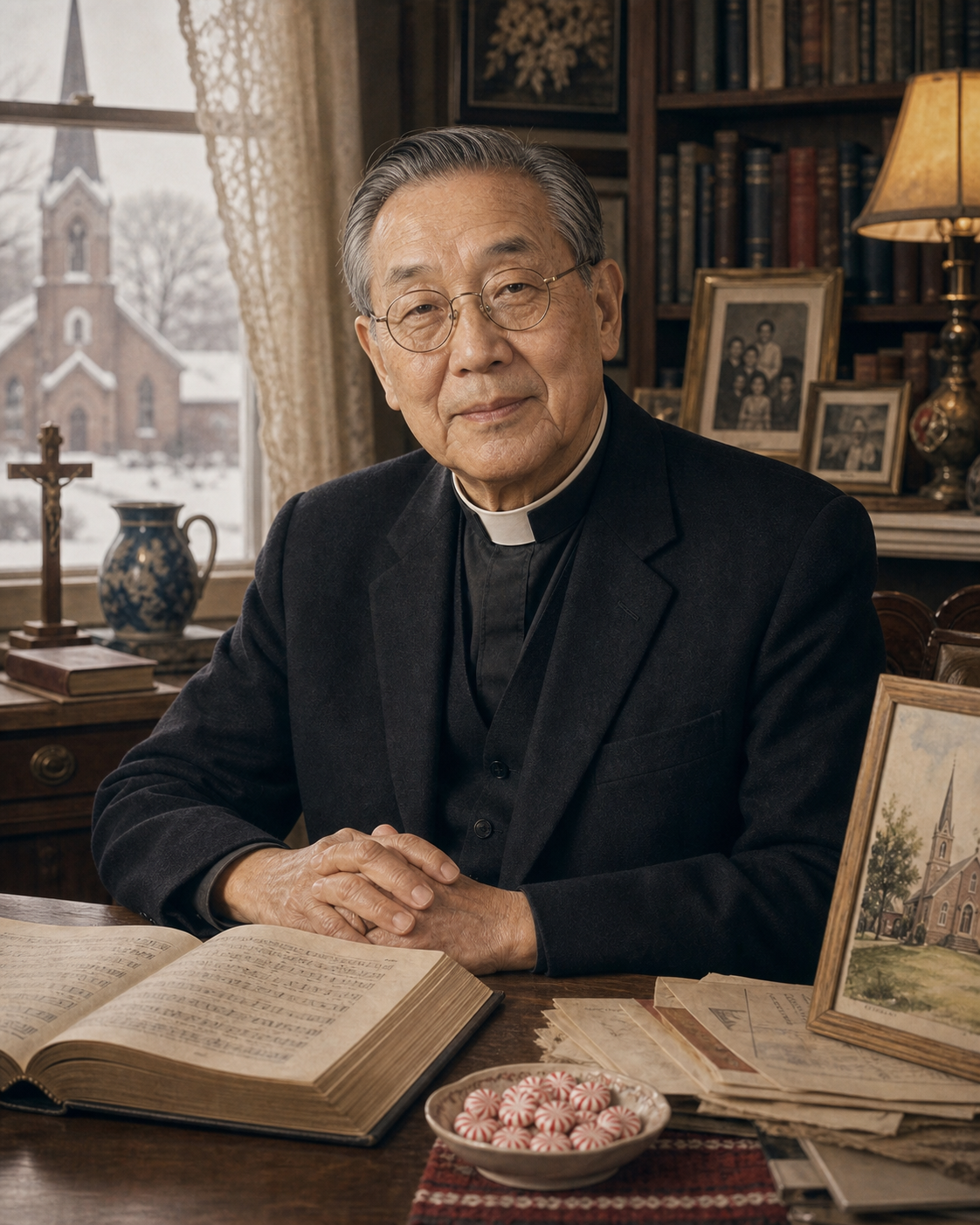
A life remembered
Born in San Francisco in 1895, Reverend Julian Park supported himself through school before building a long Presbyterian ministry and family life in the East. The interview is conversational and sometimes uncertain on early family chronology, but it is clear about his faith, ambition, work ethic, and love of memory.
Christian vocation shaped Julian's life. He supported himself through small jobs, studied at schools including Baldwin-Wallace and Princeton-linked settings, preached in Pennsylvania, New Jersey, and Canada, and built a family with an American wife. In old age, he remembered hymns, work, children, candy shared after church, and his conviction that the Lord had guided ordinary decisions. Some dates from his early years remain uncertain, but his work, ministry, family life, and gratitude are clear.
Based on interviews held by the USC Digital Library.
1895-1910s
A Korean American Beginning
Julian Park identified San Francisco as his birthplace and gave June 22, 1895, as his birth date. His recollections of his parents were fragmented, and the person guiding the conversation and family members tried to reconstruct whether his mother returned to Korea after his father's death.
What remained clear was that Julian grew up between San Francisco and Los Angeles, attending grammar school, lower high school, and then finishing high school in Los Angeles. He remembered work as part of boyhood rather than an interruption of it.
Early family memory was incomplete, but that incompleteness became part of the story. Julian remembered helpers, teachers, and opportunities more vividly than genealogy, suggesting a life built through relationships beyond the household.
The person guiding the conversation's questions repeatedly tried to anchor his parents' dates and movements, but Julian's memory moved elsewhere. He returned instead to school, work, music, and faces that had impressed him. Those gaps reflected the way he remembered a long life across several places and languages. It suggests how a very early Korean American life could be reconstructed through institutions and mentors when the family record itself had become faint.
Uncertainty is unavoidable in Julian's early chronology. Born in the nineteenth century, he stood near the beginning of Korean settlement in the continental United States, when records were thin and families moved under pressure. Children often received only fragments of what their parents had lived through, and some details could no longer be recovered by the time of his interview.
1910s
Scrubbing Steps and Seeking the Best
As a student, Julian took almost any job that would help him stay in school. He remembered scrubbing steps, working around hotels, and receiving a loan from a retired missionary, which he repaid before leaving Cleveland.
He was drawn to distinguished institutions and spoke of Princeton, Harvard, and Yale as names that shaped ambition. He did not describe ambition as vanity; he saw it as part of an inner drive toward serious education and public respectability.
A hotel job in Cleveland became one of his memorable stories. He saw a woman whose face impressed him, later found an opening at her hotel, and worked there for more than two years, turning observation and nerve into survival.
Julian's stories about work are full of chance, but they also show discipline. A loan had to be repaid, a job had to be kept, and school had to continue. He did not separate dignity from labor. Scrubbing steps, watching faces, serving in hotels, and seeking better colleges all belonged to the same self-making project: a Korean American young man insisting that he belonged in serious rooms. His desire for high standards appears again and again. He wanted good schools, good hotels, good habits, and respectable company, not because he denied hardship but because he believed refinement could be chosen. That aspiration helped him move through spaces where few Korean Americans were expected to appear. That belief gave his ambition a moral shape rather than a merely social one. It endured.
1910s-1920s
College, War, and a Hymn Remembered
Julian attended Baldwin-Wallace in Berea, Ohio, and carried memories of campus life through hymns, professors, athletics, and wartime tensions. One incident involving a German-born college president forced to kiss the American flag stayed with him for decades.
What Julian remembered most was not the politics alone but the man's tears and the hymn he hummed afterward. The scene became a moral lesson about dignity, cruelty, and the consoling power of faith.
He played sports and valued wholesome physical activity, including basketball, gymnastics, and tennis. For Julian, disciplined study, work, worship, and exercise belonged to the same vision of a well-formed life.
The hymn episode also reveals the emotional register of Julian's memory. He could forget dates but remember a melody, a bowed head, and tears from sixty years earlier. Faith for him was not only doctrine or church office. It was the language through which injury, patriotism, education, and compassion could be understood without becoming merely political. The hymn scene became a moral memory because Julian recognized humiliation when he saw it.
Watching a German-born educator suffer public suspicion during wartime may have resonated with his own experience as a racial outsider. The song allowed him to remember the man with compassion rather than only as a victim of mob feeling. For Julian, song preserved what chronology could not. The remembered hymn turns a public insult into a private lesson in mercy. The song carried the meaning forward.
Ministry
Preaching Across Towns and Provinces
Julian's ministry took him through churches and preaching assignments in Pennsylvania, New Jersey, and Canada. He remembered Sunday school and Bible school beginnings, rural congregations, and families who drove long distances so he could preach.
He also remembered making money while preaching and studying, sometimes enough to feel unexpectedly secure. The stories blend practicality and calling: ministry was spiritual work, but it was also how a young man ate, traveled, and continued his education.
Dreams and providence mattered to him. In old age he described moments when he believed the Lord guided him away from danger or toward a better path, and he interpreted these memories as evidence of care.
His ministry was also entrepreneurial in the older Protestant sense. He spoke of starting Sunday schools, building interest, traveling between congregations, and depending on families who believed in his preaching enough to carry him from place to place. Behind the title Reverend was a life of scheduling, walking, earning, persuading, and showing up every Sunday where people expected the Word. His ministry also involved constant adaptation to place.
A congregation in one town, a chapel in another, a Canadian summer assignment, or a family that drove him each Sunday all required trust. Julian's vocation was carried by roads, schedules, and the hospitality of people who believed his preaching mattered. The ministry he remembered was made of motion as much as office. His vocation depended on the repeated trust of people who made his travel possible. Roads and borrowed rides were part of the ministry.
Family
An Interracial Minister's Household
Julian married an American woman, and the account includes her perspective on life as a minister's wife. She remembered sensitivity in the early years, the broadening of her shoulders over time, and the demands placed on a pastor's household.
Their sons carried different gifts. Philip later moved toward ministry after working with boys at George Junior Republic, while Arthur showed artistic talent early and became associated with painting and design.
The family also faced racial difference in small-town life. The children were sometimes marked as different, but the parents remembered that the setting, Julian's position as a minister, and changing times all shaped how the family was received.
The account gives rare attention to the perspective of a white minister's wife in a Korean American household. She remembered hurtful remarks, social expectations, and the broadening of patience over time. Their marriage belongs to both Korean American and interracial American history, showing how family, church respectability, and local prejudice had to be negotiated in daily life. For their children, Korean identity was present but partial.
The family knew a few Korean words, occasionally visited Korean church settings, and understood that Julian was different from other fathers, but the household was largely English-speaking and embedded in American Presbyterian life. That partial inheritance is itself an important Korean American pattern. That partial inheritance complicates simple stories of assimilation or retention. Their household shows Korean identity becoming thinner, but not disappearing entirely. The traces remained in words, visits, and family awareness.
1978
Candy, Memory, and Gratitude
In old age, Julian and his wife spoke from a settled home, grateful for health, companionship, and freedom from financial worry. Their conversation moved between repairs, windows, family distance, and the everyday blessings of being together.
Julian was known for giving candy to children and even to adults at church, banks, and stores. The habit was small but revealing: he believed it was more blessed to give than to receive, and he turned that belief into a daily gesture.
His oral history ends with humility about memory. He said he remembered what mattered, especially the best things. That selectiveness gives the story its tone: not denial of hardship, but an old minister's decision to let gratitude have the last word.
The candy stories make his theology tangible. Julian did not only preach generosity; he carried it in his pockets, sometimes to the embarrassment of family members who worried he was holding up the church line. In those small exchanges with children, bank clerks, neighbors, and ministers' families, he enacted a lifetime of belief that blessing should move outward, hand to hand. In the end, Julian's gratitude is not vague optimism.
It is the conclusion of someone who had worked from childhood, paid debts, crossed institutions, endured gossip, raised children, and reached old age with companionship. His memory chooses blessing because it knows exactly how much could have gone otherwise. Gratitude, in his telling, was earned through the long discipline of survival. For Julian, blessing was not abstract; it was companionship, shelter, health, and enough.