A life remembered
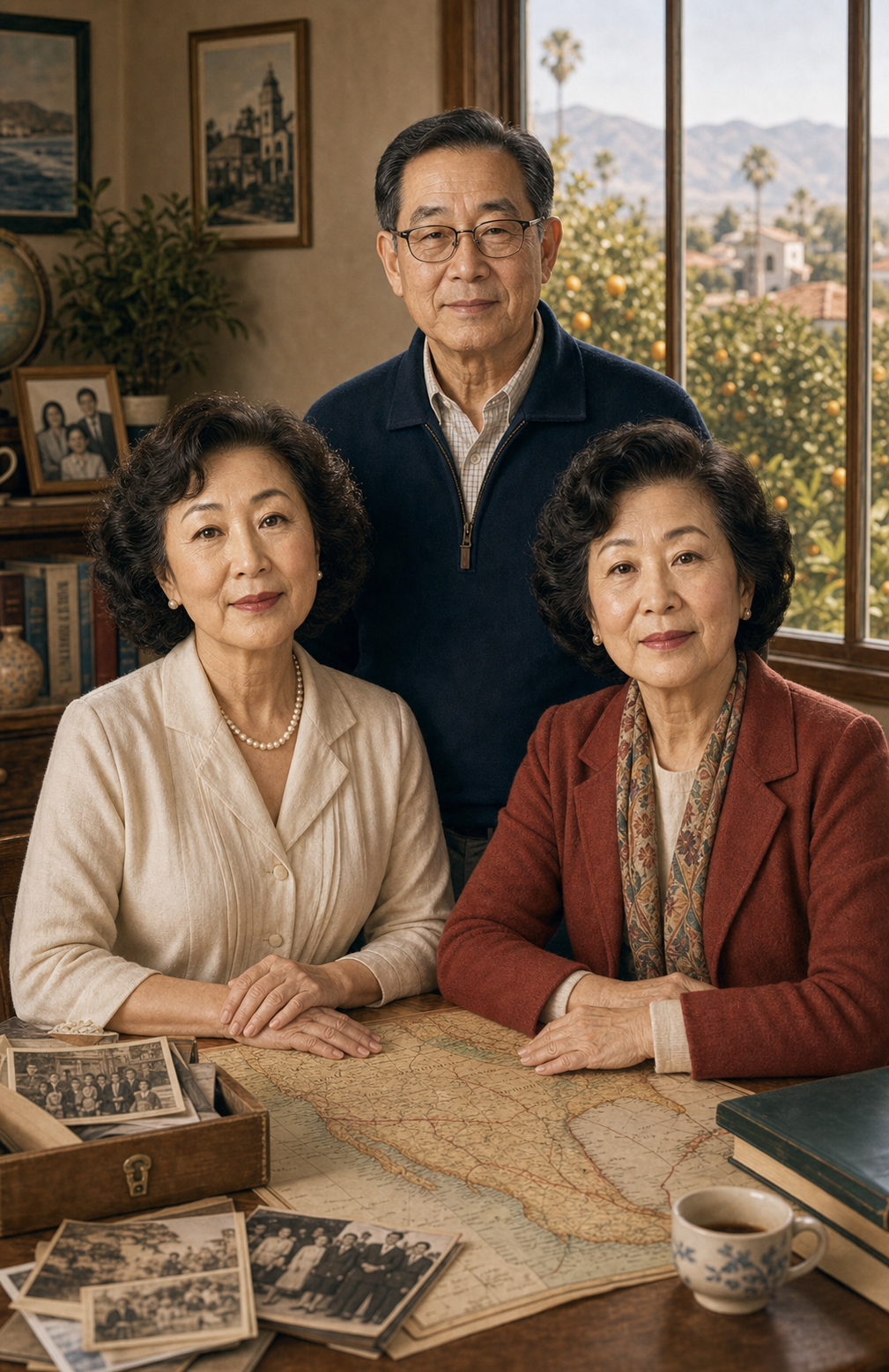
Julia Kim Ide, Frank Kim, and Betty Chung Kim told their family history in several voices, sometimes reinforcing and sometimes correcting one another. Their memories move from Korea to Sonora, Mexico, Los Angeles, Orange County farms, a return to Japanese-occupied Korea, American high school, church life, marriage, work, food, discrimination, and the later reflections of siblings who understood themselves through both Korean and American worlds.
Julia, Frank, and Betty remembered parents who crossed borders, a mother who protected her children fiercely, farm labor and household work, and Presbyterian social life. Their memories sometimes overlap or disagree, but all three defend the sacrifices of the pioneer generation.
Based on interviews held by the USC Digital Library.
Early 1900s-1920s
A Family Across Borders
The family story began with parents who left Korea under difficult conditions and eventually lived in Mexico before settling in the United States. Julia identified Sonora, Mexico, as her birthplace in 1914, while Betty was born later in Los Angeles.
The siblings understood their parents' migration as shaped by poverty, political pressure, and the need to survive. Some details came through family telling rather than documentary certainty, but the sense of danger and improvisation remained strong.
Their mother stands at the center of the family memory. She bore children, lost children, remarried, worked, and refused to let her children be separated from her, even when outsiders offered money or relief.
The siblings' memories overlap without forming a perfectly tidy chronology. One recalls Mexico, another the return to Korea, and another the store or the farm. Together they reconstruct a migration that no child in the family could have fully understood while it was happening. Their disagreements remain visible instead of being forced into a single version.
Parents could be brave and imperfect; Korea could be homeland and hardship; America could offer safety and exclusion. The siblings remembered these truths from different angles, and the result is a richer family portrait than a single polished account would provide. The family's history is strongest when those different memories remain in conversation. Their shared account gains force because it leaves those tensions visible.
1930s
Six Years in Korea
Part of the family returned to Korea in the early 1930s, staying for several years before returning to the United States as war approached. The children had to learn quickly, mastering Korean and Japanese in school even though they had been formed by an American-born childhood.
They remembered heavy studying, missionary school on Sundays, shopping trips with uncles, picnics along the Han River, and the pressure of Japanese cultural control in schoolbooks and customs.
The return gave them language and memory, but it also created a later educational gap. When they came back to American schools, they had missed formative English-language schooling and had to rebuild confidence in a setting that did not easily include Asian students.
This period also shows the irony the siblings themselves recognized. Their parents had left Korea to make a life elsewhere, yet later sent children back into a colonized Korea because family strategy, money, and opportunity seemed to require it. The children gained fluency and cultural knowledge, but they paid for it in disrupted schooling and the social awkwardness of returning to America at precisely the age when belonging felt urgent.
The Korea years gave the children memories their American-born peers did not have: language drills, Japanese school structures, missionary circles, river outings, and relatives who treated them as both family and outsiders. Those memories later became a resource, even though at the time they complicated the children's return to California. The return to Korea gave them depth, but it also made American reentry harder.
1930s-1940s
Back to American Schools
High school in California was difficult, especially for those returning from Korea. Julia remembered Van Nuys High School as socially isolating, with Asian students left outside the dances, dating, and ordinary inclusion that other teenagers expected.
Other memories placed the family in Orange County, where school, sports, buses, and farm labor shaped daily life. The children participated in athletics, but they also hurried home to cook, help, and work because both parents labored.
The siblings learned to move between American and Korean expectations. They could value their parents' strictness and still remember how hard it was to feel different in nearly all-white schools.
Sports and schoolwork offered one kind of recognition, but not full acceptance. The siblings remembered being capable, quick learners, and strong athletes, while also knowing that dances, dates, and adolescent ease were often closed to them. Their account captures the double standard of assimilation: they were expected to perform well in American institutions, but not always welcomed into the ordinary pleasures those institutions promised.
The pain of school exclusion appears most clearly in the ordinary teenage desires the siblings named: to meet boys, go dancing, join groups, and feel included. Their recollections show that discrimination extended beyond law and employment practice. It also operated through invitations not given and friendships never allowed to begin. The wound was social as much as academic. Those exclusions shaped confidence as surely as grades or athletics did. Belonging was withheld in small daily ways.
Family Labor
Fields, Stores, and Household Work
The family worked in small stores, farms, and household economies that required everyone to contribute. They remembered tomatoes, string beans, avocados, grocery work, and the ordinary pressure of keeping a large family fed.
Betty described jobs that revealed quiet discrimination. In one jewelry-store position, she was kept in the office and made to understand that she should not appear at the front counter, even when no one stated the rule plainly.
Cooking also became a family language. The account lingers over noodle soup, broth, Korean seasonings, and the difficulty of making dishes such as naengmyeon before later Korean groceries made ingredients easier to find.
These work memories are important because they connect gender, race, and class. The daughters learned to wrap packages, keep books, cook meals, and help with fields or stores, but they also learned where they were allowed to be seen. A back office, a kitchen, or a farm row could be acceptable; the public counter could be silently forbidden. The family survived through work that was both necessary and constrained. The household economy also depended on children becoming competent early.
Cooking after school, helping with crops, managing store life, and learning office work were not optional character-building exercises. They were survival tasks. Through them, the siblings learned both self-reliance and the unequal expectations placed on daughters in immigrant families. The work trained them for adulthood before adulthood had officially arrived. Labor, in their memory, was the family curriculum. It shaped their expectations permanently. That lesson lasted.
Community
Church Picnics, Courtship, and Family Ties
Presbyterian church life provided one of the main Korean social spaces. Picnics, gatherings, and church introductions helped young people meet in a community that was too small for many separate institutions.
Betty remembered meeting Richard at a park gathering and being too shy to speak easily. Family rules limited dating, and courtship often moved through sisters, church events, and careful watching by older relatives.
The interview also remembers the Jefferson-area Presbyterian church as a place where weddings and community milestones took place. For the family, church was both a religious home and a social map.
Their courtship stories show how small the Korean American social world could be. A picnic, a checker game, a sister who did the talking, and a church wedding could become the bridge between guarded young adulthood and marriage. The details are modest, but they reveal the community's structure: parents watched carefully, churches gathered scattered families, and young people found one another in the narrow spaces allowed to them. The church period shows how a small community created rules of respectability around young people.
Shyness, family supervision, and Christian gatherings all shaped courtship. A young woman might barely speak to a suitor, but sisters, picnics, and church networks could still carry the relationship forward until marriage became possible. Their courtship memories turn shyness and supervision into social history. The smallness of the community made every gathering carry unusual weight. A picnic could become the community's courtship system. Those small rituals carried large consequences.
1999
What Later Arrivals Did Not Know
One of the strongest reflections in the account concerns later Korean immigrants who arrived with money and asked why earlier Korean Americans did not own apartment houses or drive better cars. The siblings remembered that question as demeaning because it ignored the hardship and discrimination pioneers had endured.
Their mother answered such attitudes directly, insisting that people of her generation had suffered so later arrivals could find a wider road. The comment became a family statement about dignity, not resentment.
Together, Julia, Frank, and Betty preserved a family story of movement, work, humor, and hurt. Their life story is a chorus: no single voice carries all the history, but together they show how Korean American family memory survives across siblings.
The siblings' later reflections are not bitter so much as corrective. They wanted later generations to understand that earlier Korean Americans often lacked property, cars, and formal status not because they lacked ability, but because exclusion narrowed their options. Their mother's blunt defense of pioneer sacrifice becomes the moral center of the account: history must account for the costs paid before later success became visible.
The siblings' defense of the pioneer generation is one of the account's clearest historical arguments. They insisted that later wealth or comfort should not become the measure of worth. Earlier Koreans had cleared social ground through sacrifice, and their lives deserved to be judged by the barriers they faced, not by the property they did not accumulate. Their testimony measures success against the obstacles those pioneers absorbed.