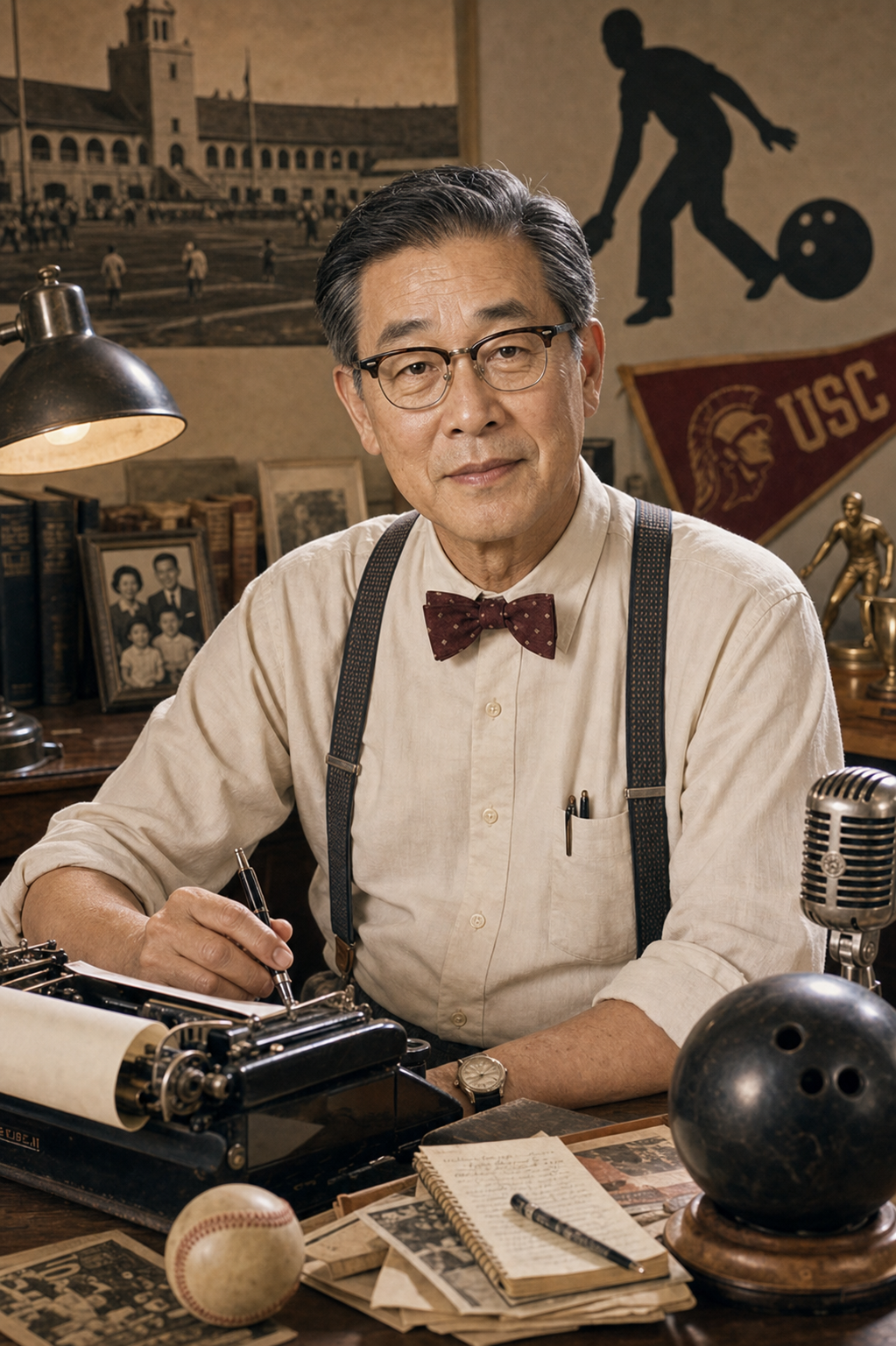
A life remembered
Born in Los Angeles, Joseph Lyou moved from Depression work and church life into wartime service, USC journalism, sports writing, marriage, and fatherhood. Born in 1919 at 106 North Figueroa Street, he connected his birthplace to the Korean community world around the Korean National Association and An Chang Ho's household.
Joseph remembered schools across Los Angeles, the CCC, the army, USC's Daily Trojan, the Los Angeles Mirror News sports desk, Jefferson Boulevard restaurants, interracial marriage, and a long career writing about bowling. His sportswriting belonged to the same life as Depression-era family responsibility, USC training, and neighborhood friendships.
Based on interviews held by the USC Digital Library.
1919-1930s
A Korean American Childhood in Los Angeles
Joseph Lyou was born in Los Angeles in 1919, in a building he associated with Korean community life and the household of An Chang Ho. His father, Sung Suk Lyou, also known as Don Harvey Lyou, had come to the United States in the early Korean immigrant generation.
Joseph grew up in a large family of five girls and three boys. His memories of siblings, loss, and holiday gatherings show a family that remained close even as children grew, married, and settled across Southern California.
At home, Korean food and language were present through his parents, especially his mother, but English and American schooling shaped the children. Joseph understood himself as Korean from the beginning, even when others could not distinguish Koreans from Chinese or Japanese people.
His family memories are full of names, birth order, and affection, but also loss. He identified siblings who had died and recalled the annual gatherings that once brought a widening clan together. That attention to kinship matters because Joseph's later confidence as a public writer rested on a private world where Korean identity, Southern California belonging, and family loyalty were all present at once. His birthplace on Figueroa gave him a symbolic connection to Korean nationalist Los Angeles, but Joseph's life also shows how quickly that world became local and American-born. He inherited pioneer memory without living as an immigrant himself, a position that shaped his relaxed but persistent sense of Korean identity. That inheritance shaped him without narrowing the life he made in Los Angeles.
1920s-1937
School Routes Through a Changing City
Joseph's school path followed the family's moves through Los Angeles: Rosemont Grammar School, Central Junior High, O'Shea Junior High, and Polytechnic High School. He graduated in 1937, still very young, in the middle of the Depression.
He did not remember high school as a time of easy social life. He loved sports and reading about sports, but he was young for his class, did not date, and often focused on helping the family.
The Depression shaped his choices. He joined the Civilian Conservation Corps because jobs were scarce and most of his monthly pay could be sent home. The CCC trained him through hard physical work, fire fighting, road building, and a routine that felt almost military.
The CCC period also shows Joseph's early sense of responsibility. He kept only a small part of his wages because the household needed the rest. The work was not glamorous, but it gave him structure, physical stamina, and a first taste of disciplined public service. When he later entered the army, the rhythms of reveille, crews, and hard outdoor labor were already familiar. His memories of poverty are practical rather than dramatic. He described schools, jobs, first cars, and household telephones through what they cost and when the family could afford them. That attention to money grounds the story in the Depression world that formed his habits of work and responsibility. Even his memories of cars and phones register the slow arrival of stability.
1930s-1940s
Church, Picnics, and Jefferson Boulevard
When the family lived near Jefferson and Vermont, Joseph became part of the Korean Presbyterian Church and the Korean National Association area. He sang in the choir and remembered church picnics at Griffith Park and beach outings as important social occasions.
He did not belong deeply to social clubs or dances, but he found community through sports, church, and familiar restaurants. Hank Lee's restaurant on Jefferson Boulevard became one of his regular gathering places.
Joseph remembered pinochle games with Hank Lee, Phil Lyou, Jimmy Lee, and himself, along with affordable Korean and American food. These ordinary afternoons were part of the social life that held the Korean American community together.
His account gives Jefferson Boulevard the feel of a lived Korean American neighborhood rather than a formal institution. Church, KNA, restaurants, bowling alleys, and card tables made a web of belonging. Joseph did not need to describe it grandly. By naming where men played, ate, laughed, and teased one another, he recorded how community was made after work and between obligations.
Hank's restaurant and the church picnics also offered Joseph a bridge between Korean community and his broader American interests. He could sing in the choir, bowl on Vermont, play cards at Jefferson, and read sports pages with equal ease. His social life was not divided into separate identities so much as layered through place. Those places let him be Korean American without having to explain the combination. The neighborhood gave him a flexible identity rooted in repeated encounters.
1940s
War Service and USC Journalism
Joseph served in the army during World War II and later attended USC. He worked while studying and moved quickly because he felt older than many students by the time he graduated.
At USC, he studied journalism and worked on the Daily Trojan, gaining experience in copy, headlines, reporting, and the daily craft of a newsroom. He remembered being one of the only Asian students in his journalism classes but did not describe USC as dominated by exclusion.
A classroom discussion about racial identification in crime stories stayed with him because he answered with characteristic dry humor. His confidence came partly from knowing that he had chosen journalism because he loved writing and sports.
USC also gave Joseph practical newsroom training at a moment when Asian Americans were rare in mainstream journalism programs. He learned to write under pressure, edit copy, and understand how stories moved from notes to print. The degree did not hand him a career, but it prepared him to recognize opportunity when a copy-boy opening led toward the sports desk. His journalism education mattered because it joined talent to craft.
Joseph already loved sports, but USC taught the discipline of writing for readers, editing under pressure, and respecting the structure of news. Those habits later made him credible in specialized sports worlds where accuracy and relationships both mattered. His training turned enthusiasm into professional habits that could sustain a career. That training made the newsroom feel like craft, not glamour.
1950s-1990s
From the Mirror News to Bowling Journalism
Joseph entered the Los Angeles Mirror News as a copy boy and worked his way toward sports writing. He believed his USC training prepared him for that work, even if the first job itself did not require a degree.
He later built a long career in bowling journalism, including managing and eventually owning a bowling newspaper. He expanded coverage, followed Southern California and national bowling, and stayed connected to tournaments and writers' associations.
Awards from bowling writers and induction into the Southern California Men's Bowling Hall of Fame affirmed the field he had helped document. Even after selling the newspaper, he continued writing a monthly column because he missed the work.
Bowling journalism suited him because it combined reporting, friendship, travel, and deep knowledge of a specialized world. He knew the tournaments, the writers, the bowlers, and the regional circuits from Southern California to Nevada. His continued unpaid column after retirement shows that writing was not only employment. It was how he stayed in conversation with the community he had covered for decades.
Bowling also gave Joseph a professional community that rewarded loyalty. He knew the writers, tournament organizers, and players over many years, and those relationships gave his reporting depth. His awards were not just plaques; they recognized decades of showing up, keeping records, and treating a recreational sport as worthy of serious coverage. The beat became a long conversation with a sport and its people. The sport rewarded his habit of careful attention.
Family
Marriage, Children, and a Working Writer's Memory
Joseph spoke openly about marriage, divorce, remarriage, and grief. His first wife, Kay, was Caucasian, and their children grew up with both Korean and American family inheritances; his second wife, Heidi, was Japanese American and shared his bowling world.
He took pride in his daughter, a registered nurse, and his son, a social psychologist, surfer, and musician. Their lives represented a later Southern California generation less constrained by the boundaries Joseph had grown up noticing.
His oral history leaves a vivid record of a second-generation Korean American who turned love of sports into a profession. Joseph's life sits at the meeting point of immigrant family memory, Los Angeles neighborhoods, USC training, and the plain pleasure of getting the story right.
He also spoke with unusual ease about interracial family life. He knew his marriages and children crossed older boundaries, but he did not frame that fact as tragedy. Instead, he emphasized affection, beauty, talent, and the ways later generations could move more freely. That generosity gives his life story a distinctly Southern California tone: mixed, practical, sports-loving, and more interested in life as lived than categories as imposed.
His family reflections broaden the story beyond career. Joseph saw his children and grandchildren as evidence that life had continued beyond older exclusions. He did not deny prejudice, but he refused to let it define the whole story. Work, humor, marriage, grief, and pride all remain visible at once. Joseph's work as a writer linked one generation to the next. His memory keeps professional pride and family tenderness in the same frame.