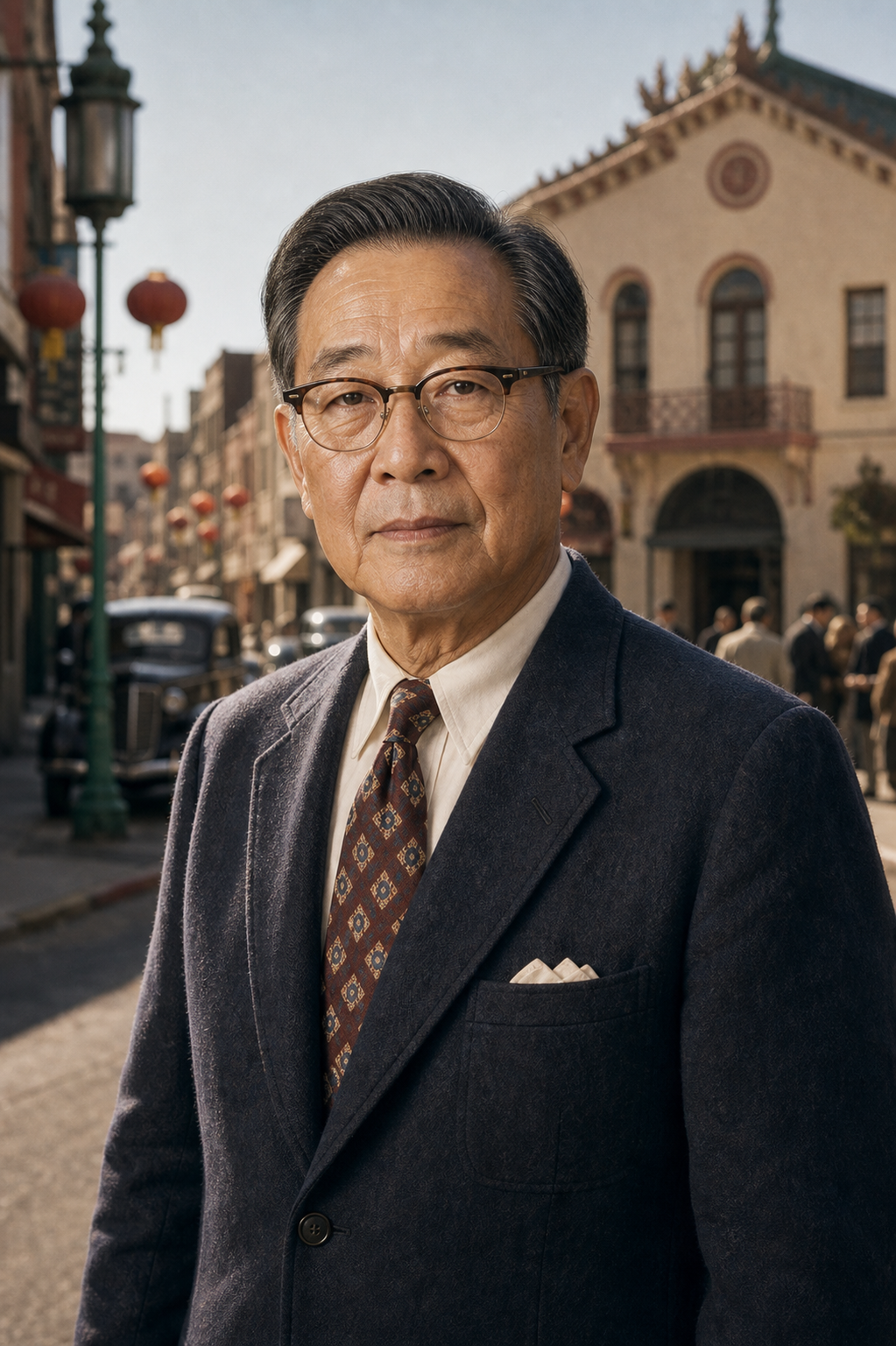
A life remembered
Born in Honolulu in 1918, John Kyudong Han grew up mainly in San Francisco and Los Angeles and learned early to make himself useful wherever work appeared. His memories connect his father's Korean National Association work, Chinatown childhood, Los Angeles friendships, print shops, Korean newspapers, wartime technical illustration, and later import and gift-show business.
John remembered linotype machines, hand-fed presses, women folding newspapers, factional Korean politics, and the back-room labor that kept small Korean American publications alive. The same practical skill carried him from newspaper machinery to defense-industry illustration and trade-show logistics.
Based on interviews held by the USC Digital Library.
1918-1920s
From Honolulu to San Francisco
John Kyudong Han was born in Honolulu in 1918, but he remembered San Francisco as his hometown because the family left Hawaii when he was still an infant. His parents had known loss before him, and he understood himself as the surviving child they tried hard to protect.
His father had been active in Korean social and political work, especially around the Korean National Association. John later explained the different independence factions in terms of their methods: organizing, diplomacy, and military preparation.
The family lived around Chinatown and Stockton Street, and his father operated a cigar stand at Kearny and Columbus. These details placed Korean immigrant family life inside a broader multiethnic urban neighborhood.
John's early memories also carry the shadow of children who did not survive. He did not dwell on the subject, but the knowledge that older siblings had died helps explain the intense care he associated with his parents. Their household was both ordinary and fragile: a cigar stand, Chinatown rooms, Korean politics, and the quiet griefs that early immigrant families often carried without much public language.
The family's move from Hawaii to San Francisco also places John within the second generation of Korean America: American-born, but raised under the memory of parents who had migrated for work, politics, and survival. He belonged to the United States by birth, yet his household remained tied to Korean independence debates and immigrant loss. That position gave him both distance from Korea and intimate access to its politics.
1930s
Friends, Work, and a Model A
After the family moved to Los Angeles, John attended school with friends who were Jewish, Greek, Syrian, Hungarian, and otherwise outside the narrow white mainstream. He remembered visiting their homes, eating their food, and inviting them into his own home, where Korean seaweed could become a comic cross-cultural moment.
He worked after school in sign shops, letter shops, and print shops, cutting banners for movie houses and learning practical skills. A used Model A gave him mobility, and he used it to drive his father to San Pedro, where they sold ginseng to Japanese fishermen.
His father did not treat Japanese immigrants as enemies, even while remaining committed to Korean independence. John remembered that distinction clearly: ordinary immigrants in California were not the Japanese government.
That distinction shaped John's own social world. He grew up among many ethnic communities, and his closest school friendships were not primarily Korean. The result was a practical pluralism: Korean food at home, ginseng sales to Japanese fishermen, Hungarian cabbage in a friend's kitchen, and the daily knowledge that working people often shared more with each other than distant governments admitted. His recollections of friendship are striking because they are so unforced. He did not describe diversity as an ideal; he described boys eating at one another's houses, reacting to unfamiliar foods, and finding ways to belong in school. The ordinariness of those friendships shows how children crossed ethnic lines even while the larger society remained sharply unequal. His friendships show how childhood could cross ethnic lines even when the larger society remained sharply unequal.
1930s-1950s
Linotype and Korean Newspapers
John's printing knowledge made him valuable to Korean community newspapers. He learned typesetting, presses, folding, stitching, and the patience required to repair a linotype machine when it froze at the worst possible moment.
He described newspaper production as a family-style operation. Women from the Jefferson area came to fold papers, print runs were modest but laborious, and each sheet had to be handled by hand.
Political differences existed, but John often worked in the back room rather than the front. He remembered writing from information others gave him, repairing machines, and helping publications continue even when he did not occupy a public leadership role.
The physical labor of the newspaper matters as much as the politics printed on the page. John remembered sheets run through one side, turned, and run through again; older machines that demanded touch and patience; and women who stayed until the folding was done. Community opinion depended on ink, metal, hands, and people willing to give an afternoon to a small press run. The pressroom also trained him in the hidden tempo of public life.
News did not appear magically; it had to be typed, set, printed, dried, folded, and distributed. John remembered the pressure of deadlines and equipment failure because community politics depended on machinery that could jam at any moment. In that back room, mechanical knowledge became civic responsibility. The newspaper existed because people accepted these repetitive tasks as community obligation, not because the work itself was easy.
1940s
Technical Illustration and Wartime Industry
During and after the war years, John worked in technical illustration and printing connected to industry and military manuals. He made drawings from blueprints so that writers and publishers could turn machines, parts, and procedures into usable instructions.
The work required precision rather than public visibility. It also gave him access to gas ration coupons because aviation and defense-related employment were considered essential.
He moved through jobs by reputation and friendship, the way skilled trades often worked. A group of men would hear of another shop or another publisher, and someone would say to come over.
John spoke casually about skills that were central to his working life. He could read a blueprint, turn it into an illustration, repair printing equipment, and adapt to different shops. Those portable skills opened jobs that formal credentials and social access might not have provided, including wartime work in the defense economy outside uniformed service.
Manuals, diagrams, and printed instructions were part of military infrastructure. John contributed through accuracy and craft, translating machinery into images that others could use safely. His drawings belonged to the quiet technical labor behind wartime production. That quiet work placed him inside the wartime economy without requiring him to narrate it as heroism. His precision helped convert complicated machines into instructions others could actually follow safely. The job demanded patience as well as skill. It mattered.
Postwar
Importing, Brassware, and Gift Shows
Later, John and his family entered import and retail work, bringing in merchandise from Korea and moving into wholesale gift shows. He remembered being among the first Koreans to have a booth at the California Gift Show.
The business grew from personal contacts and practical adaptation. A supplier shifted into another line, brought brass goods to them, and urged them to try a gift show; from there they built a wholesale route through San Francisco, Los Angeles, and Seattle.
John also knew when the business model was changing. As gift shows became less central and new forms of ordering emerged, he recognized that younger people would carry that work into websites, fax orders, and other systems.
This later business period extended the same pattern as his print work: he learned systems, watched markets, and moved when a new channel opened. Korean imports were not simply products on a shelf. They connected postwar Korea, American consumers, family labor, and the confidence to stand in convention halls where few Koreans had yet claimed space. The gift business later connected him to a changing Korea.
What had once been a colonized homeland became a source of goods, design, and commercial identity in American markets. John watched that shift with the same practical eye he brought to printing: what matters is how things move, who buys, and what system replaces the old one. Commerce became another way to translate Korea into American public life. The goods also let Korean identity circulate through design, display, and purchase.
Community
A Back-Room Builder of Community
John did not describe himself as a public hero. His importance lies in the labor he knew how to do: driving, printing, translating technical designs, repairing machines, and keeping community institutions functioning.
His memories of Korean factions, Japanese fishermen, Methodist churches, Los Angeles pool halls, and women folding newspapers offer a practical map of Korean American life between formal politics and daily work.
Technical competence and social steadiness recur throughout Han's interview. John Kyudong Han helped preserve community not by standing at the podium, but by keeping the press running.
Han did not exaggerate his own importance. He called himself a lowly employee, laughed about back-room assignments, and admitted when he could not remember a name. Yet institutions depended on people who drove cars, fixed machines, handled copy, and opened booths. His competence made public work possible even when his name was not on the front page.
John fixed the linotype, drove his father to San Pedro, and set up trade-show booths. These jobs rarely appeared in organizational minutes, but they kept newspapers, businesses, and community projects running. He spent much of his life doing the maintenance, repair, and logistical work on which public institutions quietly depended.