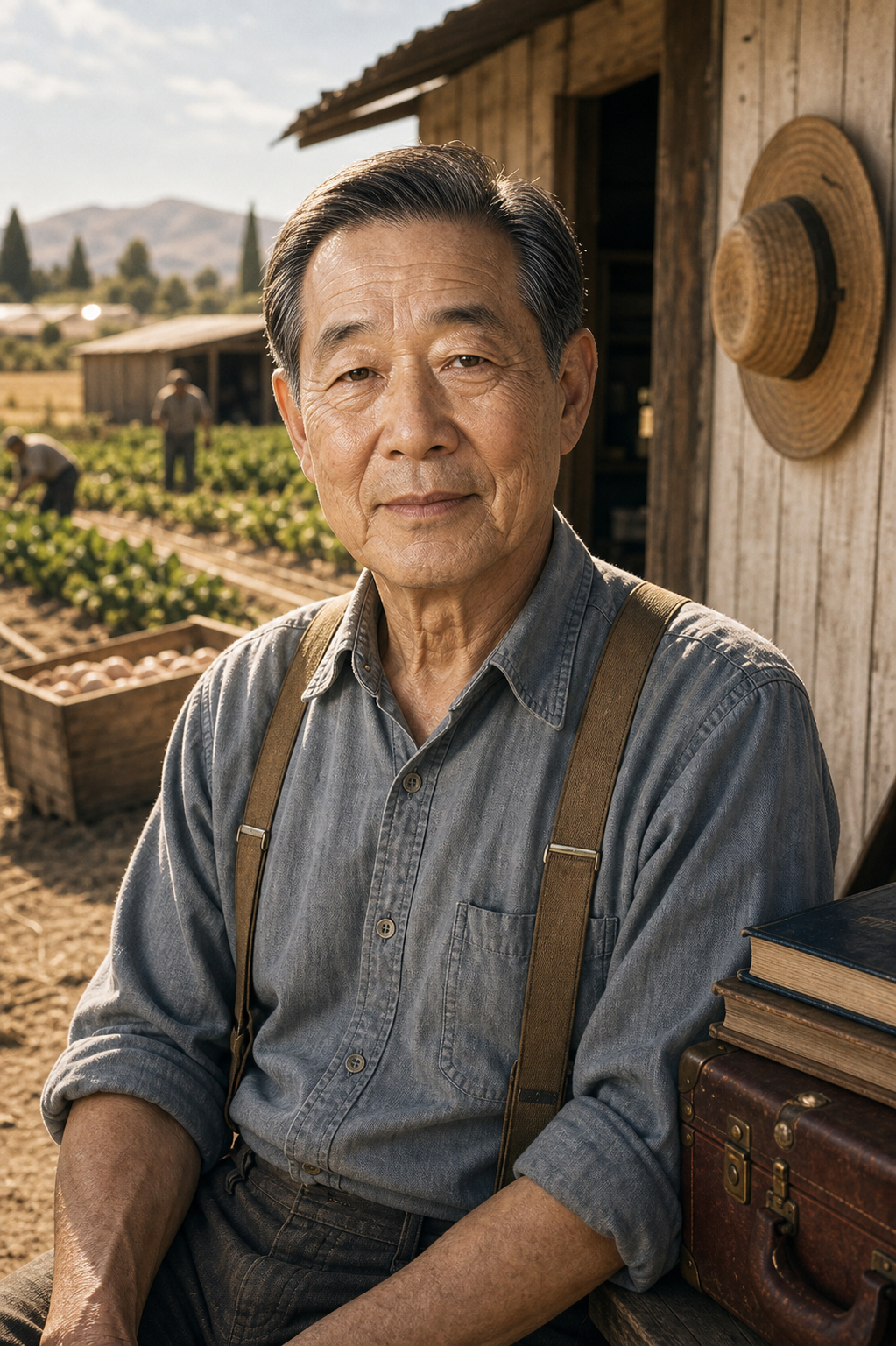
A life remembered
As a teenager, Jin Song Kim escaped Japanese-ruled Korea and entered a life of farm labor, boarding school, delayed education, business, and family in California. He came to the United States in 1916 through Shanghai, traveling as a young man with little money and no secure destination beyond the help of Korean community networks.
Speaking by telephone in 1977, Jin Song remembered the Korean National Association office, the Olive Street house in Los Angeles, tomato and citrus fields, windblown barns, the Claremont Korean boarding school, and photographs he had kept for decades. His voice is practical, humorous, and unsentimental about hardship. Lodging, school, work, and community contacts were what made survival possible.
Based on interviews held by the USC Digital Library.
1916
A Sixteen-Year-Old Leaves Korea
Jin Song Kim said he left Korea in early 1916 and reached America that October. Because Korea was under Japanese rule, he described the journey as something Koreans had to do indirectly, passing through Shanghai and using Chinese passage rather than traveling openly as Koreans.
He was about sixteen, the oldest son in a family that wanted him to find opportunity elsewhere. He did not present the departure as romantic. He was young, homesick, and aware that failure would disappoint parents who had helped pay his way.
San Francisco was his first American landing, but he stayed only briefly. The Korean National Association gave new immigrants a place of orientation, and soon a fellow traveler's connection helped bring him to Los Angeles.
The route mattered because it shows how young migrants survived before they had language, money, or family nearby. Jin Song did not step into an established immigrant neighborhood with many choices. He relied on a woman traveling to relatives, the Association's presence, and the willingness of strangers to point a boy toward the next bed, meal, or train. His independence was real, but it was never solitary. That dependence did not weaken his story; it makes it more historically exact. Early Korean America was built through relays of help, with each person carrying the next newcomer a little farther. Jin Song entered the country as a boy, but the community immediately treated his survival as a shared problem. His first period is both a migration story and a map of mutual aid.
1916-1917
The Olive Street Korean House
In Los Angeles, Jin Song found the Korean house on Olive Street, a place connected to church services and temporary lodging. For people with no family, little English, and almost no money, the house offered a bed, a stove, and a small measure of community protection.
He remembered older Koreans trying to help him, even when they had few resources themselves. His youth made work difficult to obtain, but the community's employment contacts eventually connected him to field labor.
The Olive Street memories reveal an early Korean Los Angeles built from improvised support. It was not wealthy or secure, but it gave a teenage newcomer enough shelter to begin.
That house also carried religious and political meaning. Jin Song remembered church services there, but the same rooms functioned as boarding house, kitchen, waiting room, and employment bureau. The smallness of the community meant institutions overlapped. A young man could sleep upstairs, cook downstairs, meet older workers, hear news of Korea, and learn which Korean had a job lead in another town.
For Jin Song, Olive Street also marked the beginning of American adulthood before he was ready for it. He was still a child by his own later judgment, yet he had to seek work, judge strangers, and learn the customs of older men. The house gave him a temporary family while he grew into those demands. For a teenager, that improvised shelter made the difference between arrival and abandonment. That shelter gave the newcomer enough time to become useful.
1917
Tomatoes, Citrus, and Sandstorms
Jin Song's first work included picking tomatoes near Chino and other crops in Southern California. He remembered a white boss trying to pay him half wages because he looked so young, and older Korean workers pressing for full pay if he could keep up.
He did keep up. The story became one of his markers of resolve: he watched, learned quickly, and worked hard enough to be paid like the men around him.
Other field memories were harsher. He described rough living conditions, barns without running water, isolation from town, and wind that piled sand against the door. He was homesick, but he said he did not regret coming because he had promised himself and his father that he would make it.
His crop stories are filled with sensory detail: tomatoes he had once disliked in Korea, citrus that felt like a rare luxury, grain cut for feed, cold mornings, and the dust of remote camps. They show the distance between the idea of America as opportunity and the first reality of America as stoop labor, uncertain wages, and a teenage body proving it could work like a grown man's. The older Korean workers in the fields served as teachers as well as companions. They showed him pace, technique, and how to negotiate wages when a boss tried to discount his youth. Their defense of him was practical solidarity, a field lesson in both labor and community. He learned that survival depended on speed, endurance, and older workers willing to stand beside him.
1917-1918
A Korean Boarding School in Claremont
During the winter of 1917 and into 1918, Jin Song attended a Korean boarding school in Claremont. He remembered a two-story house with rooms for Korean students, many of them newcomers, and teachers who helped them study language and adjust to American life.
Dr. Kang, whom he remembered with respect, taught grammar in a way that connected Korean and English. A woman from Pomona College also came to teach English pronunciation, giving the students daily practice in a language they needed for school and work.
The school was also a community center. Local Korean families came there, students cooked for themselves, and weekend work helped support the arrangement. Jin Song saw it as a good idea, even decades later when he was unsure what had become of the building.
His memory of Claremont is important because it complicates the picture of early Korean immigrants as only laborers. Even while students worked weekends and cooked for themselves, the purpose was education. Grammar, pronunciation, church, and boarding life formed a bridge between the Korean world they had left and the American schools and jobs they hoped to enter. Claremont also gave him time to be a student among other young Koreans rather than only a worker among adults. The memory of pronunciation lessons, shared cooking, and jokes about English names suggests a brief protected interval, one in which language learning could be awkward, communal, and even funny. The school made education communal, practical, and inseparable from work. Its rhythm joined books, chores, and weekend wages in one discipline.
1919-1935
Schooling Interrupted, Schooling Continued
Jin Song came to America intending to study, but work repeatedly interrupted that plan. He began high school in 1919 and did not graduate until 1925, moving through Dinuba and Los Angeles while supporting himself as needed.
He attended USC for about a year and studied architecture, but money and family obligations made continuation impossible. He spoke without self-pity about that loss, treating it as one of the hard facts of immigrant life.
By 1935, he was married and returned to Korea with his wife and young son for a six-month visit. Seeing his parents after nearly twenty years mattered to him, even though he had no intention of resettling there.
The return sharpened the meaning of his American life. He had left as a child under Japanese rule, struggled through work and school, and built enough stability to travel with his own family. Yet he did not imagine going back permanently. His obligations and future were now in the United States, even as the emotional debt to parents and homeland remained. His long route through high school says much about determination. Six years to graduate could sound like delay, but for Jin Song it meant persistence through interrupted semesters, jobs, moves, and money trouble. He measured success not by speed, but by the fact that he kept returning to school at all. That persistence gives his interrupted education the dignity of achievement. The delayed diploma records stamina as much as schooling.
1977
Albums, Children, and Historical Memory
In later life, Jin Song kept photographs carefully, with dates and identifications that impressed the person guiding the conversation. He understood that pictures which looked ordinary to one generation could become precious evidence for the next.
He told a moving story of sending a grandmother's photograph to a younger woman who had lost her own copy during war. That act left an empty space in his album, but he knew the image meant more to her than it could have meant remaining in his possession.
Jin Song remembered immigrant life through boarding houses, crop work, schoolrooms, wages, churches, and family albums. Jin Song's life shows how survival itself became an archive.
The modesty of his narration is part of its authority. He often interrupts himself to say a story is too long or not important enough, yet those very stories preserve the texture of early Korean America. Through Jin Song Kim, a tomato field, a boarding-school joke, a missing photograph, and an old address become evidence of how a community learned to endure. The photo albums gave those memories a physical form. They gave shape to lives that otherwise risked being dismissed as scattered labor and private hardship. Jin Song knew that a labeled photograph could connect descendants to people, schools, and friendships no official record would bother to explain. In his keeping and giving of photographs, memory became an act of care. The album preserved relationships that migration and war might otherwise scatter.