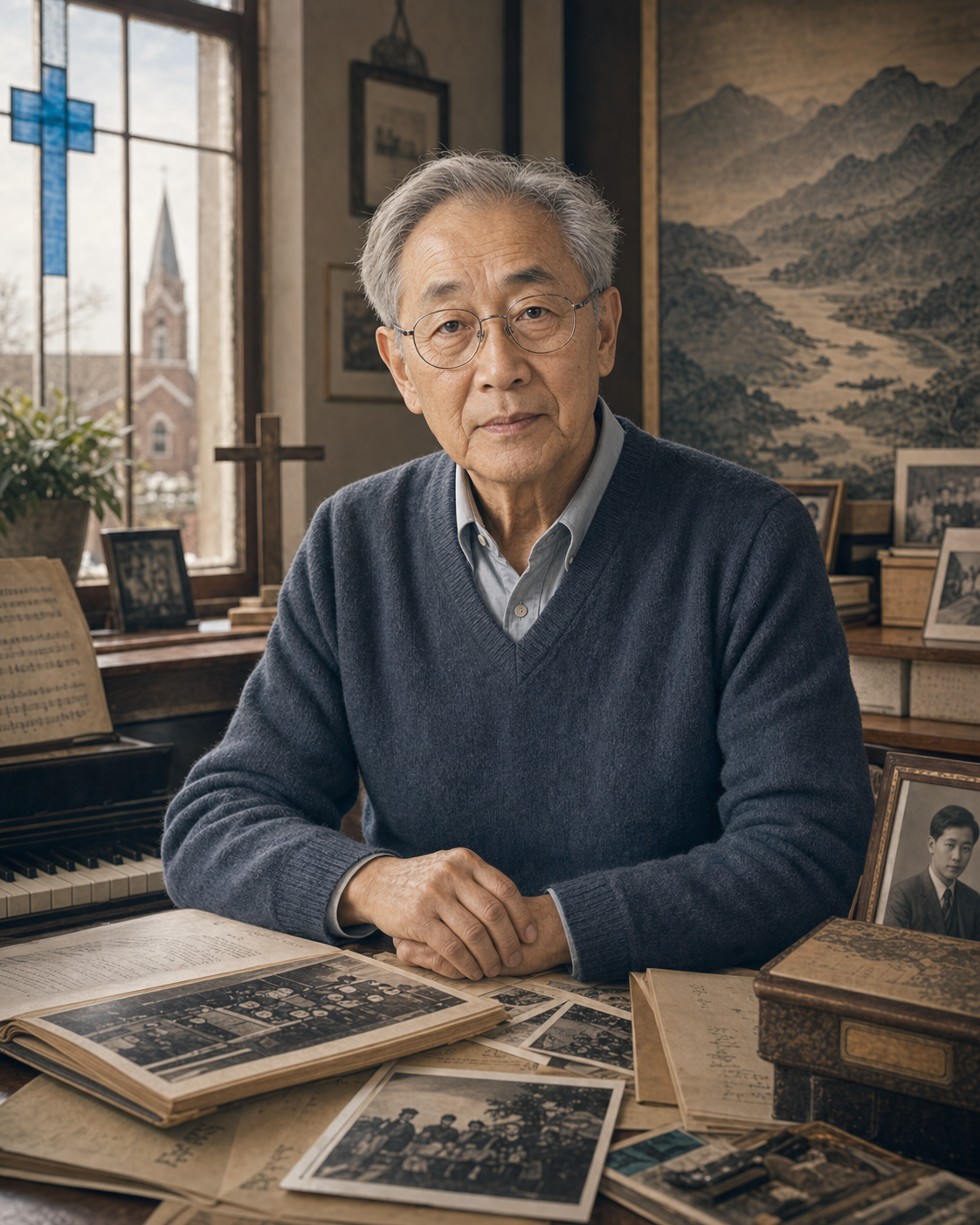
A life remembered
In Hwan Han remembered Hamhung city, an orchard in Dongcheon-myeon Daedong-ri, Seoul churches, Philadelphia, Los Angeles, and the photographs that connected those places to his family. He identified himself as born on May 1, 1914, and returned repeatedly to Hamhung as a landscape of river, mountain, apples, church work, and family separation.
Han gave a concrete account of how one Korean Christian family tried to survive colonial rule, liberation, division, and migration. Han remembered a 30,000-pyeong orchard, apple varieties and storage cellars, a father who built church and school institutions, a 1946 crossing south after Soviet occupation, arrival in the United States in 1971, and family life remade through education, music, ministry, and careful explanation of photographs.
Based on interviews held by the USC Digital Library.
Early memory
Northern Landscapes and Family Loss
Han located his childhood in Hamhung, Hamgyongnam-do, naming both Hamhung city and the family orchard outside the city in Dongcheon-myeon, Daedong-ri. He remembered the Songchon River, a mountain he called Ballyeong Mountain, the broad Hamhung plain, and a city world close enough to rural land that the family could have both an orchard house and a town residence. The places mattered because they made memory geographical, not abstract.
The orchard was one of the most specific inheritances in the interview. Han described about 30,000 pyeong of orchard land planted with apple trees when ordinary field crops could not lift rural families out of poverty. At first, older villagers laughed at the saplings and wondered when they could ever produce income; after several years the apples began to bear, and by seven or eight years the orchard economy was strong enough that the surrounding area followed the same path.
Apples became a language of home. Han named early and late varieties, including Benisaki, Iwai or Chuk, Hongok, Waegum, Gukgwang, and Samgwang, and explained how color could matter for ceremonial display even when flavor was less prized. He remembered Hamgyongnam-do as an apple region alongside Hwanghae-do in the North and Daegu in the South, and he recalled women buying apples from orchards to resell in town, an example of the hard-working local economy he associated with Hamgyong people.
Family loss enters through this same landscape. Han said his father died in 1944, the year before liberation, and he returned painfully to separation from his mother, an elder brother, and sisters after the division of the peninsula. The orchard, the brick house, the church, and the photographs were not only signs of former prosperity. They were reminders of a family world that could no longer be gathered in one place.
Seoul years
Churches, Music, and Urban Community
Church life in Han's account begins before Seoul. He remembered his father as a Presbyterian elder who served the church, built a church building with brick, and helped make education part of Christian duty. In the orchard district, Han said the only brick buildings were the church and the family house, a striking image of faith and household standing side by side in a rural place of thatched homes.
His father's Christianity was tied to public service and anti-colonial history. Han connected him to the March First Movement in Hamhung, imprisonment, an appeal to the Seoul High Court, and time in Seodaemun Prison. Afterward, Han said, his father made education the first task for Koreans: he established night classes at the church for children who had missed schooling and founded a private Hamsan kindergarten, where Han remembered himself as a first graduating student.
The church network also shaped marriage and family ties. Han named Rev. Bae Min-su as the minister who connected the families, remembering that Bae had known his father from imprisonment during the independence movement and later knew his future wife's family through Bible-school circles. Han placed his own school life at Yonhi Professional School, later Yonsei University, while his future wife studied piano at Ewha Women's Professional School, making courtship part of a larger Christian and educational network.
In Seoul, Han named congregations such as Saemoonan Church, Dongsin Church, Seoul Yongnak Church, and Namsan Methodist Church. Music stayed close to this faith world: he spoke of choirs, orchestras, piano, and his own participation as a trumpet player in a symphony orchestra. The Seoul years appear as a reconstruction of community through worship, schools, and music rather than a simple interval between North Korea and the United States.
1971
Migration to the United States
Han's migration story begins with the earlier move south. After liberation, he remembered Soviet soldiers taking the family's piano and other possessions, a loss that mattered especially because one of his sons showed unusual musical promise. He framed the decision to cross the 38th parallel as a choice to leave property behind so that his son's piano education might continue.
He dated the southward move to May 1946 and gave it a physical route. The family could still travel by train toward the Hantan River near the 38th parallel; relatives and children crossed dangerous bridges and river passages, sometimes helped by small gestures toward soldiers. Still, Han arranged for valuables packed in eight wicker trunks to move separately by a hired fishing boat from Hungnam to Gangneung, then onward by train to Seoul.
Seoul was not accidental. Han said he had bought a house before liberation in Mapo-dong, Mapo-gu, giving the family a southern foothold when escape became necessary. The move from Hamhung to Seoul combined planning, improvisation, fear, and luck: rail travel, river crossing, hired boat, relatives, children, money paid to guides, and the grief of leaving his mother and other relatives behind in the North.
The American period came later. Han stated that the family immigrated to the United States in 1971, first locating their life through Philadelphia and a Philadelphia church. He later associated Los Angeles, or Naseong, with 1979 and with organizing and serving a Korean Presbyterian congregation for six years before retirement. Philadelphia and Los Angeles appear in the interview as extensions of the same pattern: migration made survivable through church, family work, and continuity of Korean community.
Children
Education Across Generations
Education is one of the most persistent values in Han's testimony. He remembered his father's night school and kindergarten in Hamhung, his own studies at Yonhi Professional School, and his wife's piano training at Ewha Women's Professional School. These details make education a family inheritance that began before immigration and was already tied to Christian service, public responsibility, and cultural refinement.
Han took equal care with his children's education and locations. He identified children born in the North and later family life in Seoul, then followed adult children across the United States and Korea. In one family roll call he placed a first son in Lexington, Kentucky, a second son in Boston as a Boston University professor, daughters in San Jose and San Francisco, and a youngest child in Seoul.
Music gave the educational record its strongest thread. Han described a daughter connected to Ewha piano study, another path through Illinois State and Indiana University toward graduate music training, and teaching at East Carolina University. He also remembered a son-in-law who studied vocal music, specifically baritone, at USC before entering seminary and ministry. These references are not decorative; they show how the family measured discipline, talent, and continuity.
The family record also includes scholarship and professional achievement. Han recalled a son's major scholarship at Boston University and returned often to the idea that children and grandchildren should be named, placed, and connected correctly. For a family divided by war and migration, schools, churches, and professions became more than accomplishments. They were proof that the family story had continued beyond Hamhung, Seoul, Philadelphia, and Los Angeles.
Records
Photographs and Family History
The interview moves like a guided tour through photographs, and Han used each image to recover names, addresses, and scenes. A 1933 photograph led him to identify his 1914 birth year and May 1 birthday. Other images brought forward Hamhung city, the orchard house, a motorcycle, a car he associated with Japanese manufacture, the brick church, and family members whose stories could not be reconstructed from the picture alone.
The house photographs mattered because they explained the orchard economy. Han described a large brick house built by a Chinese architect, with ondol rooms inside and a cellar below used to store apples through the winter. He remembered the orchard not just as land but as a working system of fruit trees, storage, transport, income, and seasonal labor, preserved because a photograph let him point to rooms, floors, and surrounding fields.
Photographs also exposed absence. Han repeatedly noted that many pictures had been lost, that some relatives had no surviving image, and that the few remaining photographs had been copied or carried through family channels. He described a sister's son, a nephew in New Jersey, older relatives, and family members left in the North with the urgency of someone trying to keep relationships legible before memory thinned.
Some images widened the story beyond the household. Han connected photographs to performances, church people, military figures, and a White House event during the Kennedy era, though the interview moves quickly through these memories. He never treated a photograph as self-explanatory. It needed his voice to say who was present, where the scene belonged, and why the moment still mattered.
Family
Faith, Music, and a Scattered Family Made Whole in Memory
Han patiently reconstructed a family world scattered by war and migration. He gathered Hamhung's river and mountain, the 30,000-pyeong orchard, apple cellars, brick church walls, Seodaemun Prison, Yonhi and Ewha, the 1946 crossing south, Philadelphia church life, Los Angeles Presbyterian service, children's universities, and the photographs that made all of this tellable.
The strongest pattern is continuity through institutions. The family orchard answered rural poverty with agricultural experiment; the church answered colonial pressure and displacement with worship, schooling, and service; music answered loss with discipline and beauty; and migration answered danger with new communities in Seoul and the United States. Han did not present these as separate themes. In his telling, they were one moral inheritance.
His testimony also preserves the texture of Hamgyong life: apples, seafood, kimchi tastes, hard-working women, dialect differences, long travel routes through Wonsan or toward Seoul, and the feeling that Hamhung and Pyongyang once stood almost as far apart socially as countries. Those observations make the life story more than a timeline. They give students a sense of how region, class, faith, gender, and migration lived inside one family's memory.
Han practiced heritage as a responsibility to name people, places, and dates for those who came after him. Han's memories are sometimes fragmented, but the fragments are specific enough to carry: May 1, 1914; Hamhung; 1944; May 1946; Mapo-dong; 1971; Philadelphia; 1979 Los Angeles; churches; schools; music; apples. The record he leaves is both mourning and instruction, a map for descendants trying to understand where the family story began.