A life remembered
Korean independence work shaped Henry DeYoung's education, migration, diplomacy, and long separation from the country he left as a young man. He remembered departing Korea in 1904 with a Korean imperial passport, arriving in San Francisco when the Korean population in the continental United States was still very small, and finding guidance through early Korean community figures including An Chang Ho.
In Colorado Springs in 1979, Henry described Korean Commission publicity work in Washington, unofficial contact with American officials, the disappointment of international conferences, the opening created by the Cairo Declaration, his return to Korea after decades away, and later work connected to Korea's first diplomatic presence in Japan. For him, diplomacy meant offices, memoranda, lectures, long family absences, and returns that were emotionally complicated rather than purely triumphant.
Based on interviews held by the USC Digital Library.
1904
A Passport from a Vanishing Korea
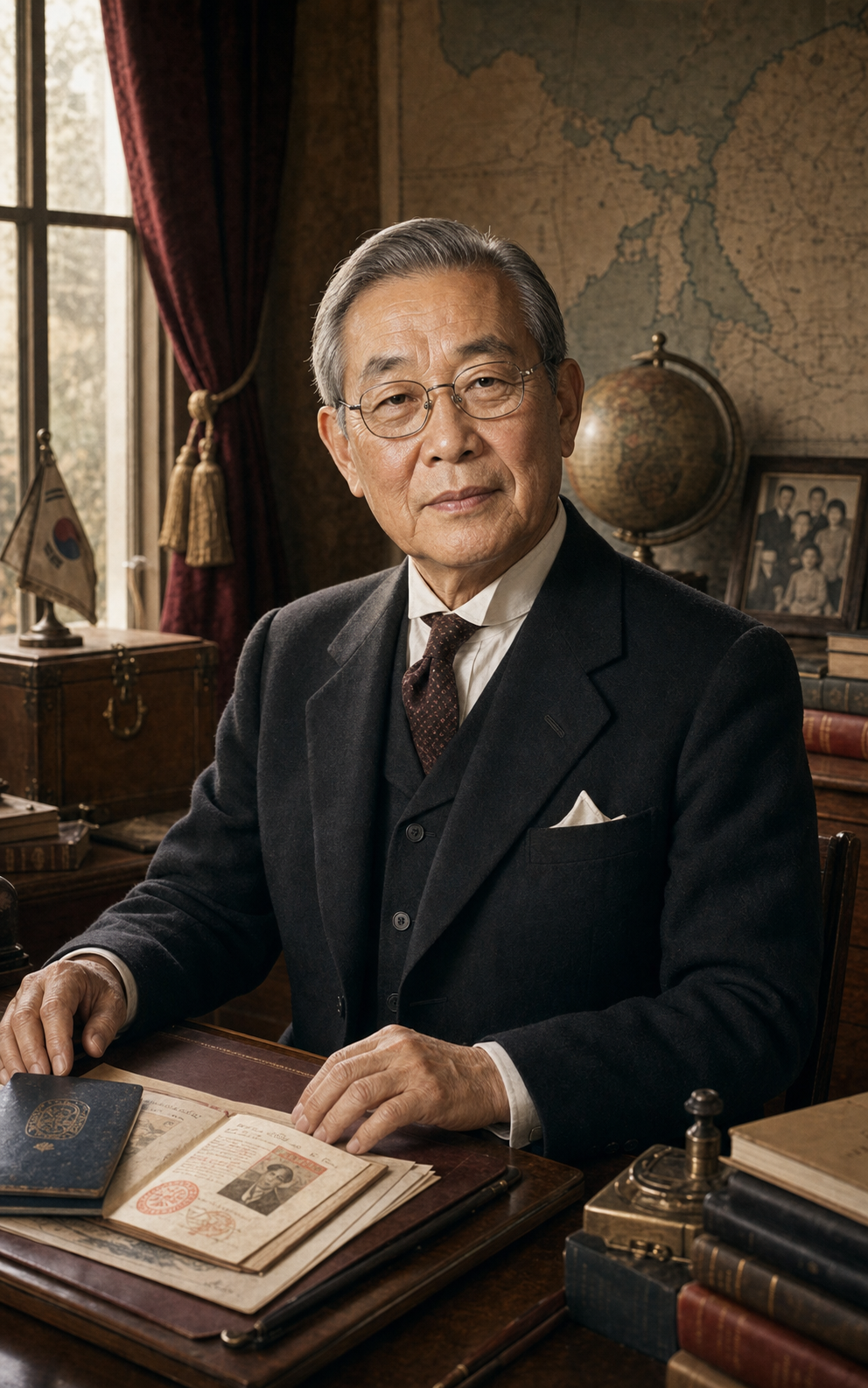
Henry DeYoung placed the beginning of his American life in 1904, during the Russo-Japanese War. He emphasized that Korea was still formally independent when he left and that his passport bore the seal of Emperor Gwangmu, a document he continued to value as a rare historical object.
His arrival in San Francisco introduced him to a small but active Korean world. He remembered only a handful of Koreans coming to meet the ship, but those men mattered: they represented restaurants, missions, employment help, and the moral infrastructure that received new arrivals.
The young Henry soon learned that migration was not simply a private decision. From the start, his education, work, and friendships were connected to the larger question of what Koreans abroad could do while Japan's power over Korea increased.
His recollection of the passport gives this opening period unusual force. It was not merely a travel paper, but proof that he had crossed the Pacific from a Korea still able to issue documents in its own name. Decades later, after annexation, war, division, and the founding of the Republic of Korea, that paper let him hold in his hands the political world that had vanished soon after he left. This also explains why his earliest American memories return so often to institutions: missions, restaurants, immigration officers, schools, and community organizers. Each institution helped transform one student traveler into a witness to the collapse and later recovery of Korean sovereignty. The passport thus becomes the story's first artifact of loss and continuity.
1900s-1910s
Schooling, Work, and Early Community
In California, Henry encountered the factional and practical life of the Korean mission community. He remembered advice from older Koreans who urged him to leave Los Angeles when an opportunity appeared, because a young student needed school and stability more than local disputes.
That opportunity took him to Nebraska, where Korean railroad connections, American host families, and school ambitions intersected. The move was physically and emotionally large for a teenager, but Henry presented it as one of the decisions that made the rest of his life possible.
He worked, studied, and tried different ways of supporting himself. The interview recalls photography, lecturing, writing, and sales work, not as a smooth career ladder but as a series of practical experiments by a Korean student trying to remain useful and independent.
The Nebraska episode also reveals the mixed networks that sustained early Korean students. Korean intermediaries found openings, American households offered room or work, and ministers or community elders advised a young man when factions or poverty threatened to stall him. Henry's later public life depended on these small acts of placement, confidence, and sponsorship, the kind of help that rarely appears in official diplomatic histories. The same pattern followed him west and east across the United States. He learned that advancement required both self-discipline and someone willing to open a door. his later service to Korea repeated what others had once done for him: interpret a need, make a connection, and help a Korean cause survive in unfamiliar territory.
1919-1920s
The Korean Commission in Washington
Henry's Washington work centered on publicity, information, and the Korean case for independence. He described gathering data, informing Koreans outside Korea, and helping American officials understand Korean conditions while Korea remained officially treated as part of Japan.
He was careful about the limits of that work. State Department contacts were unofficial, and he knew that sympathy did not equal recognition. Still, the Commission's presence allowed Koreans to keep a public office open and to speak whenever international events created even a narrow opening.
The Washington Naval Conference brought hope, then disappointment. Henry remembered that Koreans contributed money while there was a conference to address, but support declined when no immediate result followed. Maintaining a movement around an indefinite promise of freedom exhausted the people who sustained it.
He understood the emotional discipline this required. Korean activists could not honestly promise quick independence, yet they had to ask ordinary people to keep giving money, attention, and faith. Henry's language is almost administrative, but underneath it is the burden of sustaining morale when international law, American recognition, and Japanese power all worked against Korean claims.
He remembered Washington not as a place of grand speeches alone, but as a place of patient information work. The Commission had to appear respectable, accurate, and lawful while insisting that a nation officially erased from diplomatic recognition still had a living people and a legitimate claim. His Washington work made that claim legible to people who otherwise might never have encountered Korea except through Japanese or American policy language.
1920s-1930s
Learning, Lecturing, and Making a Living
After the Commission's early work ebbed, Henry moved through lectures, writing, and business efforts. He spoke frankly about the difficulty of making a living from public education about Korea in an American climate that was often uninterested in foreign struggles.
His education remained part of his public identity. He recalled American University, a commencement scene involving prominent Washington figures, and the way public ceremonies could unexpectedly place a Korean advocate near the center of American political life.
The years also asked much of his family. Henry's wife and children were often at home while his obligations took him elsewhere. In the account, his public service and domestic cost sit side by side, neither canceling the other.
His account of lectures and writing is especially revealing because it shows how far ahead of American public opinion Korean advocates often were. He found that many audiences still preferred isolation, business, and domestic concerns over distant Asian politics. To speak about Korea in that climate required persistence, but it also required translation: turning colonial rule, self-determination, and Korean suffering into terms Americans might hear.
His professional disappointments reveal the tension between public ideals and the need to support a family. Failed lectures and modest business efforts were not side stories; they show how independence workers lived between public ideals and the need for rent, food, and family stability. Henry spoke of that tension plainly, without asking the listener to sentimentalize it. That candor helps the story avoid myth while still honoring commitment.
1943-1948
Cairo, Korea, and a Return After Decades
The Cairo Declaration gave Henry what he called a first real glimpse of hope. He was teaching Korean history at the University of Washington when Korean independence work drew him back to Washington, where the old Commission was revived in a more favorable wartime atmosphere.
He described Koreans in Washington as unofficial allies after Cairo. That did not remove every limitation, but it changed the reception they received and made their arguments sound less impossible than they had in the 1920s.
In 1948 Henry returned to Korea for the first time since leaving in 1904. The return was emotionally complex: Korea had changed, the peninsula was divided, and refugees told him that close relatives in the North had died. The homeland he reached was both long desired and painfully altered.
The return also placed him inside the unsettled machinery of liberation. American military occupation, United Nations action, and the emergence of a South Korean government all appear in his memory as overlapping processes rather than a single clean transition. Henry had fought for an independent Korea from abroad; when he finally stood there, independence was real but partial, shadowed by division and the absence of the family he had hoped to find. He also understood that liberation did not restore the Korea he had left. The people who remembered his childhood world were gone or unreachable, and the political border made even mourning incomplete. His return thus joined national fulfillment to private bereavement, a difficult combination that gives the account much of its emotional weight.
1950s-1979
Diplomacy, Family, and Retrospect
Henry later helped establish Korea's diplomatic presence in Japan, accepting the assignment after Syngman Rhee urged him to go long enough to set things in motion. He remembered postwar Tokyo and Yokohama as bomb-damaged, then later rebuilt, and he understood the assignment as another duty rather than a personal ambition.
In old age, he spoke from Colorado Springs, a place he had chosen for its beauty, climate, and manageable scale. His family included sons, a daughter, and an adopted Korean orphan whom he and his wife brought over and raised.
DeYoung's public roles were only one part of his experience. It is the story of someone who lived inside the long delay between hope and recognition, who knew that independence might not come in his generation, and who kept working anyway.
His later reflections resist triumphal simplicity. He could be sharp in judgment, affectionate toward colleagues, and candid about ambition, age, and family responsibilities. His memories move from global diplomacy to the practical work of offices, lectures, memoranda, and family separation. Henry DeYoung did not remember independence work as a heroic pageant, but as offices, memoranda, travel, unpaid hopes, strained households, and the stubborn conviction that Korea's case had to remain before the world.
By the time he spoke in 1979, Henry could look back across almost the entire twentieth-century Korean independence story. His testimony links imperial Korea, immigration, exile diplomacy, wartime alliance, divided liberation, and postwar representation. Few lives in the collection span so much institutional change from such a personal vantage point. His old age reads as witness, not withdrawal.