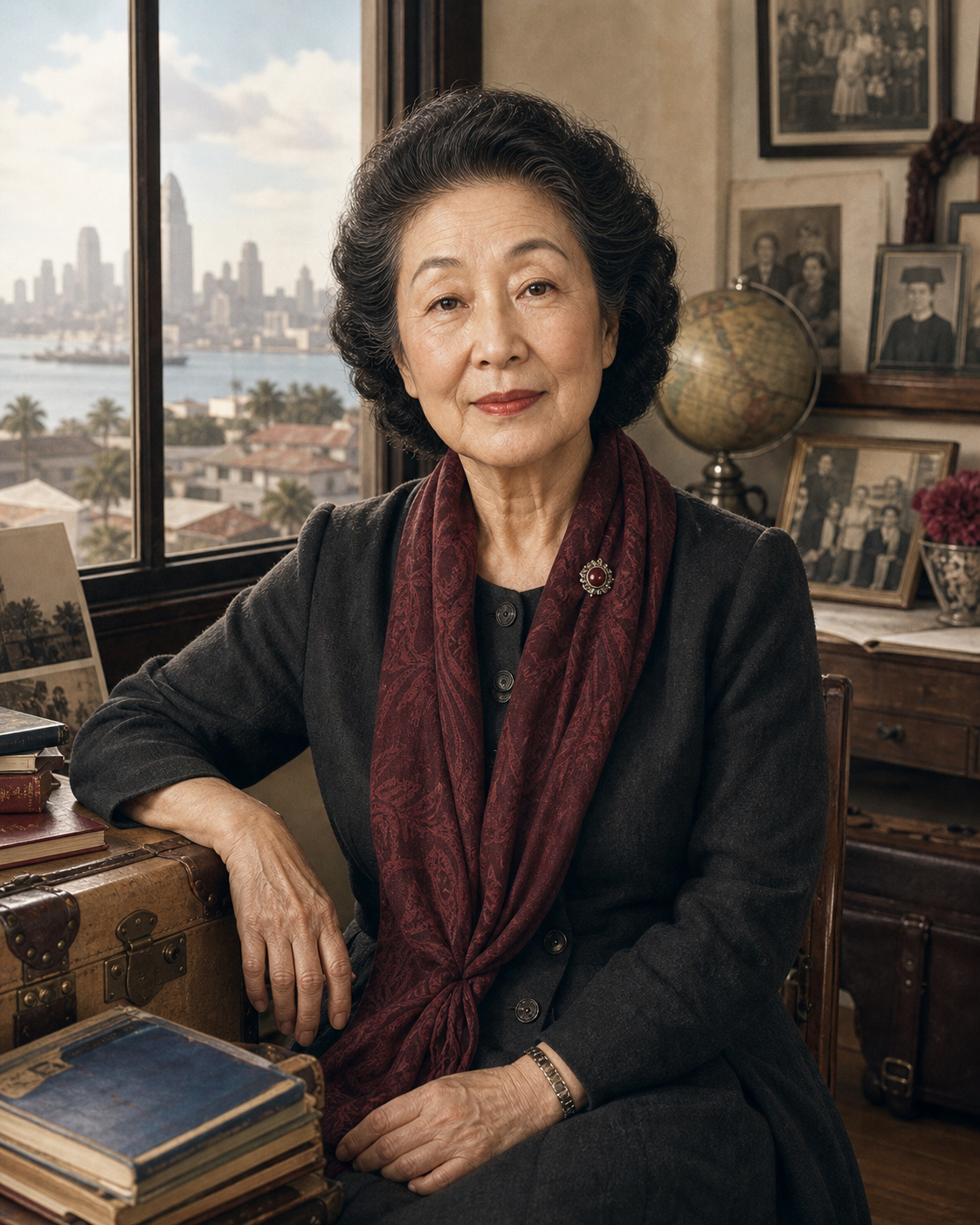
A life remembered
Born in Pyeong, Korea, in 1904, Helen Cho Paik spent the twentieth century moving through Hawaii, California, the Mountain West, and back to Southern California. Her father, Wondu Cho, had been a teacher in Korea; her mother, Hoseon Cho, worked in Hawaii and then in the migrant farm and boarding-house economy that sustained the family.
Helen's life story is marked by early responsibility. After her mother's death, she helped care for younger siblings, lived in Christian homes for Korean and Japanese children, married Peck Man Sue Paik in Wyoming at sixteen, raised children through coal camps, farms, restaurants, lumber camps, and agricultural work, and supported her family after her husband's death. She spoke bluntly about labor, loss, food, childhood institutions, and Korean movement across the West.
Based on interviews held by the USC Digital Library.
1904-1910s
From Korea to Hawaii and the Mainland
Helen Cho Paik was born in 1904 in Pyeong, Korea, on her maternal grandmother's farm. Her father, Wondu Cho, had been a teacher in Korea but saw little future in that work. He went to Hawaii, studied English, and eventually brought the family onward to the continental United States.
Helen's mother, Hoseon Cho, worked in Hawaii in fields and homes and later carried the labor of feeding families and workers across the mainland. Helen remembered her parents' lives through work more than through formal documents: teaching, studying, cooking, farming, boarding houses, and constant movement to wherever a job might be found.
The family first settled in San Francisco and then followed crops through California. Helen's earliest American memories include Redlands, San Luis Obispo, Dinuba, and other agricultural places where children played among trees, drew water from wells, and learned that a household could be packed up and moved when work required.
Because Helen was very young during the earliest moves, her life story depends on both memory and inherited family explanation. She knew her father had been educated and had wanted more than Korea or Hawaii seemed to offer, yet she mostly saw the consequences: a family that followed opportunity from place to place. Her childhood began inside adult hopes that were constantly being tested by American labor conditions. That perspective lets the story treat migration not as adventure but as a chain of adult decisions children had to inhabit. The child's memory and the adult explanation complete one another.
1910s
Childhood in Camps, Fields, and Schools
Helen's childhood was defined by movement and by the presence of Korean laborers, Chinese workers, boarding houses, and rented farms. Her father leased land and supplied men to work in crops; her mother cooked for them, rose early, prepared rice, and packed lunches. Helen remembered mosquito netting, food buckets, steamed dumplings, and the practical creativity of women feeding many people with limited resources.
Schooling was intermittent. Helen remembered crying at an early school in San Francisco until an older Korean boy was called to speak to her, and she remembered being the only Korean in class. Later she attended school in Dinuba and Los Angeles, but family illness and care for younger siblings often interrupted education.
Hardship entered early. In Redlands and farm districts she witnessed illness, fire, poverty, and the vulnerability of Korean families living in temporary quarters. When her mother became seriously ill, Helen stayed home to care for the baby and younger children. Childhood, in her account, ended not through ceremony but through necessity.
The food memories are especially important because they show Helen's mother as an innovator. Cooking for workers was not merely routine; it required planning, speed, flavor, and the ability to feed men before dawn with ingredients at hand. Helen remembered other women noticing her mother's dumplings and methods. In a world with few written records, such kitchen practices preserve women's expertise with unusual clarity. These food scenes also show how culture traveled through technique, taste, and improvisation rather than through formal celebration alone.
Teen Years
After Her Mother's Death
Helen's mother died when Helen was still young, leaving the family to reorganize around loss. Her father wanted the children to have education and care, so he sent them to Christian homes in Los Angeles and San Francisco that served Korean and Japanese children. These institutions provided schooling but also separated siblings when a young boy could not remain in a girls' setting.
The San Francisco Korean school became part of Helen's memory. She recalled Mr. Yim teaching Korean after regular school in a kindergarten room, and she remembered Korean families who invited children for meals. These memories show how community care extended beyond blood family when immigrant households were strained.
Helen did not romanticize the homes or the separations. She remembered confusion, limited choices, and children being moved because adults were trying to solve practical problems. Still, the experience connected her to a wider Korean and Japanese American child welfare world that is rarely visible in public histories.
The homes also complicate the idea of community care. They were shelters, schools, and sites of separation at once. Helen and her siblings received supervision and education, but institutional rules could divide girls from boys or move children far from their father. Her memory captures the ambiguity of help: adults were trying to protect children, yet protection still felt like displacement. That ambiguity is one reason her recollections feel so modern: help and loss often arrived together, carried by the same institution.
1920s
Marriage in a Wyoming Coal Camp
Helen married Peck Man Sue Paik in Green River, Wyoming, in 1920, when she was sixteen, though the marriage certificate recorded her as older. She remembered that she had said no to other men but could not say no to Peck. The ceremony itself was improvised because no minister was available, so a justice of the peace came from his garden in work clothes to marry them.
The couple lived in Superior, Wyoming, where Peck had a camp connected to coal-mine labor and boarding arrangements. Helen's early married life included children, camp life, and a measure of protection when others cooked or sent food while she was pregnant. Her first child, Pearl, was born soon after the marriage.
Wyoming and Colorado also brought farm experiments, turnips, coal work, boarding houses, and contact with other Korean families. Helen remembered Mrs. Han, Mrs. Park, Mrs. Shin, and Korean children who toured as performers. The Korean families she remembered were scattered across mining towns, farms, and small businesses far from California's better-known communities.
Helen's account of marriage is striking because she neither romanticizes nor condemns it in simple terms. The age difference, the improvised courthouse ceremony, and her statement that she could not say no all belong to a world where young women had limited power. Yet married life also gave her a household, children, and a role within Korean camp networks. Her life story holds both realities together. That balance is crucial for reading her life respectfully, neither judging the past too simply nor ignoring the constraints she named.
1930s-1950s
Restaurants, Camps, and Widowhood
The family's search for work took Helen through New Mexico, lumber camps, Colorado, and back to farming. In Gallup, New Mexico, the family ran or worked in a restaurant that served mostly American food and stayed open long hours. Business was difficult, and a prohibition-era incident led to bankruptcy and her father's time working around a jail setting as a cook.
Helen repeatedly became the person who held family life together. She helped cook for large crews, cared for children, worked where necessary, and watched siblings and relatives face illness and death. The account includes painful memories of a brother's death and of family members scattered by work, disease, and poverty.
Her husband later worked in camps and farms, including in Colorado, Utah, and near Fresno. When he became ill with cancer and died, Helen was forty-eight. She moved back to Whittier because her sister Rose was there, bringing children with her and beginning another stage of work and support.
Wherever the family landed, Helen cooked for dozens, watched children, handled night shifts, and held households together through illness, arrest, and debt. Relatives came to rely on her because she kept taking responsibility when no one else could.
Later Life
Whittier Work and a Full Life
In Whittier, Helen worked in a laundry, then for Ernie's vegetable market, and later in hardware and department-store jobs. She retired near eighty, after decades of paid labor that followed decades of unpaid family responsibility. Her later life included children, grandchildren, great-grandchildren, and a plainspoken sense that she had lived fully.
The account's power lies in its detail. Helen remembered shoes bought for fifty cents, potato-flour cake, cantaloupes packed into a car, Harvey House girls in Gallup, coal-camp boarding houses, and Korean teachers in San Francisco. These details do not decorate the story; they are the evidence of how Korean immigrant families survived.
Helen Cho Paik recounted hardship without turning it into a sentimental tale. She endured migration, maternal loss, institutional care, early marriage, widowhood, work, and old age with a voice that remained direct and observant. Her oral history enlarges Korean American history by showing its camps, kitchens, orphan homes, small towns, and women who kept families alive.
Her later work in Whittier continued the family duties she had carried for decades. Laundry, market, hardware, and department-store jobs all drew on the same endurance she had practiced since childhood. By the time she described taking life easy, the phrase carried irony and relief. She had earned quietness through decades of movement, caregiving, widowhood, and paid labor. Her full life, as she called it, was full not because it was easy, but because she had passed through so many kinds of responsibility.