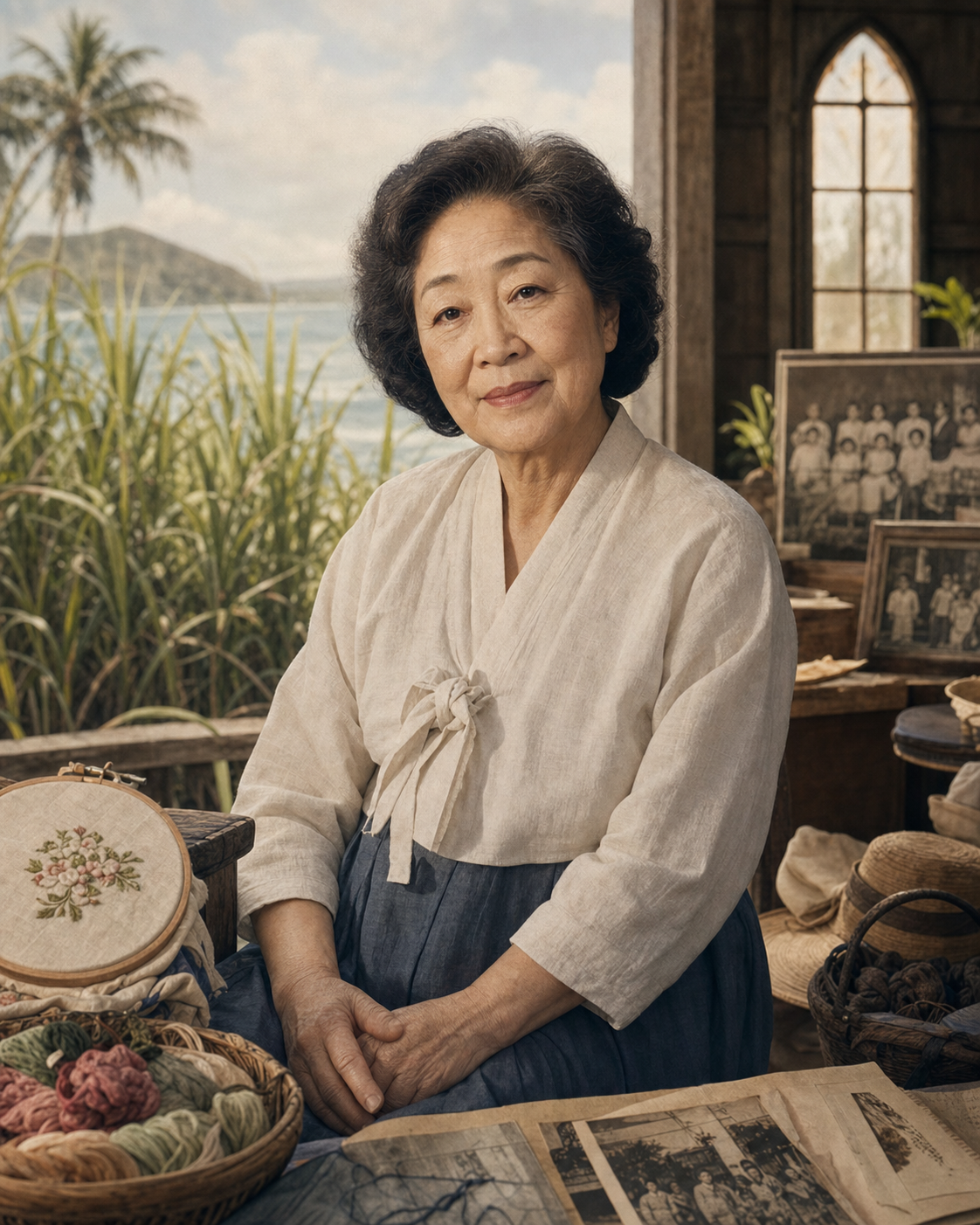
A life remembered
Around ninety years old, Hei Won Kang could still describe the first shock of Hawaii in concrete detail when she began recalling her life in 1975. She said she came to Hawaii in 1905 with her mother, brother, and sister while her father remained in Korea, because her mother believed the children could be educated in America and someday bring honor and help back to the family.
The story that follows is not a simple migration success tale. Kang remembered Maui's Kipahulu plantation, Native Hawaiian church members who welcomed frightened Korean newcomers, baptism and a new Christian community, Honolulu and Ewa plantation labor, laundry and sewing for cash, an unfulfilled hope for schooling, marriage in the Korean church world, farm work around sugar beets and vegetables, children born into scarcity, women's independence organizing in 1919, handwork in old age, and a fierce wish that Korean American women remember their own history.
Based on interviews held by the USC Digital Library.
Early migration
Across the Pacific for a Future
Kang began with a family decision. Her father stayed in Korea, but her mother brought the children to Hawaii, telling the father that she would educate them and make them a source of pride. Kang remembered arriving without money and soon learning that America would not simply provide schooling. The family's hope for education met a plantation economy that treated newcomers first as labor.
She came with her mother, a brother, and a sister. In later recollection she described a brother who became known for technical ability in Hawaii, including electrical work, and she named another family member as Dr. Kang. Those references show the educational dream that had pulled the family across the Pacific, but Kang's own youth was spent largely in work rather than study.
The family first went to Maui's Kipahulu plantation. Kang said they had not understood that they were being brought as laborers. Her mother and younger family members were too vulnerable or too young for full plantation work, while the family tried to survive in a place with few Koreans and unfamiliar language, food, and social rules.
From the beginning, gender shaped the burden. Kang's mother had made the migration decision, and Kang herself had to turn that decision into daily life: cooking, cleaning, caring for family, learning whom to trust, and trying to hold onto the promise that there might still be schooling somewhere beyond the field.
Plantation years
Hawaii, Labor, and the Shock of Reality
Kang's Hawaii was specific: Kipahulu on Maui, then Honolulu, then the Ewa plantation community where many Koreans lived. On Maui, Native Hawaiian church people invited the Korean newcomers to worship. Kang remembered being afraid of the men and of people she did not understand, but a church woman reassured her that they loved her and meant no harm. That welcome became one of the first bridges into a new world.
The church also changed her identity. She remembered being baptized there and being given or called by an English Christian name, while her Korean name, Hye Won or Hei Won, was pronounced in several ways by others. The point was not only a name change; baptism gave an isolated young immigrant a community that saw her as more than a plantation hand.
A pastor and church-connected people argued that the family should not be left simply as field laborers and helped send them to Honolulu. From there they moved into the Ewa plantation orbit, where Kang remembered perhaps fifty or sixty Koreans and people from familiar hometown networks. Her mother and other women did laundry, repaired clothing, and sewed; Kang bought a sewing machine and remembered earning twenty-five cents for sewing a shirt, with extra work for missing buttons.
The material world of plantation life remained hard. The family lived in a one-room plantation house, cooked over wood, sometimes cooked outside, fetched fuel, and made money through small services. Kang tried to pursue schooling, but tuition at a Hawaii seminary was remembered as fifty dollars a year, beyond what she could manage. For roughly nine years in Hawaii before marriage, she lived with the ache of wanting education and being unable to afford it.
Community
Church, Baptism, and Belonging
Christian community was not a decorative part of Kang's story; it organized the practical world around her. The church on Maui welcomed her family, a pastor helped move them away from plantation confinement, and Korean church networks later shaped marriage, work, and public life. Faith gave Kang a language of endurance, but it also gave her contacts, witnesses, and advocates.
Her marriage grew out of that community world rather than a private romance. A Korean man connected through friends and church circles had been in Korea and returned without the wife he had expected to bring; a trusted acquaintance proposed Kang, partly because she wanted a way to continue life and perhaps study. Her mother objected that he was older by eleven years and had little money, but Kang concluded that going with him might still make education and a future possible.
The wedding, as she remembered it, was officiated by a minister and witnessed by Korean community women, including women from the Yang Ju-won and Kang circles. Kang was frank that love was not the language of the arrangement at first; respect, survival, and the hope of a workable life mattered more. That honesty makes the marriage account historically valuable.
After marriage, the family moved through farm labor. Kang described work connected to onions, sugar beets, and vegetables, a later farm disaster caused by heavy rain and flooding, and the birth of her first son around 1914. When workers scattered and money ran out, other people pooled what they could so she could give birth. The church and community networks did not erase hardship, but they kept people from being entirely alone.
1910s-1920s
Women, Patriotism, and Organizing
Kang's most public memories concern Korean patriotic organizing. She spoke of organizing a women's patriotic association in 1919 and named branches or connected groups in places such as San Francisco, Denver, Los Angeles, Sacramento, and Mexico. She described herself not as a spectator but as someone who helped pull scattered women's groups into a shared structure.
The work was financial as well as symbolic. Kang remembered women sending money to the Korean independence movement, including funds for the Shanghai Provisional Government and the Independence Newspaper. She recalled amounts in the hundreds and thousands of won, emphasizing how large such gifts were when farm labor could be paid by the hour at only fifteen or twenty cents.
Her political memory is also a record of disagreement. She recalled debates over leaders, branches, and who had the right to speak for Korean women. She did not romanticize the organizations as perfectly united. Instead, she remembered the practical difficulty of gathering people, keeping accounts, sending notices, selling publications, and persuading women whose household burdens were already heavy.
Kang understood this work as history that needed to be preserved. She spoke of the Shinhan Minbo, Korean National Association circles, women's branch records, photographs, lists, and the need for Korean and English documentation. In old age she wanted women's patriotic labor recorded in books, not lost as a few remembered names.
Later life
Children, Education, and Handwork
Children brought Kang both pride and regret. She said her eldest son could not attend college because the family had no money, while other children and relatives found paths into medicine, technical work, music, art, and professional life. Kang spoke of Dr. Kang, a son or family member associated with electrical work in Hawaii, and of children who understood Korean even when English dominated their adult households.
Kang measured education as a family achievement rather than an individual credential. The sacrifices of plantation work, sewing, farm labor, and child care were linked to the later possibilities of children and grandchildren. She also remained candid about intermarriage, divorce, language loss, and the awkwardness of speaking Korean when an English-speaking daughter-in-law was present. Korean identity, for her, could survive even when Korean speech weakened.
Her later handwork became another form of self-presentation. She talked about making, drawing, and small crafted objects; the person asking the questions compared the work to an exhibition or even a one-woman show and urged the family to save it. Kang's response was practical, but the exchange shows that her old-age creativity was visible to others as more than a pastime.
Old age also brought new living arrangements. Kang was described as living in a secure building near Japantown, high enough to look out from a balcony, with alarms and safety systems that reassured her children. That setting matters because it frames her as an elder still negotiating independence, family concern, safety, and memory in Los Angeles.
Later Years
An Elder's Public Memory
Hei Won Kang insisted on holding together memories that ranged across work, faith, family, and public life. She was a child migrant, plantation worker, baptized Christian, would-be student, wife, mother, farm laborer, patriotic organizer, maker, and elder. None of those roles alone explains her; together they show how Korean American women's lives crossed domestic, religious, political, and artistic worlds.
Her testimony also preserves a geography of early Korean America: Maui's Kipahulu plantation, Honolulu, Ewa plantation, farms tied to sugar beets and vegetables, Los Angeles, San Francisco, Denver, Sacramento, Mexico, and the imagined Korea for which women raised money. These places make the life story larger than one household while keeping the household at the center.
Kang's late-life comments about history are especially important. She worried that records would be scattered, that younger people would not know what women had done, and that Korean materials should be kept and translated. Her concern was archival before it was academic: names, photographs, association papers, and women's branch work had to be saved because otherwise no one would believe the labor had happened.
She did not sentimentalize hardship, and she did not pretend community work was free of conflict. But she remembered welcome from strangers, courage from women with little money, children who carried pieces of Korea forward, and the obligation to leave a record. Her memories join personal experience to the community work she wanted recorded.