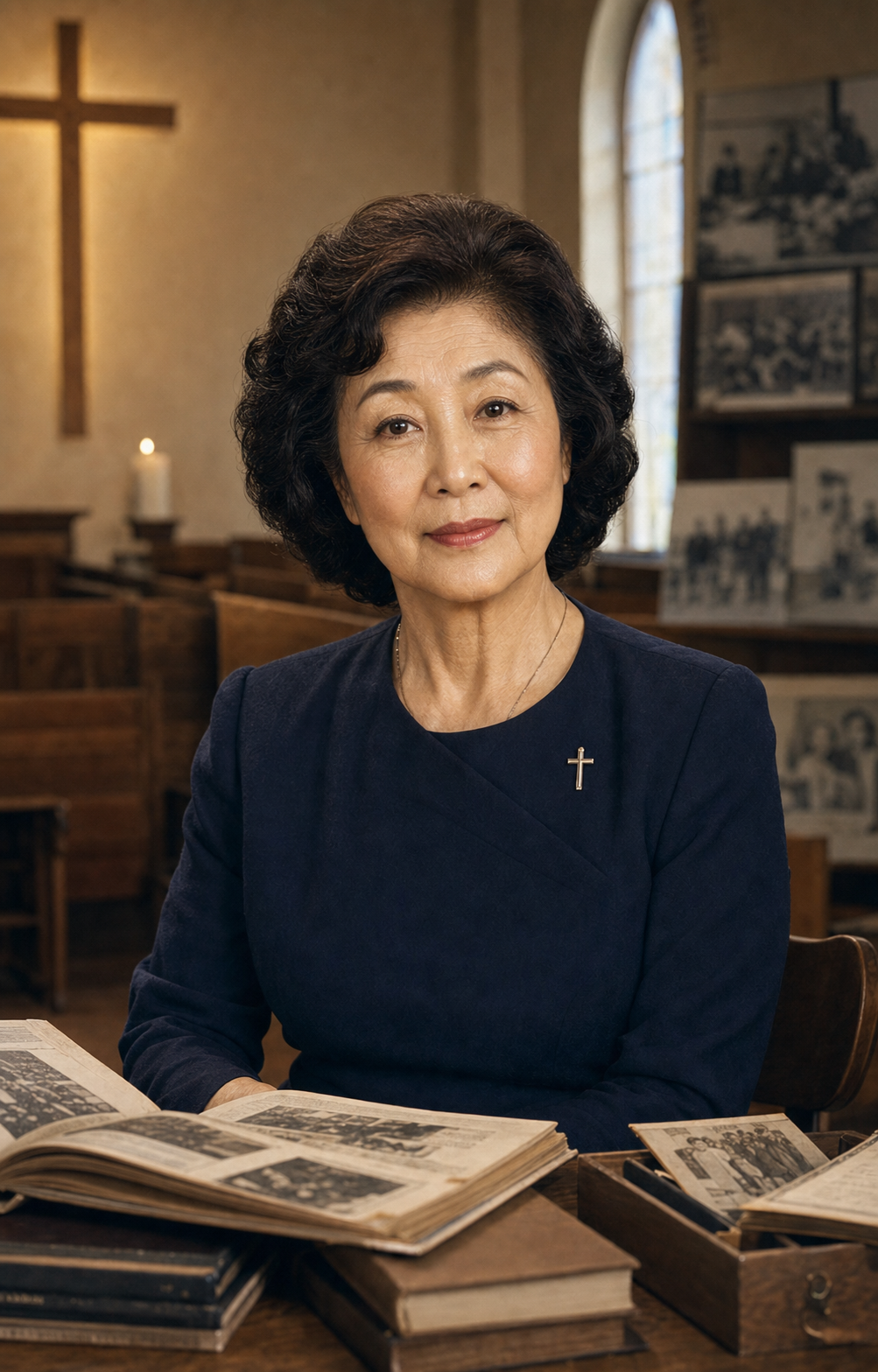
A life remembered
When Hei Kyung Chung spoke in Los Angeles on July 29, 1972, she returned to the church disputes, fundraising, property, and women's labor she believed others had misremembered. Speaking in Korean, she corrected institutional memory, recalled names, factions, fundraising, property purchases, Presbyterian and Methodist disputes, and the way small groups of immigrants struggled to make lasting religious institutions with very little money.
Her own story appears through that community history: arrival through Hawaii and the mainland, orange work, hospital work, tailoring or dry-cleaning labor, small business, children, and later Los Angeles life. She insisted that history begin with the people who had done the work, not only those currently in charge. She remembered the people who organized Bible meetings, raised money, sold food, bought buildings, argued over pastors, and made Korean American communal life possible.
Based on interviews held by the USC Digital Library.
1972
Correcting the Record
Hei Kyung Chung began the account by challenging simplified accounts of Korean church history in Los Angeles. She objected to the way later leaders treated their own arrival as the beginning of history. For her, the past had to include earlier meetings, earlier sacrifices, and the people whose names were being forgotten.
Her tone is sharp because the stakes were personal and communal. She remembered who gathered, who counted as members, who belonged to which faction, and how families and friends could be counted or miscounted during church disputes. She insisted that the people who had done the work should not be left out.
Rather than offering a smooth autobiography, Hei Kyung Chung described institutional formation from inside the arguments. She appears as a witness, organizer, worker, and keeper of difficult communal memory.
Hei Kyung Chung tracked events that minutes, plaques, or anniversary booklets might simplify. She knew which claims sounded inflated and which omissions felt insulting. Her speech is sometimes heated because she believed the way events were remembered determined whose labor counted.
1900s-1910s
Hawaii, the Mainland, and Early Work
It appears that Hei Kyung Chung's early migration story moved through Hawaii and then the mainland in the early twentieth century, though exact dates are difficult to confirm from the interview. She referred to Hawaii, plantation or field labor, and later mainland work connected to oranges and other jobs. Like many Korean immigrants of her generation, her path was shaped by labor before institutions could become stable.
She also recalled years of hospital work and later business activity. The account mentions tailoring, machines, dry cleaning, pressing, and skilled work that required long hours and technical care. These details show the economic foundation beneath community service: churches and associations were supported by people who worked exhausting jobs.
Her story belongs to the immigrant generation that moved from contract labor and agricultural work into urban service, repair, cleaning, and small business. Hei Kyung Chung remembered this not as a ladder of easy progress, but as labor that demanded stamina, thrift, and willingness to sacrifice.
Her references to work are scattered, but together they suggest a life in which earning and serving were inseparable. Wages from fields, hospitals, tailoring, cleaning, or shops helped sustain families, but they also made donations, church rent, and community projects possible. In early Korean Los Angeles, institutional life did not float above labor. It was financed by pressed clothes, cooked food, saved coins, and women who kept accounts in memory. The same hands that earned wages also prepared food, organized rooms, and turned private exhaustion into public infrastructure. That economics of faith runs beneath the whole account.
1920s
Presbyterians, Methodists, and Self-Governed Faith
A major portion of the account concerns the formation, division, and reorganization of Korean Protestant congregations. Hei Kyung Chung described Bible gatherings that grew into church efforts, disputes over whether groups were Presbyterian or Methodist, and periods when members operated independently because no stable arrangement satisfied everyone.
She remembered pastors, elders, deacons, and laypeople by name or role, and she described how small membership counts could be distorted by including relatives, children, and friends. For her, numbers mattered because they determined authority and legitimacy. A congregation of forty or fifty people could be pulled apart by disputes over leadership and denominational identity.
The story also shows how immigrant churches were never only religious. They were places for language, reputation, moral judgment, youth activity, fundraising, and connection to Korea. To debate a church was to debate the structure of Korean American community itself.
Factional conflict carried an emotional cost. People who had worshiped together became opponents over pastors, denominational labels, or accusations about moral standing. Hei Kyung Chung showed how fragile a small community became when every disagreement touched friendship, money, reputation, and faith, while also preserving lay judgment rather than only clerical authority.
1920s-1930s
Money, Buildings, and Public Trust
Hei Kyung Chung returned repeatedly to money because money revealed trust. She remembered fundraising for church work, disaster relief, and property purchases, including sums that were large for the time. She also remembered uncertainty when money was sent away and receipts or confirmations did not return.
Property was another source of struggle. She described buying houses or church spaces, arranging deposits, negotiating with limited funds, and trying to create buildings that could serve worship, students, clubs, music practice, games, and wider community life. Her imagined church was not only a sanctuary but a common institution.
These details make the account unusually concrete. It records the infrastructure of community formation: deposits, pianos sold, food prepared for fundraisers, rooms rented by the hour, and arguments over who had the right to use a space. Hei Kyung Chung understood that ideals needed walls, kitchens, instruments, and money.
Food fundraising appears as one of the most concrete forms of women's leadership. She remembered dumpling soup, cold noodles, and other foods sold to raise money, turning domestic skill into institutional support. Food sales and kitchen work rarely received the same recognition as pastoral leadership, yet they were indispensable to keeping the institution open. In her telling, a building was never merely real estate; it was proof that scattered immigrants could create a place of their own. She remembered ledgers and kitchens together because both belonged to the work.
Midcentury
Business, Children, and Racial Lessons
The latter part of the account moves through work, children, and small-business life. Hei Kyung Chung spoke about shops, prices, supplies, customers, and the practical intelligence needed to survive in business. She remembered long hours and the problem of balancing family responsibility with earning enough to live.
She also discussed discrimination in business and daily life. Customers might hesitate to buy from Asian-owned stores, yet they returned when goods were clean and service was courteous. Her response to prejudice was direct, sometimes confrontational, and shaped by a strong sense that Koreans had contributed to American life and deserved respect.
Children and youth appear as a recurring concern. She wanted church spaces and community institutions that could serve students, give them activities, and keep them connected. Her vision of community was intergenerational: adults worked and argued, but the point was to leave something usable for young people.
Her comments on race were equally direct. She understood that Asian shopkeepers could be treated as inferior even by customers who depended on their cleanliness, courtesy, and reliable goods. She argued back, linking Korean dignity to labor, wartime contribution, and the broader struggles of minorities in America.
Later Years
A Keeper of Uncomfortable History
Hei Kyung Chung did not polish institutional conflict into a celebration. She remembered conflicts, accusations, missing money, personal pride, denominational maneuvering, and the exhaustion of people trying to make a church survive. Her testimony insists that community history includes friction as well as achievement.
Her anger was inseparable from deep commitment. She cared enough to remember names, dates, sums, buildings, and arguments decades later. The anger in her account is inseparable from loyalty; she wanted the community's foundations to be described truthfully because people had paid for them with work and sacrifice.
As a community historian from below, she preserved the lived mechanics of Korean American religious life in Los Angeles: who gathered, who cooked, who donated, who left, who returned, and who kept asking for the record to be corrected.
Hei Kyung Chung remembered the inconvenient parts, asked who paid and who left, and challenged later versions that sounded too neat. She did not smooth over institutional conflict: she watched, remembered, objected, and left behind an account that still argues.