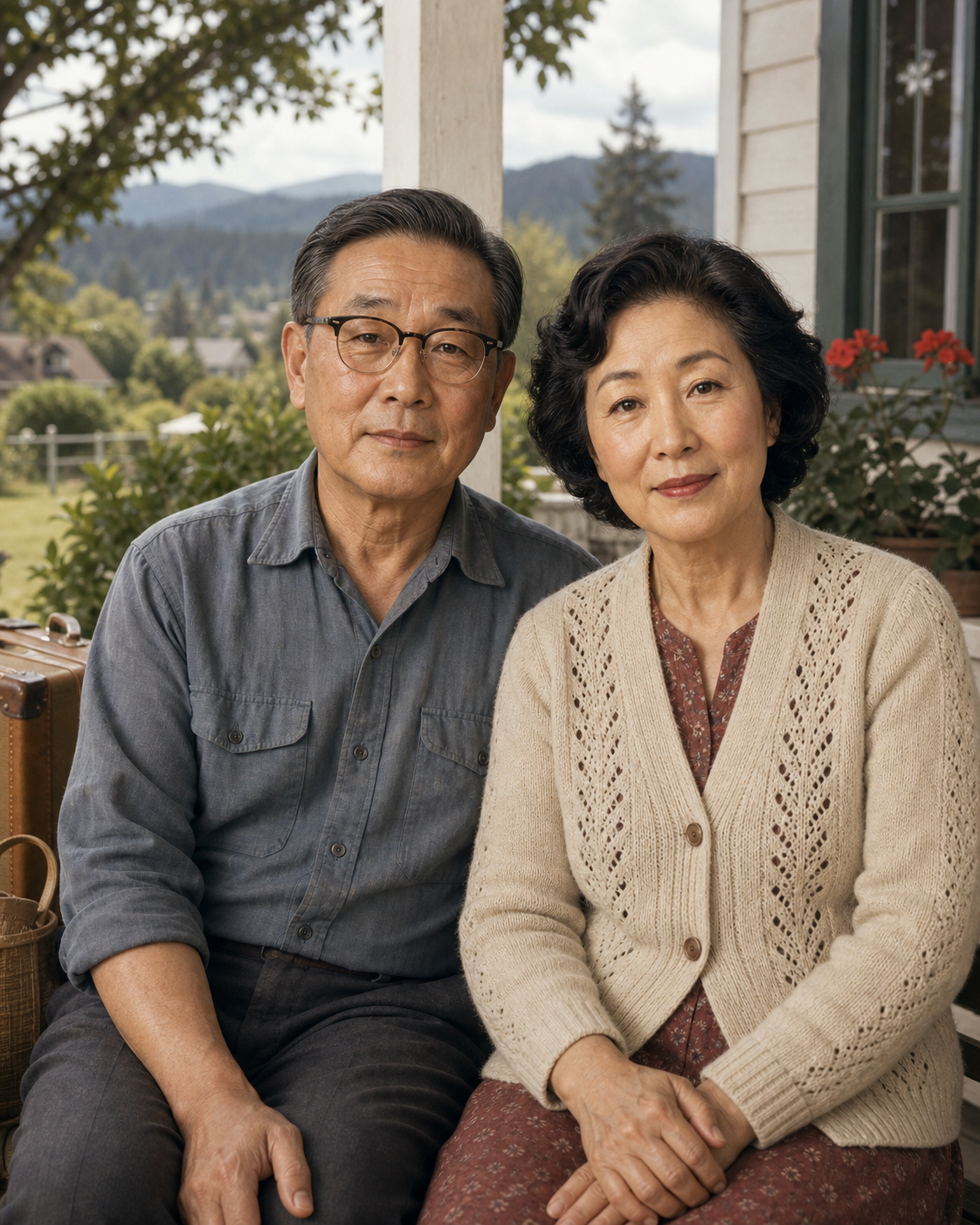
A life remembered
Two Korean diasporic journeys met in Oregon after World War II when Harry Park and Rak Soon Lee Park began their life together. Harry was born in Fairview, Oregon, on July 24, 1918, and grew up farming in Oregon and Eagle, Idaho after his mother's early death. Rak Soon, known as Rocky, came from Korea to study at the University of Portland and entered a Korean American farm community whose language, customs, and prejudices she had to learn as an adult immigrant.
Their shared life story centers on farming, marriage, children, land, and the gradual growth from small crops to nursery work. Harry remembered strawberries, cantaloupes, onions, cattle, kerosene lamps, school exclusion, and the loss of a brother in World War II. Rocky remembered arriving with limited English, Korean gatherings, August Fifteenth picnics, and the challenge of interpreting American social life. Together they built a family and a farm near Portland that became a long-term home.
Based on interviews held by the USC Digital Library.
1918-1930s
Harry's Farm Childhood
Harry Park was born in Fairview, Oregon, a few miles outside Portland. His father, Kyung Soo Park, had come from Korea by way of the early Korean migration routes, though Harry was not certain of every step. Harry's earliest memories were shaped less by stories of Korea than by work on rented land, rough farming, and a father who seemed always to be laboring.
Harry's mother died when he was seven, and the family moved to Eagle, Idaho, near Boise, where relatives offered some connection. He remembered very little of his mother's face, only a faint scene of her holding a child. After her death, his father carried the burden of cooking, farming, parenting, and keeping the children together.
The Idaho farm world was small and demanding. The family grew strawberries, cantaloupes, tomatoes, onions, potatoes, and other crops, with children working after school and on days when other children might have played. Harry remembered a house without electricity at first, kerosene lamps, shared bedrooms, and the excitement when his father wired the house himself.
The father's labor gave the children stability but also narrowed childhood leisure. Harry remembered his father converting an old sedan into a farm vehicle, cooking noon meals, and working after the children returned to school. Those images are intimate because they show invention under constraint. A widowed immigrant farmer did not have spare systems around him; he made tools, meals, and routines by hand. That practical inventiveness became one of Harry's deepest inheritances, more remembered than speeches about ambition or identity.
School Years
Work, Basketball, and Exclusion
Harry attended grade school and high school in Eagle, where the combined school population was small enough that participation depended on available bodies. He played basketball, and his sisters played as well, sometimes doing better than he did. School offered moments of pleasure, but farm work remained the constant routine around it.
He also remembered racial exclusion clearly. At a school outing, he was not allowed into an indoor swimming pool because he was Asian or considered nonwhite. In grade school basketball, a teacher may have wanted to take him to games, but travel limits and prejudice left him behind when other children were chosen.
Harry later saw a change after World War II, especially when nieces became visible leaders in school as editor of the paper or cheerleaders. To him, those achievements marked a transition. The prejudice he had known in childhood did not disappear entirely, but the social climate for the next generation seemed less closed.
The exclusions were especially painful because they occurred inside ordinary childhood activities. Swimming, basketball travel, and school outings were supposed to be neutral pleasures, yet they taught Harry where racial boundaries lay. He did not present himself as embittered, but he remembered the rules precisely. That precision gives his testimony weight: prejudice was not abstract; it decided whether a child could enter a pool or ride with a team. Remembering those exclusions also helped him measure change when his children and nieces entered schools with more visible confidence.
1940s
War Loss and a Move Back to Oregon
World War II divided the Park siblings' paths. Two of Harry's brothers served, and one, Jackson, was killed over Italy as a navigator or bombardier. Harry stayed home with his father to continue farming, a responsibility that kept the household economy going while others were in service.
In the late 1940s, Harry and his father sold land in Idaho and moved back to Oregon, buying land near Gresham and Portland. They wanted cooler weather, a different farming future, and more contact with Korean people than isolated Idaho had allowed. Around Portland, they found a small but meaningful Korean community of several families.
The Oregon farm began with cattle and berries and later changed over time. Harry described the process without drama: look for land, judge what could be afforded, work it, and adapt. That practical approach would become the foundation for his married life with Rocky.
Jackson's death placed the war inside the family even for those who stayed on the farm. Harry did not dramatize his father's grief, perhaps because grief in that household was often private and folded back into work. The farm still had to run, crops still had to be handled, and younger siblings still needed support. In that silence, the cost of military service becomes visible in what the family could not stop doing. The restraint of that memory makes it more powerful, because the absence of dramatic language mirrors the household's return to necessary labor. It also explains why the later Oregon farm carried so much emotional weight.
1949-1951
Rocky at the University of Portland
Rak Soon Lee, known as Rocky, came to Oregon as a student at the University of Portland. She had relatives or family friends in the Gresham area and entered the Korean American social world through visits, picnics, and special gatherings. In 1949, when she first met Harry, she spoke very little English and often did not know what people around her were saying.
Rocky's memories add another layer to the story because she had grown up in Korea under Japanese rule. She graduated high school in 1945, just before liberation, and remembered classrooms that included Japanese girls. Her experience of difference in the United States was filtered through language, foreign-student status, and the shock of learning how race worked in America.
Harry and Rocky met repeatedly at Korean gatherings, including August Fifteenth events and community picnics. Harry was not a graceful dancer, and Rocky remembered discovering that Americans were not automatically good at everything she imagined. Courtship developed slowly across language gaps, family visits, and shared Korean community occasions.
Rocky's presence changes the account's perspective from second-generation farm childhood to postwar Korean student migration. She entered an American Korean community that looked familiar in ancestry but unfamiliar in language, humor, and daily custom. Her memories of sitting through conversations she could not understand show the loneliness of arrival. Yet community gatherings also gave her a path into belonging, one picnic and family visit at a time. Her perspective shows a Korean America continually renewed by new arrivals, generations, and languages.
1951-1960s
Marriage, Children, and a Growing Farm
Harry and Rocky married in 1951 and built their household on the farm. At first the farmhouse was small, with only two bedrooms and Harry's father still living with them. As children arrived, the house and farm had to grow around the needs of three generations.
Their children were Rodney, born in 1954; Joyce, born in 1956; Douglas, born in 1959; and Thomas, born in 1963. The family later built a larger farmhouse on the same land. Their children moved into professions and studies that reflected the expanded opportunities Harry had noticed after the war: design, dentistry, engineering, and other fields.
The farm also changed. Harry described moving from berries, cattle, and general crops toward nursery plants and specialized growing. What had begun as small-scale farming became a more complex operation, with tractors, plant stock, and a business shaped by decades of accumulated knowledge.
Their marriage joined two kinds of Korean experience: Harry's rural American upbringing and Rocky's education in Korea under Japanese rule. On the farm, those experiences became practical partnership. She learned the rhythms of a household built around land, while he gained a spouse who brought Korean language, memory, and a different understanding of national history. Their children inherited both the farm's demands and a broader Korean identity. The partnership gave the family a bridge between memory of Korea and the very local demands of Oregon soil, weather, schools, and markets. Their household made those worlds practical rather than symbolic.
Family
Land as Memory
For Harry, land carried memory because every field marked work done by hand. He remembered hoeing, hand-picking strawberries, cooking at noon, missing baseball games because work could not stop, and feeling pity for draft animals that needed rest. His later preference for tractor work came from a lifetime of knowing what manual farming demanded.
For Rocky, community memory centered on Korean gatherings in Oregon: March First, August Fifteenth, Christmas parties, and the older first-generation farmers who remained deeply attached to Korea. Without a full Korean church nearby, Rocky maintained Korean identity through neighbors, family events, food, and national commemorations.
Together, Harry Park and Rak Soon Lee Park described how they made a Korean American farm family in the Pacific Northwest. It honors a widowed father's labor, a son's endurance, a student immigrant's adjustment, and a marriage that turned small acreage into home. They built their lives around land, children, and the patient work of staying.
The nursery business gives the story a forward-looking ending. Plants require patience, propagation, timing, and care across seasons, all qualities already present in Harry's life. The move from hand-picked berries to a more developed nursery operation mirrors the family's own movement from subsistence struggle toward rootedness. Land remained work, but it also became inheritance, a place where children and memory could gather. the farm was never only acreage; it was the place where grief, immigration, marriage, work, and children became one story.