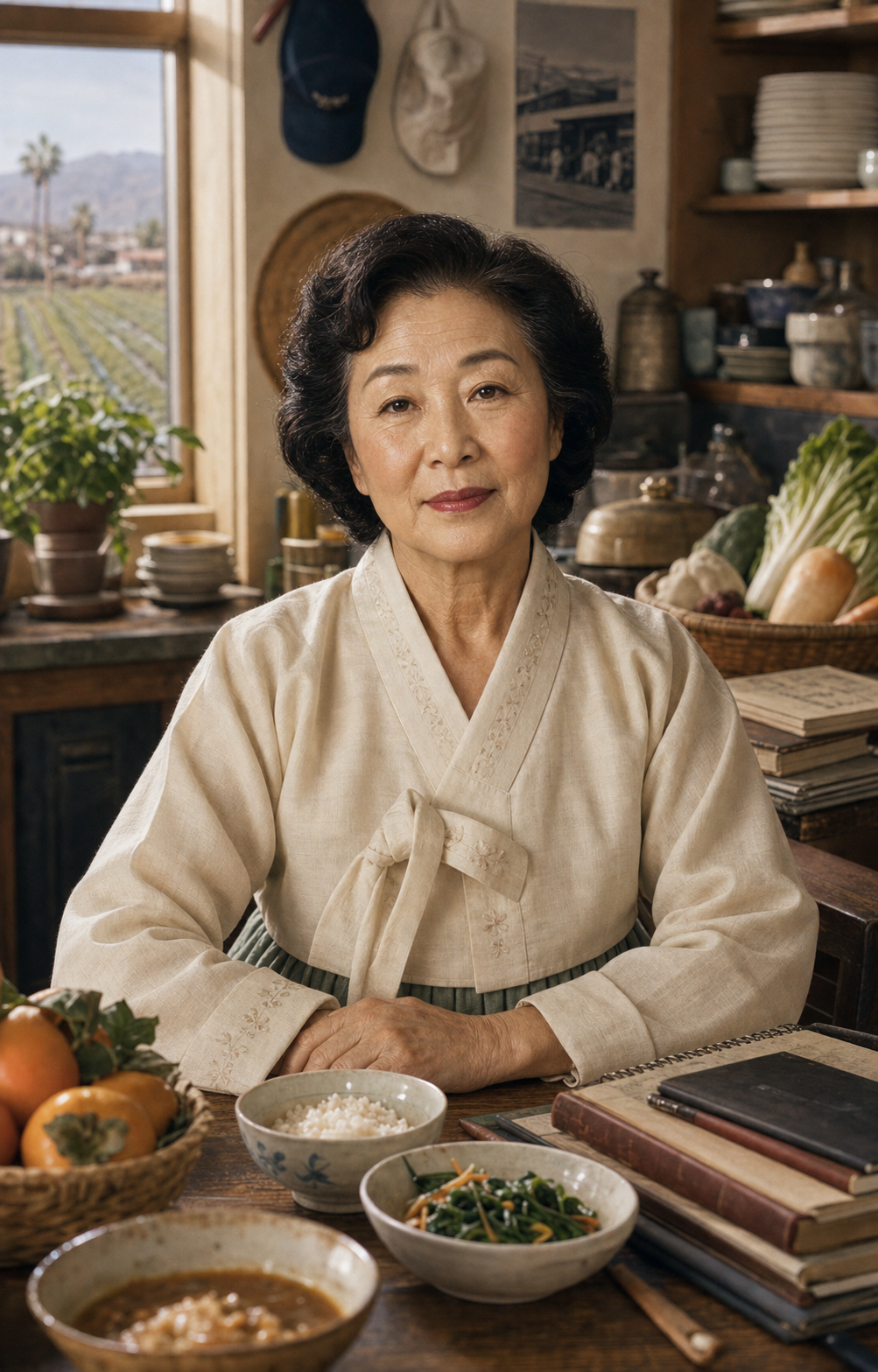
A life remembered
Gloria Kim Hahn left a northern Korean village and built a life through Hawaii, California farm districts, Midwestern restaurant work, and extended-family responsibility. Born in 1901 near Pyongyang, she came across the Pacific as a small child with her parents and grandmother during the Korean labor migration to Hawaiian sugar plantations. Her memories preserve the texture of early immigrant movement: San Francisco, Seattle, railroad work, seasonal farm labor, and the search for communities where Korean families could work, worship, and survive.
Gloria remembered childhood through loneliness, resourcefulness, delayed schooling, and the heavy expectations placed on the eldest daughter after her mother's early death. Her story moves through Sunnyvale, Watsonville, Manteca, Lincoln, Kansas City, Topeka, Cincinnati, and Chicago, carrying both intimate family detail and a broader history of Korean American adaptation. The account is especially valuable for its candid account of gender expectations, courtship, work, caregiving, business risk, and the small Korean networks that turned boarding houses, churches, restaurants, and family kitchens into places of continuity.
Based on interviews held by the USC Digital Library.
1901-1906
From Northern Korea to Hawaii and the Mainland
Gloria (Kim) Hahn was born in 1901 in a rural northern Korean setting she remembered as near Pyongyang. Her family background was agricultural, and the older generation spoke of leaving Korea during a period of economic pressure, uncertainty, and recruitment for labor abroad. She was too young to remember the departure clearly and reconstructed the journey from fragments repeated by her parents and grandmother.
The family went first to Hawaii around 1903, part of the early Korean labor migration to the sugar plantations. Gloria remembered the plantation years through family stories of severe labor conditions, long hours, little freedom, and a sense that the promise of opportunity had been far harsher than expected. When the family's obligation there ended, they moved on rather than remaining in the plantation system.
Their mainland life began through San Francisco and then Seattle, where one of Gloria's younger sisters was born. The family did not stay long in any one place. Safety concerns, language barriers, the need for work, and the search for other Koreans pushed them from city to city and job to job. The family later returned to San Francisco and also spent time around railroad and farm work.
Gloria's earliest memories follow a chain of moves rather than a single migration. Her parents and grandmother carried a child from Korea to Hawaii, then into the uncertain world of the American West. The details are sometimes approximate, as childhood memory and family memory overlap, but that uncertainty is part of the historical texture. Her family relied on partial information, informal networks, and a willingness to move whenever work disappeared.
1910s
Loss, Grandmother, and the Eldest Daughter's Work
A turning point came when Gloria's mother died in Mountain View after a brief illness, when Gloria was still a child. She remembered the family's effort to obtain medical help, the movement from farm space into town, and the funeral that followed. Her mother's death left the household reorganized around her father, grandmother, and the children.
The youngest child, Helen, was still an infant, and the family made the painful decision to place her with another Korean couple who wanted a child. Gloria later described this as one of the family's most tender and complicated memories. She understood the practical pressures behind it, while also remembering how deeply the separation affected the children who remained.
After her mother's death, Gloria's grandmother became the central authority in the home. Gloria's account is frank about a household shaped by older Korean hierarchies, with strong devotion to the son and different expectations for girls and boys. As the eldest daughter, Gloria sewed, helped with younger siblings, took on household tasks, and learned early that family survival depended on her labor.
Her childhood was not only burden. She remembered herself as active, curious, and sometimes daring, a girl who climbed trees, explored farm spaces, and took on tasks adults might have expected from a son. She also remembered loneliness, especially in isolated farm settings with few playmates. Those memories give the story its emotional center: a child carrying adult responsibility while still finding moments of freedom in fields, schoolyards, and the edges of small towns.
1910s
Sunnyvale, Watsonville, and Manteca
Gloria's family moved through California farm districts including Sunnyvale, Watsonville, and Manteca. In Sunnyvale they lived among a cluster of Korean families working land on shares, with simple housing, improvised interiors, shared yards, and constant concern over water, crops, and fairness. She remembered picking tomatoes, watching other laborers in the fields, and seeing how easily cooperation among families could be strained by scarcity.
Schooling came late and irregularly because the family had moved so often and lived far from schools. Gloria began formal schooling after her mother's death and later felt embarrassed by being older than classmates. Still, she remained attached to school. One teacher, Nellie Stone, stood out as a figure of kindness and refinement, and Gloria remembered a San Francisco World's Fair visit connected to that teacher as an exceptional moment of beauty and possibility.
Manteca brought a larger Korean setting. The same families who had followed farm opportunities gathered again, and there were enough Koreans for church meetings, prayer gatherings, and community activity. Gloria's family ran a boarding house for Korean workers, while her father helped men find seasonal jobs in sugar beets, tomatoes, grapes, and other crops. The boarding house became both an economic strategy and a social crossroads.
Teenage social life remained tightly supervised. Gloria remembered choir practice, church functions, occasional movies, trips to Stockton, and the careful separation of young women from men. Because there were few Korean girls and many bachelor laborers, marriage talk and community attention could surround young women quickly. Her Manteca memories show a small Korean America in motion: devout, practical, watchful, and always balancing opportunity with reputation.
Teen Years
Courtship, School, and Choosing Jason
Gloria met Jason Han Chang Ho through the boarding house world, where young Korean men passed through for work, meals, and lodging. She was still a teenager and had other possible suitors, but she remembered Jason as unusually cultivated in manner and speech. His background and personal history made the relationship complicated, and her family did not see him as the secure match they wanted for her.
Her grandmother preferred a husband chosen through family approval, background investigation, and practical considerations. Gloria wanted some voice in the matter. The tension between those views runs through the account: an older immigrant household trying to protect reputation and survival, and a young woman trying to understand affection, compatibility, and choice under strict social rules.
The courtship became secretive, involving letters, intermediaries, post office arrangements, and a photograph episode that drew family and community scrutiny. Gloria spoke candidly about the shame, gossip, and harsh discipline that followed. The incident hardened rather than erased her attachment to Jason, partly because opposition made her feel more isolated from her own household.
After her grandmother's death, Gloria's father softened enough to allow an engagement, but tension soon returned over money, authority, and Jason's expected obligations to the family. Gloria eventually left home with Jason, carrying belongings in an improvised bundle and stepping into an uncertain future. Her account does not present the decision as simple rebellion. It was a young woman's attempt to move from a household governed by duty into a marriage she had chosen, even when the path was risky.
1920s
Lincoln, Kansas City, and Family Responsibility
Gloria and Jason went to Lincoln, Nebraska, where she hoped to continue school before settling fully into marriage. They had little money, no established Korean circle, and few guarantees. Jason found work connected to a fraternity house, and Gloria tried to keep schooling within reach even as married life, pregnancy, and household demands began to overtake her plans.
Their first son, Richard, was born during this period, and Gloria later returned to finish school after an interruption. Her father, siblings, and others eventually followed them to Nebraska, turning the couple's private start into another extended family household. Together they tried a restaurant venture, first with an existing waffle-shop model and then with a more ambitious chop suey cafe. The change proved costly, and the business failed within months.
The restaurant story is one of the liveliest parts of the oral history because it captures ambition, improvisation, and inexperience at once. Gloria worked while pregnant, sewed uniforms, helped with service, and watched family members learn under pressure. The episode reveals how immigrant families often entered food work not because they had abundant capital or training, but because restaurants seemed like one of the few available routes toward independence.
From Lincoln the family moved to Kansas City, where Jason pursued restaurant and food-service work and Gloria's extended family began to separate into nearby households. Her father developed serious heart problems, and Gloria became the person called on for hospital decisions, interpretation, food, and care. Near the end of his life, he expressed regret over past harshness and unfairness toward her. That late reconciliation gives this period a quiet emotional weight: the eldest daughter who had carried so much also became the one who steadied the family at the bedside.
1920s-1930s
Restaurants, Depression, and Chicago
After Kansas City, the family moved to Topeka when a Korean salesman connected Jason with a cooking job. The work was useful, but Gloria remembered the loneliness of places with few Koreans. Their household also became a stopping place for traveling Korean salesmen and acquaintances, a reminder that scattered immigrants often depended on one another's kitchens and spare rooms as informal community infrastructure.
The Hahns then moved to Cincinnati, where there were more Koreans and more possibility for family and business life. Richard began school there, younger children were born, and Gloria's siblings moved into their own adult lives. The family again tried to make stability through restaurant work, but the Great Depression shook that world. By 1929 and 1930, bankruptcy and job loss forced another round of movement.
A brief move connected to work in West Virginia collapsed almost immediately when the job disappeared. With very little money, Gloria, Jason, their children, and their belongings drove on to Chicago, where Korean networks and restaurant work offered another chance. They began in modest lodgings, piecing together income through short shifts, waiting tables, cooking, and related food businesses before later finding stronger footing.
Gloria's later account of Chicago suggests resilience without romance. The family endured crowded rooms, unstable work, failed partnerships, and constant calculation, yet she remembered the details with humor, precision, and a practical eye. Her oral history turns domestic labor, restaurant labor, and family care into historical evidence. It shows how Korean American life was built not only by public leaders and institutions, but by women who cooked, sewed, interpreted, nursed, remembered, and kept families moving when each new city had to become home.