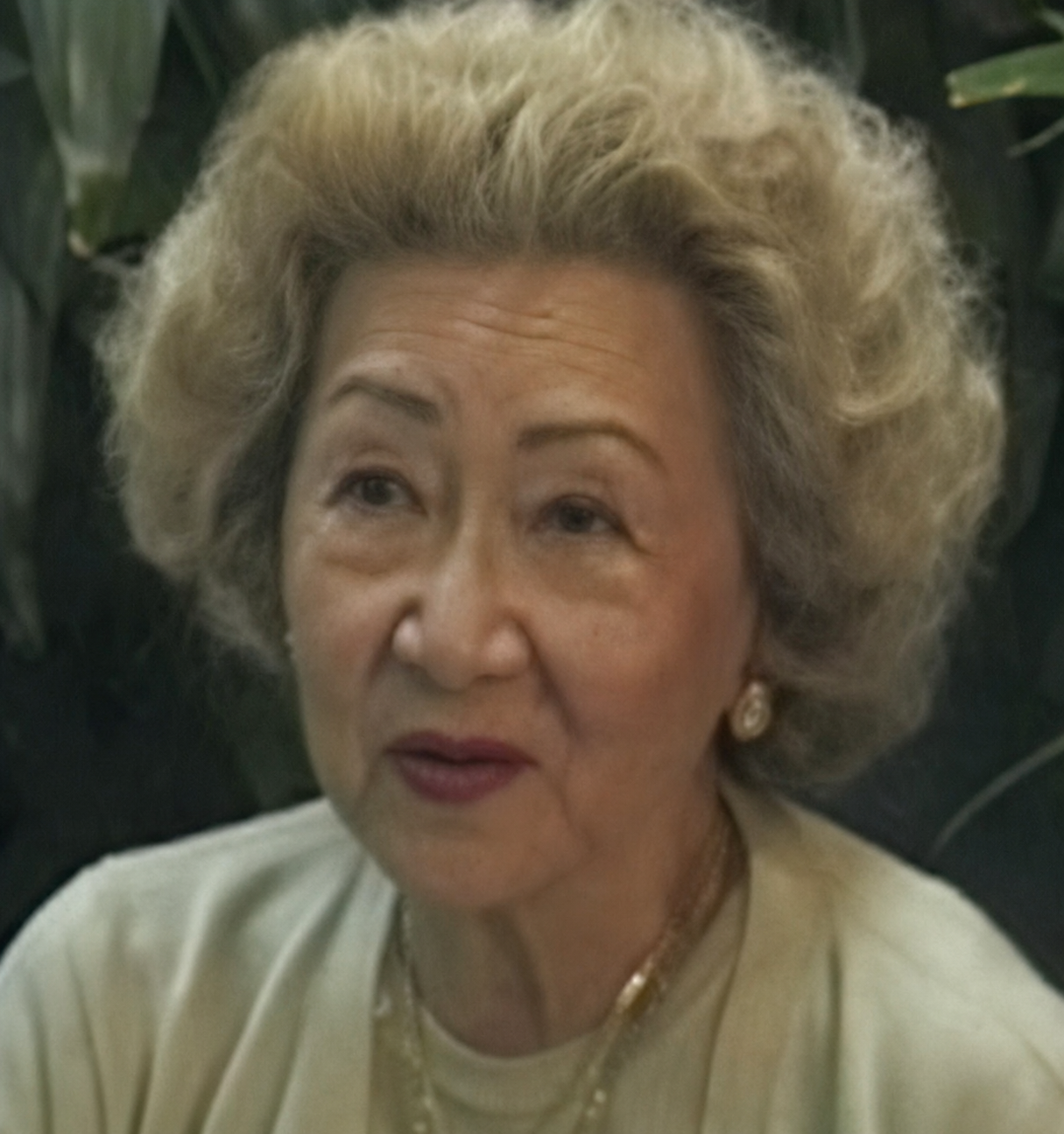
A life remembered
Florence Ahn pursued music from Honolulu and Los Angeles to New York, Havana, Seattle, Las Vegas, and the touring stage. Born in Honolulu in November 1919 to Won Kiu Ahn and Chung Song Lee, she grew up in a Korean Methodist household where church, Korean language school, YWCA cultural programs, piano lessons, dance, and recitals made performance feel ordinary before it became a profession.
Florence met each new constraint with confidence. Florence studied at Los Angeles City College and Juilliard, sang for Korean independence gatherings, married, raised children, supported two sons as a working singer, found nightclub and radio work in New York and Cuba, and later appeared with Flower Drum Song. She spoke frankly about racial ceilings, stage exoticism, family responsibility, and the courage her mother gave her to keep going.
Based on interviews held by the USC Digital Library.
1919-1930s
A Musical Childhood in Honolulu
Florence Ahn was born in Honolulu in November 1919, the first child in a family that eventually included sisters and a brother. Her father, Won Kiu Ahn, had come from Korea to Hawaii in 1903, worked briefly in plantation labor, and then built businesses that included a grocery store, tailoring, and food production. Her mother, Chung Song Lee, came from Korea in 1919 through a marriage arranged with the help of Reverend Sun Hyun.
The Ahn household centered on the Korean Methodist Church on Fourth Street and on Korean language school, where Florence's mother taught. The children were told to study hard, finish college, and use their education for Korea. Florence remembered a home filled with Korean culture, piano, clothing, brass objects, dances, and community events, even as Depression losses forced the family to move and adapt.
Performance entered early. Florence sang in school, plays, contests, recitals, and YWCA cultural programs where Korean songs and dances were presented to broader audiences. As a child in Hawaii she did not yet understand how difficult a professional career would be for an Asian woman; she simply knew that music, theater, and voice belonged to her.
Her parents showed Florence how reinvention could work. Her father moved from plantation labor into business, and her mother, educated through Korean Christian networks, became a teacher, organizer, speaker, and later real estate worker. Their household was ambitious but not secure; Depression losses changed its circumstances. Florence absorbed both sides of that inheritance: cultural confidence and the knowledge that talent still had to earn its way.
Late 1930s
Los Angeles and a Wider Musical World
Florence first came to Los Angeles with ambition and partial opportunities, including study at Los Angeles City College and voice lessons. In Los Angeles she encountered musicians who knew orchestral scores, opera, and concert life in ways that expanded her sense of what training required. Hollywood Bowl concerts and friendships with serious young musicians made her realize that natural talent was only the beginning.
Los Angeles also changed her understanding of race. In Hawaii, she recalled, she had not been made constantly conscious of being Asian. On the mainland she saw Japanese American college graduates confined to fruit stands and began to understand the ceilings placed above Asian Americans, including artists.
That awakening did not stop her. She returned to Honolulu, gave concerts, and then decided to go to New York to audition for Juilliard. The decision echoed her mother's own history of leaving home for education: a daughter repeating, in musical form, a Korean woman's refusal to let family expectation be the edge of the world.
The mainland also taught Florence that art could be narrowed by other people's imaginations. She saw how Asian performers were expected to appear charming, quaint, or exotic, and how educated Asian Americans were denied ordinary professional openings. Rather than retreat, she studied more seriously. Los Angeles became the city where she first recognized prejudice as structure, not just personal rudeness, and where she prepared to test that structure with training. This mattered for a singer because the stage was not exempt from those limits; it could reproduce them with applause, contracts, costumes, and billing.
1940s
Juilliard, Marriage, and Wartime Korea Work
Florence was admitted to Juilliard's graduate school, where she studied voice, languages, acting, movement, and the discipline of professional music. She remembered individualized lessons, competitive standards, practice rooms, and the exhaustion of young musicians working intensely toward mastery. For a Korean American singer, Juilliard offered both prestige and proof.
In New York she met Kun Sung Ree, a Korean student connected to Harvard, at International House. Their relationship began awkwardly but became marriage. During World War II they moved through San Francisco and Los Angeles as his language skills and political commitments connected him to wartime information and intelligence work.
Florence also sang for Korean political and community events, including gatherings associated with Syngman Rhee. She did not always agree with his politics, but she described singing for the Korean cause because the larger struggle mattered. Music, in those years, was both art and public service.
The wartime years also placed Florence inside a circle of Korean intellectuals, students, activists, and military-linked workers. She was not a politician, but her voice moved through political rooms. Singing arias and Korean songs for Korean causes gave her a public role that drew on family patriotism from Honolulu. the conservatory-trained singer and the Korean Methodist daughter were never fully separate people. The account makes that combination feel natural rather than contradictory, because Florence had been taught from childhood that talent should serve more than the self.
1949-1953
Supporting Her Sons Through Song
After her marriage faltered, Florence returned to New York in 1949 with two young sons to support. She found agents, auditions, and nightclub work in a city full of excellent singers. Her difference as an Asian soprano could be used by employers as novelty, but she also turned that visibility into wages, singing popular and classical material in hotels and clubs.
Her career took her to Cuba, where she sang in theaters, nightclubs, and radio programs in Havana before the Castro era. She performed Spanish songs, managed publicity, and balanced stage work with care for her sons. The work could be glamorous from the outside, but the account makes clear that it was labor, scheduling, childcare, money, and constant adjustment.
In Cuba she also encountered Korean and Chinese diasporic communities whose food, work, and family histories complicated any simple idea of Korean America. Florence's story at this point is transnational in practice: a Korean American woman from Hawaii, trained in New York, singing in Spanish, raising children, and using performance to survive.
The glamour of these years could easily obscure the strain. Florence had to persuade agents, arrange childcare, travel, perform in unfamiliar languages, and manage how promoters used her image. She knew when exotic billing helped her get hired and when it reduced her. Her work in Havana especially shows professional flexibility: she turned opera training toward radio, theater, nightclubs, Spanish songs, and the practical needs of two boys. Her sons were present inside these choices, whether physically with her or temporarily cared for elsewhere, making career and motherhood impossible to separate.
1950s-1960s
Los Angeles, Family, and Flower Drum Song
Florence settled in Los Angeles in the 1950s and continued singing, though family life reshaped the scale of her career. She married Joseph Takeuchi, whom she had met through performance and travel-business circles, and had two daughters in addition to her sons. She chose him in part because she believed a kind stepfather mattered for children who had already lived through instability.
The family lived around Vernon Avenue, Browning, and the Martin Luther King and Vermont area, where they built and managed rental units. Florence's children grew up with Korean and Japanese heritage, but even language schools could be complicated by a Japanese surname and Korean identity. She tried to give them cultural grounding without pretending the categories were easy.
Her most visible later stage work included the touring production of Flower Drum Song, where she understudied and performed a minor lead, traveling through San Francisco, Texas, the Midwest, Denver, Chicago, and later a long Las Vegas run at the Thunderbird. The show gave her a professional platform, but it also belonged to the era's narrow staging of Asian American performers.
Los Angeles also became a base from which Florence could combine earning, parenting, and performance in uneven proportions. The rental units, neighborhood life, and second marriage gave her children a steadier domestic frame than the touring years. Yet she remained alert to culture: Korean furniture, Korean school, Japanese language, Chinatown entertainment, and Asian American theater all entered the family's life in complicated, sometimes contradictory ways. This domestic base did not end ambition; it changed its scale, forcing performance to coexist with rent, school schedules, marriage, and neighborhood responsibilities.
Later Years
Feisty, Korean, and Never Finished
Florence spoke with unusual candor about the contradictions of her career. Her Asian identity sometimes opened novelty work and sometimes limited serious opportunity. She remembered being asked to perform stereotypes, being marketed through exotic labels, and needing to be better or more inventive than others simply to keep working.
Her mother's influence remained central. Chung Song Lee had been active in YWCA, Korean cultural organizations, radio, real estate, and public speaking, and Florence credited her with giving children confidence. That confidence could look reckless in hindsight, especially when Florence remembered going to New York with two sons and little certainty, but it was also the engine that made a career possible.
Florence pursued professional music when few Korean American women could follow that path. She carried Honolulu's Korean church world into conservatory training, nightclub labor, Cuban radio, Broadway touring, and family life in Los Angeles. She kept singing across borders that were never designed for her.
Her advice to younger artists was not packaged as a formal lesson, but it emerged through the account. Be better, be inventive, and do not assume permission will arrive. Florence described herself as feisty and Korean, and that self-description matters. It named the confidence her mother planted and the stubbornness required to turn a voice into a career when few institutions were prepared to welcome her. Her testimony goes beyond a performance resume and records the confidence required to keep entering rooms that underestimated her.