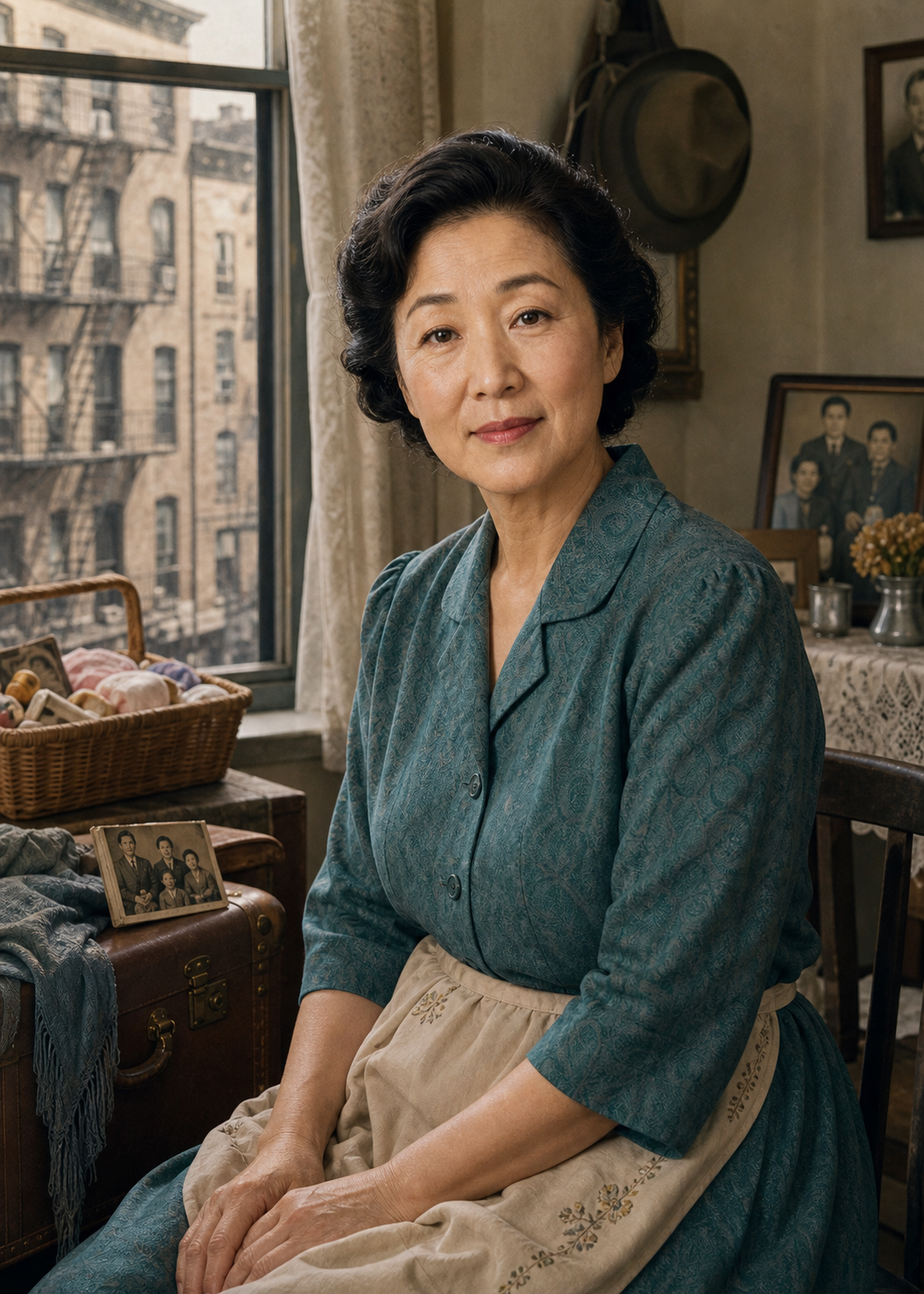
A life remembered
Interrupted education, uncertain immigration status, household labor, marriage, and family ambition shaped Evelyn Charr's American life. Born in Korea as Kim Young Chun, she came to the United States in 1928 with hopes for study and self-development, including music and university training. Instead, the practical demands of marriage, children, legal status, and economic survival carried her through San Francisco, Chicago, Nevada, and Portland, Oregon.
Evelyn's surviving recollections are uneven, but the pattern of her responsibilities is clear. Evelyn remembered a life in which formal schooling slipped away while responsibility grew heavier: babies born in hard years, a husband taking whatever work he could find, sewing and domestic labor, moments of racial exclusion, and the long effort to give children more choices than she had. Her story is not a tale of public fame, but of endurance made intelligent by love, thrift, pride, and hope.
Based on interviews held by the USC Digital Library.
1928
Kim Young Chun Comes to America
Evelyn Charr identified her Korean name as Kim Young Chun and remembered coming to the United States in 1928. In the account, America first appears as a place of study, a place where a young woman might continue school and widen the future available to her. She spoke of university, music, piano, and professional possibility, suggesting that her journey began with ambition as much as with migration.
San Francisco was one of the first American settings that held her. It offered schooling and Korean social ties, but it also placed her inside a complicated world of student status, limited money, and expectations surrounding marriage. The interview moves in fragments, yet those fragments show a young woman trying to imagine an independent future while depending on community introductions and the protection of people already established in the United States.
Marriage entered that world quickly. Evelyn remembered being introduced to the man who became her husband and being drawn into a relationship that seemed to promise companionship, stability, and a household of her own. What she had imagined as a student journey became a family story, and the change was not merely sentimental. It redirected her time, her legal standing, and the education she had hoped to complete.
The courtship details survive unevenly, but they suggest the vulnerability of a young immigrant woman making decisions inside a small community network. Gifts, introductions, promises of a good home, and the approval or pressure of acquaintances all mattered. Evelyn's account is not simply about arrival in America; it is about how quickly arrival became entanglement, and how little room she had to separate romance from survival.
Late 1920s-1930s
Marriage, Motherhood, and Permission to Stay
After marriage and childbirth, Evelyn could no longer organize her life around school. She recalled the pressure of student requirements and the realization that marriage and motherhood made it difficult, perhaps impossible, to satisfy the terms under which she had entered the country. At one point, relatives were considered as possible helpers with childcare so that she might continue, but the larger direction of her life had already changed.
Her immigration situation became frighteningly precarious. Evelyn remembered being told that she might have to leave the United States, despite having a husband and children there. The family sought legal help, wrote to public officials, and tried to explain why she should be allowed to remain. The details of the legal process are blurred in the oral-history material, but the feeling is not: a family was forced to argue for the right to stay together.
When permission to remain finally came, it did not restore the schooling she had lost. It gave her safety, but it also confirmed that the life ahead would be built through work rather than the formal education she had once imagined. Evelyn's account carries that mixture of relief and grief. She did not present herself as defeated, but she remembered the moment as a turning point where possibility narrowed and duty took command.
The episode also shows how immigration law entered the most private parts of family life. Evelyn's marriage, her child, her husband's status, and her own hope to study were all made into questions for officials. In later memory, she did not organize the story by statute or case number. She remembered the terror of possible separation and the practical scramble to gather help before time ran out.
1930s
Children and Hard Years
The Depression years and their aftermath brought constant economic strain. Evelyn remembered living in Chicago and San Francisco, children being born at home or with very little help, and her husband losing or searching for work. Training and ambition did not always match the jobs available, so printing, drafting, sales, and whatever practical work could be found became part of the family's survival.
Money was often painfully short. Evelyn described a household that sometimes relied on small gifts, groceries, odd jobs, help from relatives, and the ability to stretch almost nothing across rent, food, children, clothing, and transportation. These were not abstract hardships. They were the daily arithmetic of whether a family could keep going from one month to the next.
The hard years also shaped Evelyn's understanding of education. She knew what it meant to want schooling and lose the chance, and that loss deepened her hopes for her children. Motherhood, in her telling, was not only sacrifice; it was a long act of imagination. She worked through the present so that the next generation might have professions, choices, and confidence that had been difficult for her to claim.
Her husband's ambitions also had to be remade. Evelyn remembered that he had wanted professional study, even medicine, but that need pushed him toward more immediately available work. Relatives and church friends sometimes helped, but money remained tight. The family's progress came in increments: a job found, a bill paid, a child cared for, a move survived.
1941 and After
A Home in Oregon
Portland became the place Evelyn most strongly associated with home. After earlier moves and a period connected with Nevada, the family settled in Oregon and secured an older house with a garden. In memory, the house was modest when they bought it, but it became precious because it offered permanence after years in which work, legal status, and housing had all felt uncertain.
Her husband worked in practical technical fields, especially drafting-related work that Evelyn associated with power, government service, and Indian Affairs. She described him as someone who had wanted more for himself but accepted the work he could do, built a pension, and remained intensely loyal to the United States. Even when the family had little, she remembered him buying bonds because he believed he was supporting the country that had become home.
For Evelyn, the Oregon house represented more than property. It held the garden, the children, the routines of sewing and cooking, the eventual security of pension and Social Security income, and the relief of having a place that could not easily be taken away. The home did not erase poverty or disappointment, but it gave the family a center from which to age, remember, and measure how far they had come.
In the account, she measured that security in concrete terms: the original cost of the house, its later value, the garden, the pension, and the careful use of money. Those figures were not boasts. They were evidence that years of scarcity had produced something durable. Evelyn's pride rested on the fact that the family had not merely endured; it had made a foothold.
Midlife
Sewing, Prejudice, and Self-Respect
Evelyn described herself as a housewife, but the account makes clear that the label covered a large field of labor. She sewed, managed the household, supported the children's schooling, and later had enough work history to speak about Social Security in her own right. The work was often quiet and ordinary, but it was the structure that held the family together when wages, health, and opportunity were uncertain.
When asked about prejudice, Evelyn answered with care. She did not claim that discrimination defined her whole life, but she remembered moments when race shaped how others treated her. In San Francisco, she encountered difficulty while seeking housing, and in a public place she and others waited without service until someone understood the silence as racial exclusion. Such moments were brief in the telling, but they left a mark.
Evelyn's response to exclusion was neither denial nor shame. She insisted that she had not spent her life feeling unwanted because she was Asian or Korean, even though she knew prejudice existed. Her self-respect came through in practical terms: she would move on, keep working, and refuse to let another person's narrowness define her worth. Belonging, for her, was made through family, endurance, and the ordinary right to live without apology.
That stance gives the account much of its force. Evelyn could name unfair treatment without allowing it to become the whole story. She placed racial exclusion beside sewing, saving, feeding children, and keeping house because that is how it appeared in life: not as a single theme, but as one more difficulty folded into the work of continuing.
Family
Hope for the Next Generation
The later parts of Evelyn's account return again and again to her children. She wanted them to study, to enter fields that suited their abilities, and to become useful people without being trapped by a parent's rigid plan. Her hopes included professional ambition, but they were also moral hopes: that the children would work seriously, choose wisely, and find lives large enough for their talents.
She also spoke about marriage and ethnic identity with a practical openness. In a place where there were not always many Korean partners nearby, she did not want Korean identity to become a cage. Her concern was less about appearances than about whether her children could build stable, honorable, loving lives. That view reflects a woman who valued heritage but understood that American life required flexibility.
Evelyn did not receive the full education she had imagined, yet she spent her life making education and security possible for others. The interview sometimes slips and blurs, but her voice remains forceful beneath the noise. Family mattered, work mattered, pride mattered, and endurance was not passive. It was active care, practiced year after year until a household became a future.
Her story also enlarges the public record of Korean American migration by preserving the domestic scale of history. Laws, recessions, jobs, and racial boundaries appear through a mother's memory of rent, babies, sewing, letters, and school hopes. Evelyn Charr described historical change through the practical question of how her family managed to keep going.