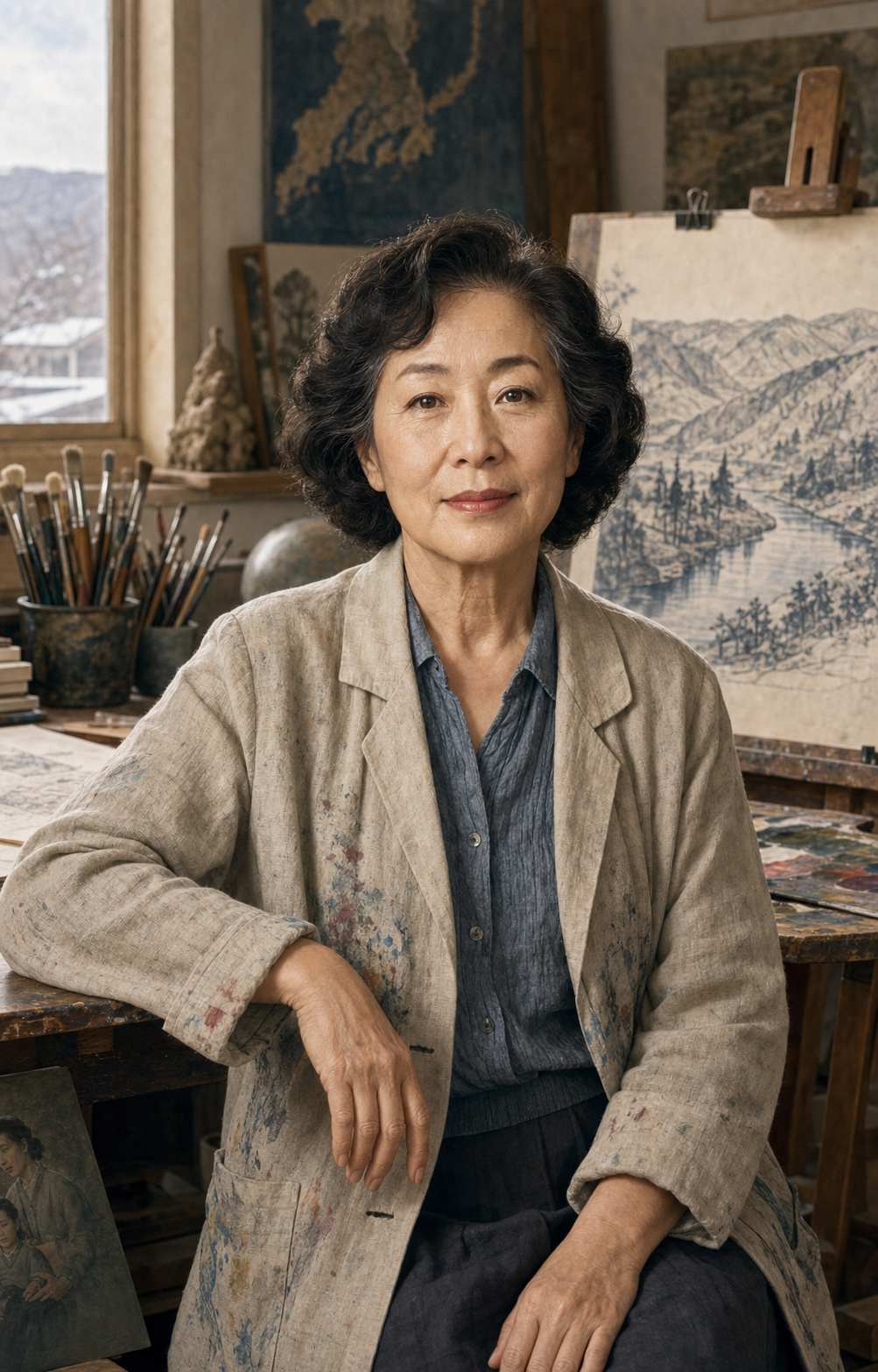
A life remembered
Displacement repeatedly forced Dora Soon Yun Kim to begin again, while art and education gave those new beginnings direction. Born in 1927 in northern Korea, she remembered a childhood connected to Hamgyong province, family construction work, Japanese colonial rule, and the sudden upheaval that came with liberation and Soviet occupation. Her account is especially vivid when she recalls fleeing with her mother, crossing dangerous roads and rail lines, and trying to preserve enough money, clothing, and courage to continue her schooling.
The interview also preserves the voice of a woman who wanted to become an artist before war and family duty rearranged her path. Dora studied art at Ewha after liberation, taught, married a Korean army officer in 1950, raised children, and later moved through business, gallery work, Hawaii, and immigration to the United States. Her path was never straight: a young painter's ambition gave way to a refugee's urgent choices, a mother's obligations, and an immigrant artist's determination to keep working.
Based on interviews held by the USC Digital Library.
1927-1945
A Northern Korean Childhood
Dora Soon Yun Kim was born in 1927 and grew up in the northern Korean world of Hamgyong province. The places she names in the account include Chongjin, Nanam, and family villages connected to her mother's side. Her memories place her inside a household with education, property, and business ties, but also inside the restrictions and dangers of Japanese colonial Korea.
Her father had studied in Korea and, according to Dora's recollection, had been affected by the March First independence movement. In adulthood he worked in a family construction enterprise, with brothers taking different responsibilities in management, finance, and supervision. Dora remembered houses, roads, factories, and building materials not as abstract economic facts, but as the built environment of childhood.
School gave her an early sense of direction. She attended elementary school, moved on to study away from home, and was drawn from childhood toward drawing and painting. Even before she understood the politics around her, Dora understood that she wanted a future with art in it.
It appears that Dora understood class, education, and gender through these early surroundings. Men in the family handled construction and public affairs, while women managed household continuity, respectability, and the delicate decisions that kept children moving through school. When she later spoke of art supplies, school uniforms, and the distance between home and Nanam, those details made childhood feel both privileged and precarious, a place where ambition could begin before history made it unsafe. It also clarifies why she later described education as both personal desire and family strategy, a means of preserving dignity after status and property became unstable.
1945
Liberation as Flight
The liberation of Korea did not arrive for Dora as a simple celebration. In her memory, Soviet forces entered the northern region, Japanese authority collapsed, and ordinary people suddenly did not know which roads, trains, or houses were safe. Dora and her mother left home with very little, trying first to reach family and then to find a way south.
She remembered the practical terror of travel: helmets used as cooking pots, strangers offering temporary shelter, aircraft overhead, soldiers on roads, and trains controlled by people with more power than frightened civilians. Her mother sold or gave up precious belongings to produce travel money. Dora's account treats these decisions with tenderness because each object carried both survival value and family memory.
The journey also taught her that history can turn families into refugees in a single day. Money saved for schooling, furniture, documents, and property could vanish or become dangerous evidence. What remained was movement itself: a mother and daughter walking, bargaining, hiding, and watching for the next possible train.
Dora's recollection of this passage is full of sensory fragments: soot, cold water, crowded stations, improvised meals, and faces glimpsed in emergency. She does not describe liberation as an orderly transfer of power. Instead, she remembered the confusion of Koreans, Japanese officials, Soviet troops, and refugees all moving through the same landscape, each group reading danger differently. That confusion shaped her later caution about certainty and chronology. The story keeps that atmosphere because her decisions only make sense inside it: every stop was temporary, every possession negotiable, and every rumor potentially life-changing.
1945-1949
Ewha and the Work of Becoming an Artist
After reaching the South, Dora heard that Ewha was reopening and expanding, and the news pulled her toward Seoul. She wanted to study art, even though she arrived with uneven preparation and few resources. She sharply remembered the difference between wanting to draw and discovering how much technical training other students had already received.
Ewha gave Dora a place to study and responsibilities she took seriously. Teachers and administrators helped her with scholarship support, work, and encouragement, allowing her to continue when family finances could not carry the cost. Dora remembered this help as a debt of gratitude, not merely a school benefit; she felt she should repay it through serious work.
Her art education also shaped how she saw herself. She was poor, displaced, and responsible to her mother, yet she did not describe herself as defeated. She saw herself as someone with a calling, someone who had been given a chance and had to use it.
Her arrival at Ewha also placed her among women who were remaking education after colonial rule. The school was reopening into a changed Korea, and Dora entered as someone who had lost property but not aspiration. She learned that art required discipline, materials, and teachers, yet she also carried a refugee's urgency. The classroom became a place where survival could become form, color, and a future profession. That combination of gratitude and urgency made her student years more than preparation for a career; they became a moral contract with the women who had helped her continue.
1950s
Marriage at the Edge of War
Dora's marriage began in a way she herself remembered as unusual. She met her future husband through friends and family connections while he was an army captain, and what began as visits, flowers, movies, and misunderstandings gradually became a proposal. She had expected to remain focused on art and teaching, but family loneliness and the instability of the time changed the decision.
They married in February 1950, just before the Korean War reshaped every plan. Dora's account places marriage beside responsibility: her mother needed care, her husband had his own dislocation from the North, and the couple had to build a household under pressure. Romance in the interview is practical as much as emotional, measured in rice, work, and the possibility of feeding a family.
The years that followed brought children and the ongoing demands of survival. Dora names a daughter and sons across the 1950s, while also returning to the tension between art and domestic life. She did not abandon creativity, but she lived with the reality that creative work had to share space with marriage, motherhood, and war's long aftermath.
Because the marriage came just before another war, Dora remembered it through interrupted plans. The proposal was modest, almost comic in its reference to whether a family could live on a sack of rice, but underneath it sat the question every displaced person knew: how can people make a household when institutions are unstable? Her answer was not sentimental. Marriage became a practical alliance of loneliness, affection, family advice, and courage. The humor of the story survives because it is attached to fear; Dora could laugh at the proposal while remembering how little security any young couple actually had.
1960s-1970s
Design, Gallery Work, and Hawaii
After the war years, Dora's story widened into business, design, and art-world work. She described painting and maintaining a studio or gallery setting while family members and business contacts became involved in export, design, and overseas representation. The details are sometimes tangled in the oral-history material, but the pattern is clear: art remained part of how she worked in the world.
A business opportunity took her to Hawaii, where she and her husband recognized the possibility of a different life. Dora remembered that they had not planned a permanent move at first. Having already crossed the 38th parallel and rebuilt from almost nothing, they were willing to consider another migration with less fear than many people might have felt.
The move was not easy. Dora recalled arriving in the United States in the early 1970s and later immigrating, only to discover that American life required difficult labor and adaptation. Her account refuses the romance of immigration; opportunity existed, but it came with exhaustion, uncertainty, and a new round of proving herself.
Hawaii mattered because it linked Korean design, trade, and immigration in a single turn. Dora was not simply following a husband or drifting into America; she was tied to a business effort that used Korean craft and design as something exportable. That context helps explain why her later immigrant life kept returning to art and commerce together. Paintings, galleries, household earnings, and migration all belonged to one problem of survival. The move also shows how Korean artists and designers entered global circuits before immigrant life was fully settled, carrying culture as labor, product, and identity.
Later Years
Painting Against Loss
In later recollection, Dora returned again and again to painting, memory, and the meanings people attach to Korean suffering. She discussed visual forms, human and birdlike figures, spiritual feeling, and the idea of han, while also resisting any interpretation that made Korean life only sorrowful. Her art drew from pain, but she did not want pain to be the whole story.
Dora set large events beside intimate details of school, marriage, work, and family. The collapse of empire appears beside shoes, socks, trains, rice, school fees, and flowers. Those details give the story its power because they show how political upheaval is lived by bodies, families, and young people trying to keep a future open.
Dora Soon Yun Kim spoke as a refugee, artist, student, wife, mother, and immigrant who repeatedly had to remake her life. She remembered loss with precision, but she also remembered help, beauty, ambition, and humor. Her life stands as a record of Korean modern history carried through one woman's eye for form, color, and survival.
The interview also shows Dora thinking like an artist even when discussing history. She noticed surfaces, arrangements, flowers, bodies in motion, and the emotional charge of images. Her refusal to let han become only sadness is important: she wanted memory to hold grief without being trapped by it. That stance gives the story its final shape, a life marked by loss but organized around making, looking, and beginning again. In this way, her life story remains faithful to her own artistic instinct: it notices what was broken, but it also follows the shapes that kept emerging from the breakage.