A life remembered
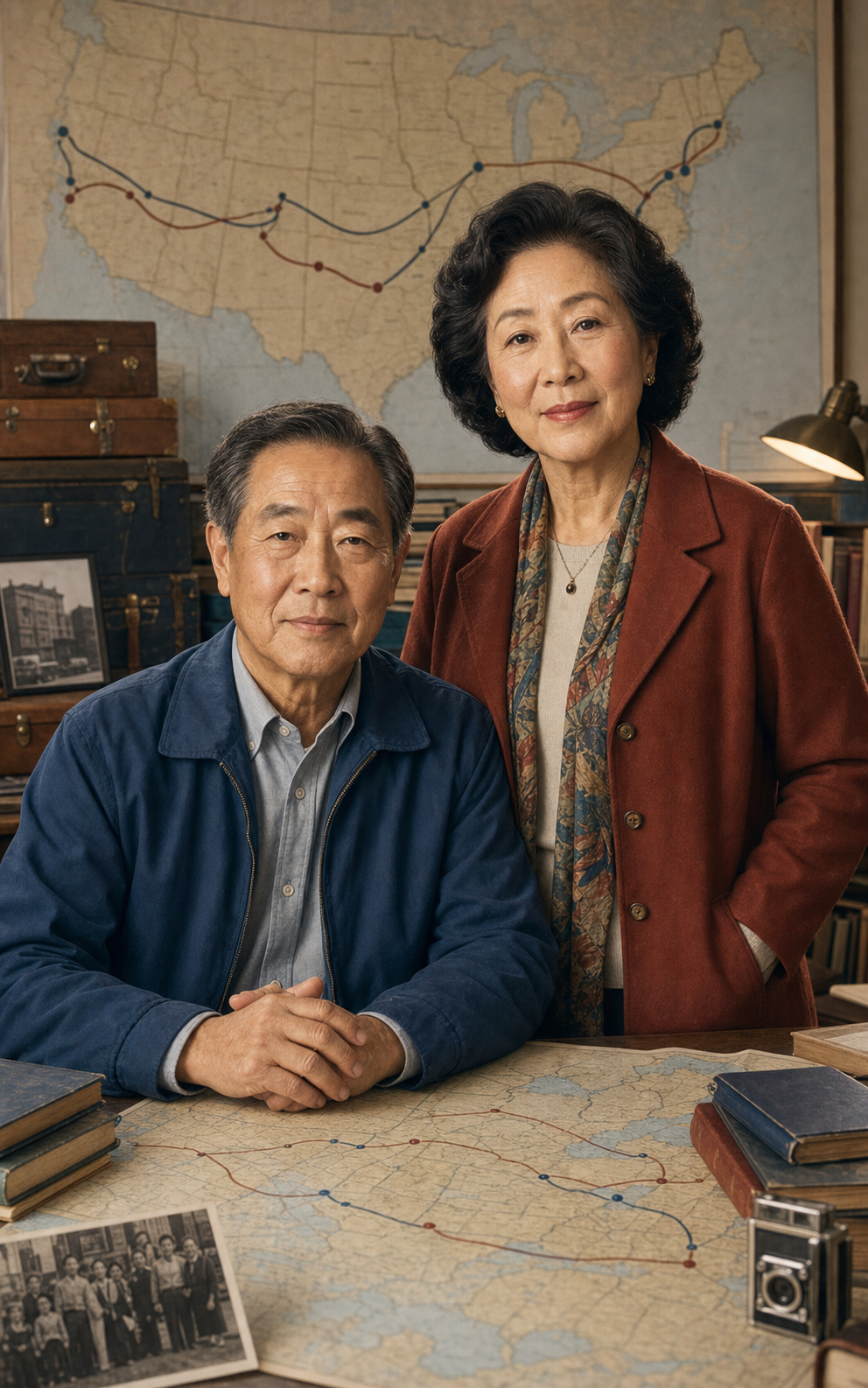
Daniel Bhang and Audrey Bhang Lee remembered the same restless family from different angles as it moved through Washington, California, Chicago, Michigan, Indiana, Missouri, New York, and Los Angeles. Their father, a Korean immigrant who had worked in Hawaii and traveled as a salesman before becoming a restaurant operator, sought opportunity in places where few Koreans lived. Their mother, Salome Lee Bhang, came as a picture bride in 1916 and raised ten children through constant work and relocation. Because the siblings speak from different emotional positions, their chronology also shows how memory can diverge within one household.
Audrey's account emphasizes childhood responsibility, illness, faith, Bible school, marriage, widowhood, and teaching. Daniel's account emphasizes art, school, the Navy, radio intelligence, comic-book lettering, commercial art, marriage, and Christian faith. Together, the siblings show how one family could produce very different lives from the same difficult beginnings: one shaped by caretaking and testimony, the other by art, war service, and New York and Los Angeles design work. Their paired life story follows not only migration and work, but also the inner lives that formed around responsibility, artistry, illness, faith, and survival.
Based on interviews held by the USC Digital Library.
1916-1920s
Picture-Bride Family and Restless Movement
Audrey was born in 1916, the first child of a couple formed through picture-bride correspondence. Her mother, Salome Lee, came from Korea after receiving steamship fare from the man she would marry. Their father had come as a young man, likely through Hawaii, worked in pineapple fields, learned trades imperfectly, sold ginseng, and eventually became a restaurant man.
The family moved often. Washington State brought racial hostility when townspeople mistook them for Japanese and refused the supplies needed for a restaurant. California farming did not suit their father, and the family later moved to Chicago, Michigan, Indiana, Missouri, and beyond. Daniel later wondered why his father kept going to the Midwest, where Koreans were scarce and the children were always outsiders.
Movement had a cost. Audrey remembered changing schools, caring for younger siblings, and living above restaurants with few friends or freedoms. Daniel remembered a father with wanderlust and a mother who had to pack, move, work, and start again whenever the family shifted.
Their parents' choices reveal both courage and strain. The father wanted new frontiers, but each move required the mother and children to absorb the disruption. The siblings' later reflections make clear that migration was not a single heroic act; it was a repeated family upheaval, with opportunity and damage traveling together from town to town. This pattern helps explain why the siblings speak with such different emphases: each child occupied a different position inside the same instability.
1920s-1930s
Audrey: Childhood Labor and Faith
As the oldest child, Audrey carried adult responsibilities early. In Chicago she stayed upstairs caring for younger children while her parents ran the restaurant below. She remembered the apartment as a jail-like place with no yard, no toys, little schooling, and the recurring duty of taking children downstairs for meals and back again.
A diagnosis of tuberculosis at sixteen unexpectedly opened a different life. Sent to a sanitarium for thirty-nine months, Audrey was gravely ill but remembered feeling relief at leaving home. There she encountered Christianity, recovered enough to continue, and began speaking publicly about her life and faith.
After the sanitarium, Audrey pursued Bible school and college opportunities through work scholarships, domestic labor, babysitting, and the help of religious mentors. She moved through Spring Arbor, McPherson, Detroit, and Marion College with little financial backing. Her story is one of faith, ambition, loneliness, and repeated improvisation.
Audrey's faith did not erase the pain of childhood, but it gave her a language for living with it. Public testimony took a girl who had felt unseen and placed her before attentive audiences. Religious life offered recognition, purpose, and a path toward education. She spoke without embarrassment about wanting attention, a candor that keeps her conversion story from sounding easy or triumphant.
1940s-1960s
Audrey: Marriage, Widowhood, and Teaching
Audrey met Chester Lee while at Marion College after he purchased her parents' former restaurant. What began partly as a practical request for help in the restaurant became a proposal and marriage. Audrey later reflected that pressure, loneliness, her father's insistence that she marry a Korean, and her own desire for family all shaped the decision.
The marriage brought restaurant work day and night, then a larger Indianapolis restaurant that failed after harsh winter months and overextension. The family moved to Detroit, where Chester worked as a cook and Audrey took various jobs while raising their sons. Chester died young in 1958, leaving Audrey with children and limited means.
After returning to California, Audrey tried college again at a new Fullerton campus but could not sustain school, children, and household demands at once. She sold Tupperware, Avon, took in washing and ironing, babysat, cleaned houses, and eventually obtained a provisional credential that allowed her to substitute teach for fifteen years. Her faith remained the language through which she interpreted endurance.
Audrey's widowhood period is also a story of women's economic versatility. She moved from restaurant work to retail, factory and food-related jobs, home sales, laundry, childcare, tutoring, and substitute teaching. None of these jobs alone promised security, but together they formed a survival strategy for a mother determined to keep her children moving forward. Her later work with children gave public form to the caretaking skills that had once been demanded of her too early and without tenderness. In teaching, she could offer structure and attention that she had once needed herself.
1945-1961
Daniel: Art, Marriage, and Los Angeles
After the Navy, Daniel returned to New York, resumed work, and used the GI Bill to study at Pratt Institute in Brooklyn. He met Vicky, a Japanese American woman who had been incarcerated at Heart Mountain during the war, at a USO dance near Times Square. Their marriage joined two Asian American wartime histories shaped by different forms of displacement.
Daniel and Vicky lived first in Hell's Kitchen, then Forest Hills, building a life around art, work, and New York's cultural world. Vicky's work in fundraising events brought them into premieres, hotels, and benefit dinners, while Daniel developed his craft as a commercial artist. By 1961, winter, crowds, and family ties drew them back to Los Angeles.
In Los Angeles, Daniel worked for design studios, later freelanced, and bought a home in View Park. His career in commercial art grew from childhood drawing, wartime discipline, New York training, and the practical need to make a living. In later life he connected his creative work to church, making visual aids and serving through Los Angeles United Methodist Church.
Daniel's marriage to Vicky adds another layer to the sibling life story. A Korean American Navy veteran and a Japanese American woman incarcerated by the U.S. government built a life together after war, suspicion, and displacement. Their story complicates simple ethnic boundaries and shows how Asian American histories could meet in affection, work, and shared fatigue with New York's pressures. Their move west was not a retreat but a recalibration, bringing professional skill and wartime memory into a city where family ties were stronger.
Family
Siblings, Memory, and Faith
Audrey and Daniel sometimes remembered the same family differently. Audrey emphasizes the pain of responsibility, emotional hunger, and the liberation of faith; Daniel emphasizes movement, school, art, and the curiosity of a child trying to understand his place in mostly white towns. Neither cancels the other. Together they give the family history depth.
Their father's ambition opened doors and caused hardship. Their mother's labor held the household together. The children learned to adapt across languages, towns, restaurants, schools, churches, military institutions, art studios, and classrooms. The family's lack of stable Korean community in the Midwest made identity both obvious in appearance and thin in cultural instruction.
Audrey and Daniel left different kinds of testimony: one religious and pedagogical, the other artistic and reflective. Together they describe the cost of mobility, the resilience of siblings, and Korean American lives beyond the familiar West Coast settlements. It also preserves the rare sound of siblings interpreting a shared past together.
The siblings do not offer one unified lesson; their memories remain in conversation. Audrey believed in answered prayer and the duty to testify; Daniel believed in art, work, and a later Christian calling shaped by experience. They remember their family through hurt, gratitude, humor, faith, and craft all at once. Because both siblings continued to interpret hardship through service, the account becomes a record of survival transformed into care for others.