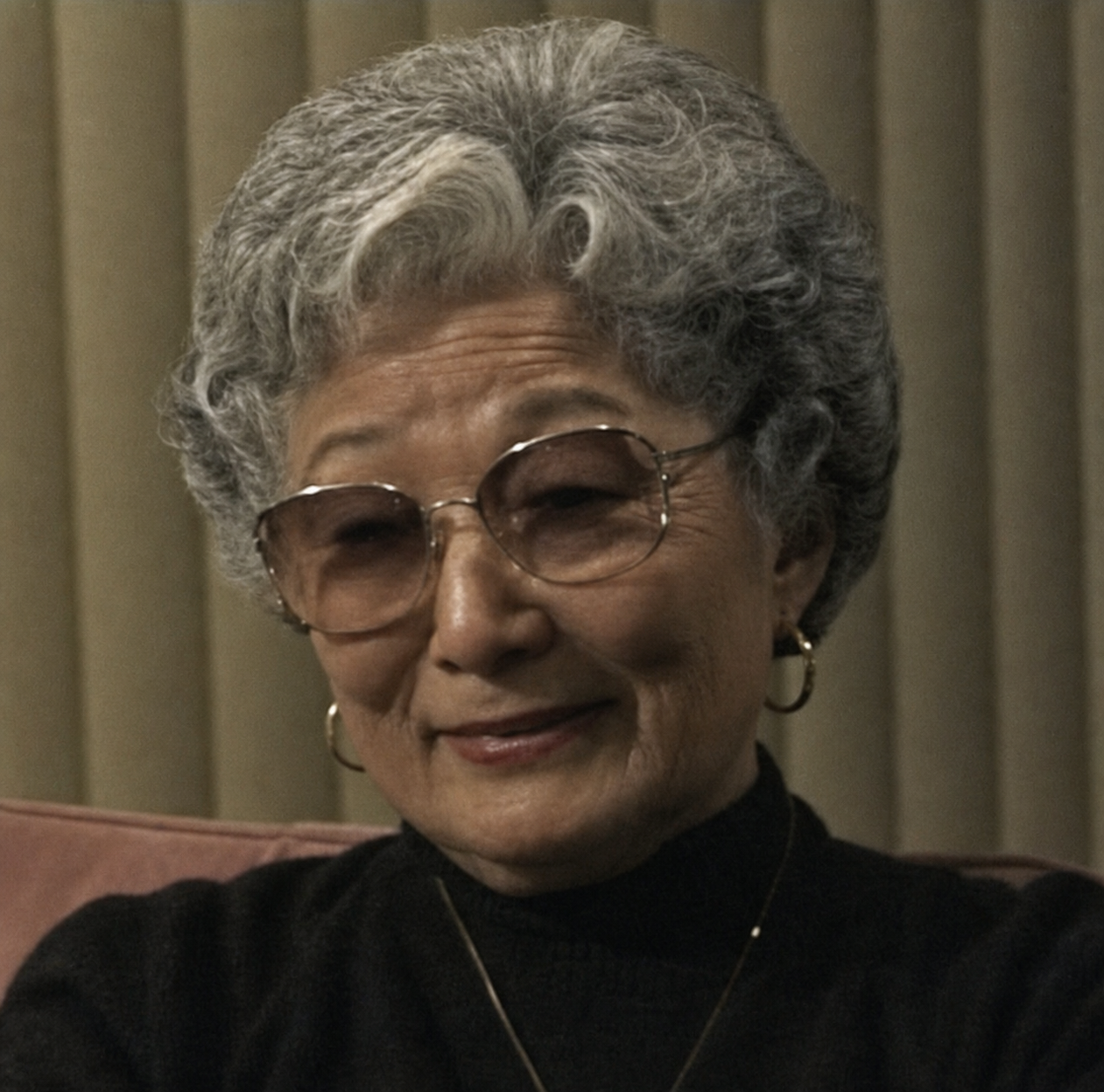
A life remembered
Cora Oh looked back across nearly a century of family memory from the perspective of a Korean American daughter who knew how much had been lost as well as preserved. Born in Colusa, California, the oldest child of Chang Lim Kim and Alice Kim, she carried early impressions of the rice-growing country around Colusa and Willows, the broad porches of a childhood house, and the family reputation attached to her father's agricultural success. Her memories also return to the flood that ended that enterprise and set the family moving through Las Vegas, Los Angeles, and later the Central Valley.
In Dinuba in 1996, Cora carefully separated childhood memories from stories she learned later. She spoke about Korean-language schooling, a patriotic household, visits from Korean community leaders, marriage, motherhood, paid work, and more than fifty years in the small California town that became home.
Based on interviews held by the USC Digital Library.
Early 1900s
A Child Near the Rice Fields
Cora Oh was born in Colusa, California, and spent her earliest years in the rice-growing landscape associated with Colusa and Willows. She remembered that her sister was born there, that the family house had large front porches, and that the fields formed part of the view around childhood. The business itself remained mostly beyond her reach; at three, four, or five years old, she knew the yard, the house, the movement of adults, and the feeling of a family established in place.
The adult questions asked of Cora often reached toward her father's public reputation, and she answered them with a child's honesty. She remembered two wooden trucks, a pair of airplanes, and family cars she associated with a Studebaker and perhaps a Cadillac. Other people later told her that Chang Lim Kim had once been unusually prosperous, even wealthy, but she did not pretend that a small child had understood money, acreage, employees, or the inner workings of rice cultivation.
That early world stayed with her because it represented a beginning before loss. Cora's memory is not a business ledger; it is a daughter's record of what prosperity looked like from below: vehicles, porches, fields, and adults who did not explain their affairs to children. In later life, the rice country became one of the places where family pride, Korean immigrant ambition, and the limits of memory all met.
Her mother's story also connected the household to a wider migration route. Alice Kim had been born in Korea and brought out as a very young child, passing through Hawaii before the family made its life on the mainland. Cora did not claim to know every detail of that earlier generation, but she understood that both parents carried Korea into California in different ways: one through public ambition and politics, the other through food, care, and daily steadiness.
1910s-1920s
Flood, Loss, and Moving On
The event Cora remembered most clearly about the rice business was its end. A flood destroyed the crop, and as she later understood it, her father put what he had into trying to save the enterprise before losing it anyway. The family left the rice country, spent about a year in Las Vegas, and then moved to Los Angeles. As a child she knew they were moving; only later did she understand the scale of the loss behind the move.
Afterward, Chang Lim Kim continued searching for a path back to stability. Cora recalled later attempts at farming, including in the Imperial Valley and, during the war years, near Parlier in the Fresno area. She also remembered a small Los Angeles-area business where she sometimes helped on Saturdays. These ventures did not restore the family's earlier position, and her father was often away, pursuing work or another opportunity with the restless drive she associated with him.
The change altered household life as well. Cora connected her mother's paid work to the family's changed circumstances and remembered learning to cook when Alice Kim began working outside the home. Korean and American dishes both belonged to the family table, and Cora later spoke with affection about foods such as kimchi, bulgogi, kalbi, and other dishes her children also loved. Economic loss, in her telling, became part of ordinary adaptation: cooking, working, moving, and learning what adults had endured only after the fact.
Family Culture
Language, Discipline, and Korean Patriotism
Inside the Kim household, Korean language was not decorative; it was discipline, identity, and obligation. Cora remembered that the children spoke Korean at home until she was fourteen and attended Korean school after regular school and on Saturdays. She and her Korean American friends could speak, read, and write Korean well in those years, and one of their teachers was a young man from Korea who was also connected to study in Los Angeles.
Her father was strict, quiet, and deeply reserved. Cora described him as a man who inspired some fear in his children, not because she portrayed him as cruel, but because he rarely sat down for ordinary conversation and expected children to speak when spoken to. His commitments were visible through Korean newspapers, meetings, household rules, and visitors rather than through long explanations. She remembered hearing of Tongji Hui and remembered Syngman Rhee coming to the house, though she was careful about details she could not verify.
The household's patriotism also shaped how Cora understood being American-born. She had Japanese classmates and even Japanese girlfriends at school, yet she understood why Koreans of her parents' generation carried anger toward Japanese rule. Korean school, family speech, and her father's political commitments gave her a sense of Korea before many Americans around her knew much about the country at all. Her account holds that tension without simplifying it: a California childhood formed inside an independence-era Korean home.
1930s-1941
School, Work, and Marriage
As a young woman in Los Angeles, Cora completed grade school, high school, and two years of city college before entering paid work. She remembered working at Bullock's department store, doing laundry-related work, and then joining two other Korean American young women in a downtown zipper factory where the work was paid by the piece. These jobs belonged to a practical stage of life, when education, family needs, and wages had to be fitted together without much ceremony.
Her future husband came from Dinuba to Los Angeles for university and dental school. Cora had seen him earlier at community events, including basketball games, but their relationship began in earnest when she was a high school senior and a social outing to the mountains brought them together. After that, their courtship became steady and familiar. She remembered him visiting constantly over several years, a pattern of devotion that made marriage feel less like a sudden decision than the next step in a long attachment.
The marriage itself was modest, shaped by limited money and by the distance between youthful choice and a strict father's authority. Cora relied on her mother to tell her father about the engagement and later told her mother when the wedding plans were settled. In 1941, after her husband completed the requirements to begin dental practice, Cora moved with him to Dinuba. She arrived with an infant son in a town that was her husband's home and would become her own.
1941-1980s
A Dinuba Life
Dinuba gave Cora the long middle period of her life. Her husband practiced dentistry there for about four decades, and the couple raised two sons and, eleven years after the second son, a daughter. Cora remembered his attachment to the town, his interest in golf, and his participation in local life as part of the pattern that kept the family rooted. What began as a move for his profession became a shared geography of children, friends, work, and memory.
Korean community life in Dinuba was real but limited, and it changed over time. Cora attended a Korean Presbyterian church when there were enough people to sustain it, then returned to a Presbyterian congregation as the Korean group diminished. She remembered Korean acquaintances and local families, but she also emphasized that everyday friendship in Dinuba crossed ethnic lines because there were never enough Koreans nearby for a fully separate social world.
World War II and Korea's liberation sharpened public awareness of Korean identity. Before the war, Cora remembered, many Americans confused Koreans with Chinese or Japanese people; afterward, Korea became a more recognizable name. She had heard occasional insults from people who mistook her for Japanese, but she did not present discrimination as the controlling fact of her Dinuba life. In a small town, many people knew who she was, and over time her belonging rested on daily relationships as much as ancestry.
1996
Work, Travel, and the Shape of Memory
In midlife, Cora wanted work beyond the home and spent twenty-one years at a high school, continuing for a time after her husband's death. Later she became a tour director and traveled with people she knew through years of local life. By the time of the account, she had lived in Dinuba for more than half a century and could explain simply why she stayed: her friends were there, her history was there, and the town had become home.
Her oral history also records how fragile family inheritance can be. Cora had few personal effects from her father, who had lived away from a settled family household for many years. After her mother's death from cancer, stored furniture, rugs, a piano, and other belongings could not be located because Alice Kim had died before telling the children where they were kept. The loss of objects made photographs, food memories, and spoken recollection even more important.
Cora recounted her life without exaggerating her own importance. She says when she cannot know, when she only heard something later, and when the perspective of a young child cannot carry the weight of adult historical questions. That restraint gives her life story its authority. She carried her family's ambition, loss, language, and tenderness forward without pretending the past was simpler than it was.
The fragments still form a recognizable whole. Cora names what was lost, what survived, and what could only be approximated through family talk, photographs, and habit. Her story honors both the famous questions around Chang Lim Kim and the quieter life she made for herself: work, children, friends, travel, Korean food, and a home place chosen again and again.