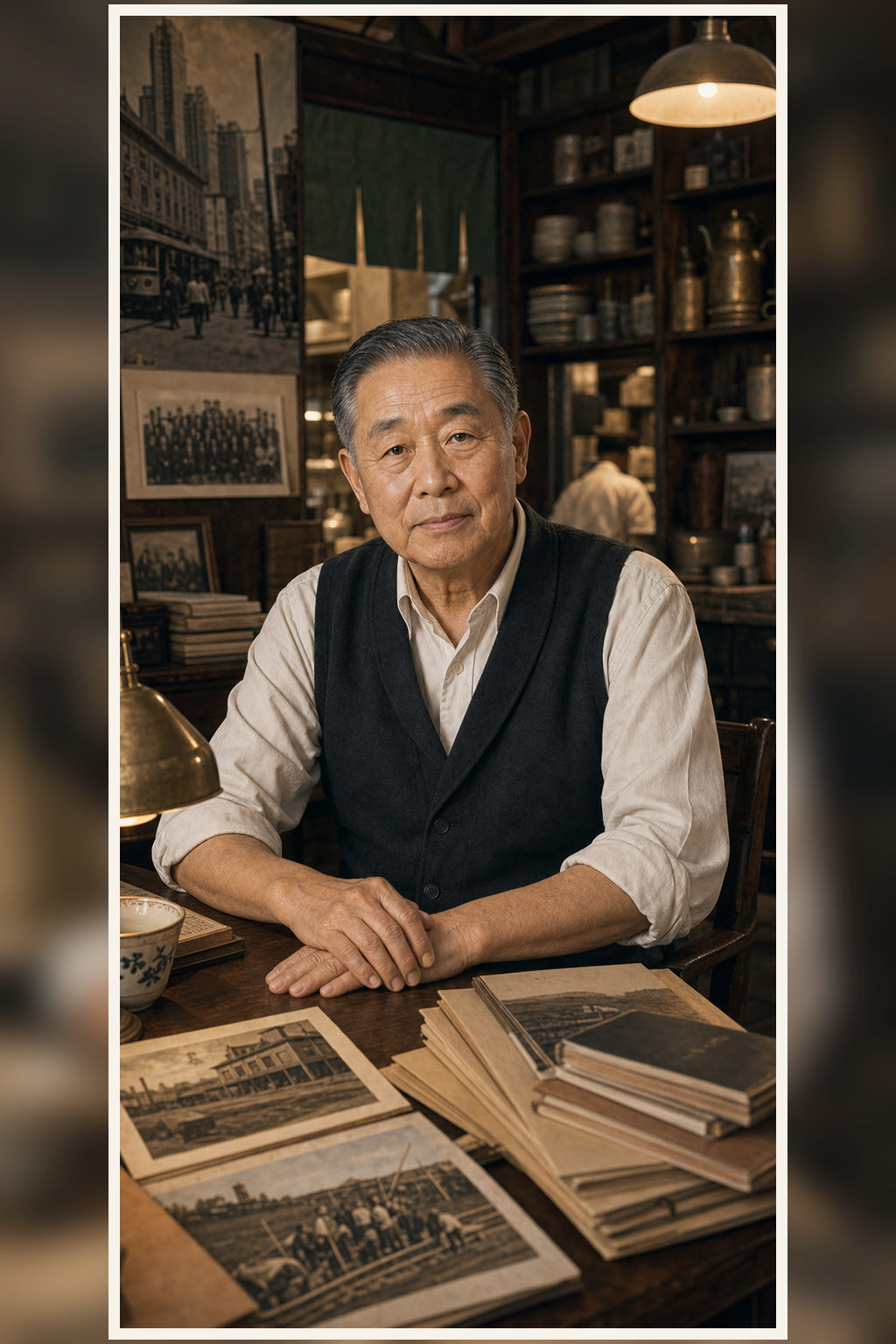
A life remembered
Choo Eun Yang's early immigrant years carried him from Hawaii to San Francisco, where labor organizing, restaurant work, student aid, and nationalist networks often overlapped. He remembered the San Francisco earthquake era, the difficulty of plantation and railroad labor, and the responsibility Koreans felt toward independence and one another.
Some dates and institutional details remain unclear, but Yang consistently described a life spent helping people rather than accumulating status. He assisted students and visitors from Korea, hosted leaders and military trainees, supported Korean publications, returned to Korea, and donated historical materials. For his generation, labor placement, hospitality, patriotic print culture, and memory preservation were all forms of national service.
Based on interviews held by the USC Digital Library.
1900s
Hawaii Labor and San Francisco
Yang appears to have left Korea in the early twentieth century and spent time in Hawaii as a plantation immigrant, working in sugar fields for roughly two and a half years before coming to San Francisco. He connected his arrival on the mainland with the era of the 1906 earthquake and fire, a memory that placed his own arrival inside American history.
He recalled plantation life as difficult and spoke of Korean workers with sympathy. The labor world he described included sugar work, railroad or coal-related jobs, and recruitment schemes that moved men into distant work sites. Korean immigrants had little leisure, little money, and few protections; their survival depended on finding work quickly and helping one another move to the next opportunity.
Even where the wording is unclear, Yang's tone is plain: work was hard, Koreans were vulnerable, and practical assistance mattered. His life story begins not with a settled home, but with movement between islands, city, field, and job site.
The San Francisco earthquake memory, whether exact in every detail or not, gives Yang's story a vivid historical anchor. He remembered fire, movement, and the astonishment of seeing American systems respond to disaster. For a Korean immigrant who had already crossed an ocean, the city in crisis became another lesson in the scale and strangeness of the country he had entered. The disaster memory also underscores how oral history preserves impressions that formal timelines cannot: sound, fire, confusion, and the shock of modern urban scale.
Independence Era
Independence, Youth, and Organization
Yang remembered a period when young Koreans in America were urged to study, investigate, and join the independence cause because Korea was in danger. Names such as Ahn Chang-ho, Syngman Rhee, and other nationalist figures appear in the interview, though the oral-history material makes exact sequences difficult to establish. What is clear is that Yang placed himself in a community where politics, education, and mutual aid were intertwined.
He spoke of groups, meetings, and organizational efforts among Koreans abroad. It appears that he understood nationalist work not only as speeches or publications, but as the daily support of students, laborers, and travelers who needed lodging, food, advice, and introductions. Independence work happened around tables as well as podiums.
He also remembered disagreements among factions and personalities, a common feature of early Korean nationalist life abroad. The details are fragmentary, but they place him inside a crowded political world that he observed with feeling.
Young immigrants were expected to earn wages, study when possible, support the independence movement, and help newcomers while lacking secure footing themselves. In Yang's world, national service meant using whatever one had at hand: a job contact, a room, a meal, a car, or a printed page.
Business
Restaurant Work and Hospitality
Yang spent many years in restaurant business, and the person guiding the conversation later noted that retirement from that work seemed to give him time to assess his life. The restaurant appears in the account not merely as a business, but as a base for hospitality. Students, dignitaries, activists, and visitors passed through, ate, stayed, and received help.
He recalled Korean students arriving with little English and little practical knowledge of American life. Yang and his household helped with procedures, travel, food, and adjustment. In his telling, a student might need not only money, but instructions about trains, meals, and how to avoid being stranded in an unfamiliar country.
That hospitality extended beyond students. Yang remembered assisting prominent visitors from Korea and later Korean military personnel who came to the United States for training. These memories can be hard to date precisely, but they show a man who saw his home and business as a bridge between Korea and America.
The restaurant gave Yang a place from which to practice that ethic repeatedly. Food made conversations possible, and a business address could become a point of contact for people arriving with introductions but few resources. His hospitality was not sentimental; it was logistical, the kind of help that made the next train ride, school term, or official appointment possible. the restaurant operated like an informal consulate for people whose official paths were confusing, expensive, or lonely. The repeated hosting also made his private labor part of public Korean history.
Records
Publications, Records, and Donations
Late in life, Yang repeatedly returned to the question of preservation. He spoke of photographs, books, newspapers, and materials accumulated over a lifetime, and of decisions about where those materials should go. He described sending important Korean-language publications and records to institutions in Korea, where they could serve national history.
Yang referred to long runs of Korean American printed material, including newspapers associated with independence-era communities. He understood such materials as rare because war, colonization, and political upheaval had destroyed or scattered many records. To preserve them was itself a patriotic act.
He also mentioned arrangements connected to a library or named collection, though the exact institution is unclear. His purpose was clear: he wanted documents of Korean immigrant and independence activity to outlive him and remain useful to later generations.
Yang's archival impulse is especially important because early Korean American history was fragile. Newspapers could be lost, photographs discarded, and personal records scattered after death. He seemed to understand that the paper traces of ordinary immigrants might one day become evidence for a national and diasporic history that had not yet been fully written. His concern for records also suggests an awareness that immigrant labor and nationalist organizing could vanish unless someone deliberately saved their traces. Saving records was another way of feeding the future, giving later historians something solid to hold.
1960s-1970s
Return Visits to Korea
Yang returned to Korea more than once in later life, including visits connected in the interview to official invitations and school or public commemorations. He compared Korea across decades, noticing roads, buildings, plantings, schools, and the speed of modernization. These impressions came from someone who had left long before and returned with an immigrant's double vision.
He spoke with pride about being received by schools and institutions, though he also resisted excessive self-praise. The account captures a tension familiar in oral history: an elderly narrator is urged to state what he did for history's sake, while he worries about sounding boastful. That modesty gives the account a particular emotional texture.
Korea in Yang's memory was not only homeland but evidence of change. The country he revisited had been transformed from the world he left as a young man, and the new roads, schools, and buildings linked immigrant sacrifice abroad to reconstruction at home.
Seeing institutions receive his materials and acknowledge his service gave shape to a lifetime of work. The visits let him measure personal aging against Korea's visible rebuilding.
Community
Service, Documents, and Memory
Some passages are difficult to follow because speakers switch languages, talk over one another, and reach for memories many decades old. Still, Yang consistently appears as a worker, organizer, host, business owner, patriot, and keeper of records who measured his life by usefulness to Koreans rather than titles.
His story expands the meaning of leadership. He may not always appear as the public face of an organization, but he helped people work, study, eat, travel, publish, and remember. That kind of infrastructure is easy to miss because it looks like errands, meals, introductions, and boxes of papers.
Yang remembered the early diaspora through Hawaii labor, San Francisco, restaurants, students, nationalist debates, visits from Korea, and his insistence that documents and photographs be kept. He connected generations through steady service that drew little attention to itself.
Not every detail can be settled, but the central pattern is unmistakable: Yang spent decades turning work, meals, money, print, and memory into service.