A life remembered
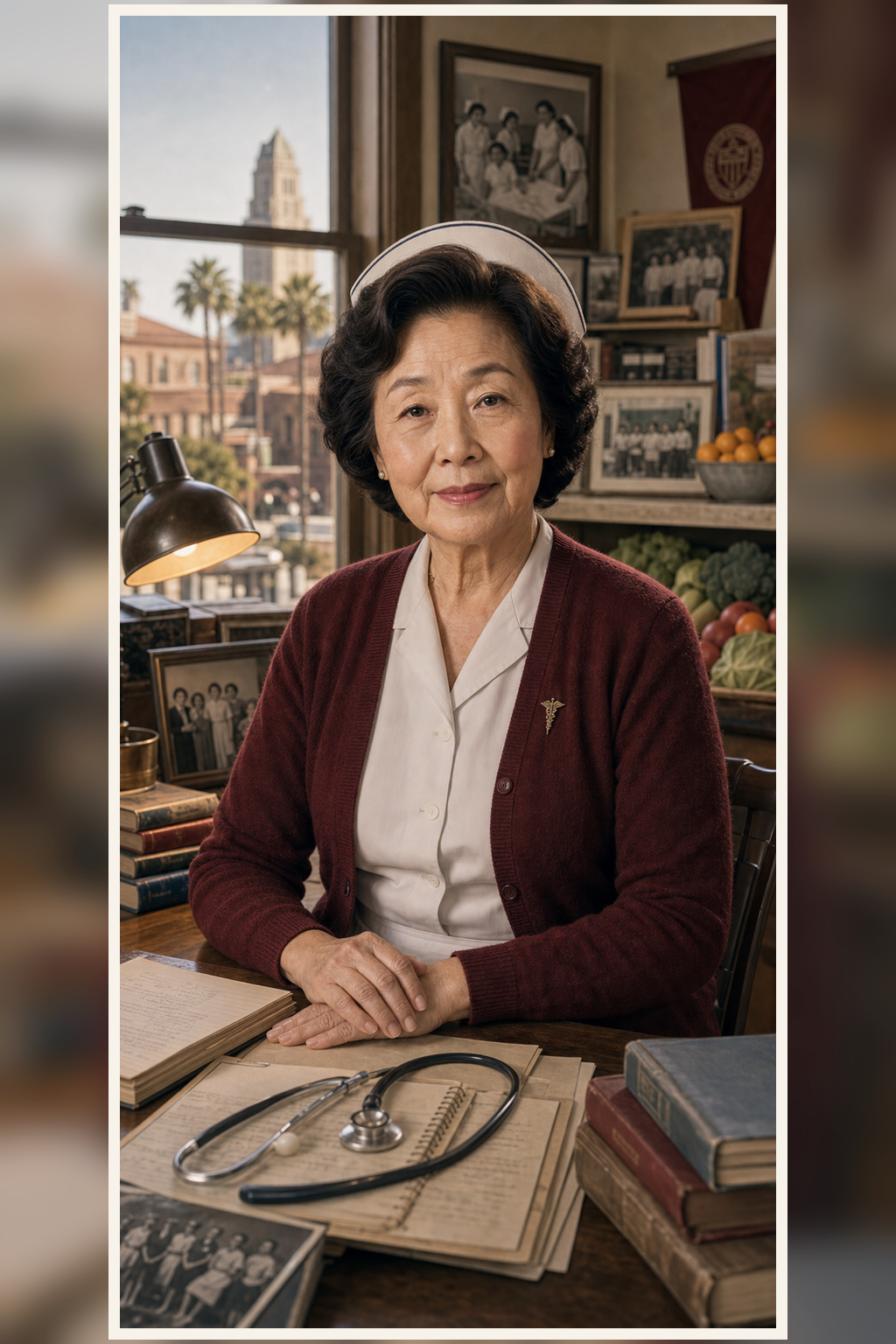
Santa Ana, USC, nursing, family, and the Korean neighborhoods near Jefferson Boulevard anchored Cecilia Lim Woo's California life. Born in 1926 to Charles Lim and Rhoda Cha Lim, she grew up in a household that spoke Korean, valued education, ran small produce and grocery businesses, and moved through the constraints of exclusion laws with resourcefulness. The account is full of place-based memory, from Santa Ana gardens to USC sidewalks, grocery counters, hospital wards, and Monterey Park civic meetings.
Cecilia became a USC-affiliated registered nurse, a Kaiser Permanente charter employee, a mother, civic participant, traveler, and Korean American Museum volunteer. Her memories are especially strong on women's labor: first-generation Korean women driving, running stores, sewing, fundraising, sending aid to Korea, and making sure their children had health care, tuition, music lessons, and a future. Her life story makes visible the infrastructure of care: stores, schools, churches, hospitals, women’s groups, and family networks that allowed later generations to move more freely.
Based on interviews held by the USC Digital Library.
1904-1929
Parents, Picture Bride, and Santa Ana
Cecilia's father, Charles Lim, came first through Hawaii and then to the mainland; family memory placed him in San Francisco at the time of the 1906 earthquake. Her mother, Rhoda Cha, was educated at Ewha in Korea and came after World War I as a picture bride, traveling with Alice Appenzeller and entering the United States through Canada and Bellingham, Washington.
The family first settled in Northern California rice country before a flood or crop crisis pushed them south. Cecilia was born in Santa Ana in 1926, where her father worked as a produce peddler with a truck, regular customers, scales, and a route. Her earliest memories include chickens, orange groves, a vegetable garden, and the small refinements her parents kept even in modest circumstances.
The move to Los Angeles came when money and work required it. Her parents made a grocery store and living quarters near USC, in an area that became dense with Korean families, students, churches, and community organizations. The store was both livelihood and home.
Cecilia's parents also embodied different forms of education. Her father rarely supplied a detailed account of his early life, but his ability to farm, peddle, convert spaces, and run a store showed practical intelligence. Her mother's Ewha education, English fluency, and later citizenship classes showed a more formal confidence. Together they made adaptation a family discipline. Their household taught Cecilia that education could be expressed through books and diplomas, but also through routes, ledgers, driving, repairs, and negotiation.
1930s
Korean Los Angeles and Girlhood
Cecilia attended Thirty-Second Street School, Foshay Junior High, Manual Arts High School, Los Angeles City College, USC, and the California Hospital School of Nursing. As a child she belonged to girls' groups such as the Trywys, went to Korean language school, attended church, and socialized through the K&A building, beach parties, dances, basketball, bowling, and inexpensive gatherings.
Her parents insisted that the children speak Korean at home until school changed the household's language balance. Cecilia could once read, sing hymns, and write notes in Korean, but after her parents and older community members died, she had fewer people with whom to use the language. Her memory captures the common second-generation experience of fluency narrowing into fragments.
The USC neighborhood was her playground. She remembered skating near Doheny Library, watching football practice, delivering groceries by bicycle, making change in the family store, and seeing Korean students and families cluster around McClintock and nearby streets. The campus was not only an institution; it was part of the social geography of her childhood.
The girlhood period is full of inexpensive pleasures because money was limited. Dances, taffy pulls, bowling, church parties, beach trips, and shared radios created a social world without requiring much cash. Cecilia's recollections make clear that Korean Los Angeles was not only political meetings and work; it was also young people learning friendship, style, music, and movement together. Those activities trained young people to be social, confident, and resourceful while remaining inside a community that understood their families.
Family Culture
Rhoda Lim and Community Labor
Cecilia spoke with deep admiration for her mother. Rhoda Lim drove when few first-generation Korean women did, managed money carefully, obtained medical and dental care for the children, paid tuition, learned citizenship, and helped her daughters become self-sufficient. Cecilia later called her mother a feminist in practice, a woman who taught survival rather than dependency.
Korean women in Cecilia's memory worked constantly. They ran stores, took in piecework, sewed handkerchiefs, sold war bonds, rolled bandages for the Red Cross, knit and sewed for Korea, raised funds, and supported orphanages and schools. Much of this labor remained in the background, but Cecilia insisted it deserved recognition. Her account names this work as history, not merely family atmosphere.
Her mother's patriotism also continued after the children were grown. Rhoda sponsored Korean students, posted bonds, and remained connected to Korean causes. Cecilia did not romanticize hardship, but she showed how first-generation women converted small incomes, language skills, and stubborn will into community infrastructure.
Cecilia's insistence on women's labor is one of the account's strongest historical contributions. She remembered names, shops, back porches, laundry work, kimchi making, piecework, and charitable projects because these were the systems children saw every day. What appeared modest from the outside was, from the inside, a dense network of production, care, and patriotism. Her testimony restores scale to that work by showing how many small acts had to happen before a community could appear stable. The women in Cecilia's memories are central to the way the community worked.
1945-1970s
USC, Nursing, and Professional Life
Cecilia entered USC and the California Hospital School of Nursing in the mid-1940s, graduating in 1949 from a program affiliated with the university. She worked while in school when she could, then relied on her parents during the demanding nursing years. She later tried to repay her mother from saved earnings, but her mother declined the money.
As one of very few Asian students in her nursing program, Cecilia encountered treatment she later understood as racialized. She remembered being singled out for discipline and a director questioning why her well-dressed father was at a school ceremony. Still, she excelled academically, earned top marks, and passed state boards with distinction.
Her professional life included California Hospital, private duty nursing at Good Samaritan, and early work at Kaiser Permanente's Sunset facility. She was present in an era when open heart surgery, perfusion equipment, grafts, and microsurgery were developing rapidly, and she took pride in the practical innovation required before many tools were commercially available.
Her nursing story also reveals the cost of entering a profession before institutions were ready to welcome Asian American women. Cecilia excelled, yet she had to endure suspicion, extra scrutiny, and moments when her family's presence was treated as out of place. Her later confidence as a nurse and manager was sharpened by having proved herself in rooms where she was not expected. The nursing period also explains why Cecilia later valued professional associations and alumni memory: institutions could forget pioneers unless someone kept track.
1950s-1990s
Marriage, Family, and Civic Work
Cecilia met Chester Woo through the Southern California Chinese Golf Club. He was a civil engineer whose career moved from public work and the Navy into aerospace. After marriage and children, Cecilia stepped away from nursing for a time, then later returned to work. Their children, Laura and John, entered medicine and computer animation, reflecting the educational drive Cecilia had inherited.
Family life remained close and lively. Cecilia spoke of siblings, nieces, nephews, cousins by affection, Korean food, travel, USC homecomings, and the pleasure of being called by kinship names even without grandchildren of her own. She made Korean food, called knowledgeable friends when she needed help, and kept culture alive through practice more than doctrine.
Civic participation mattered to her when her children were young. She attended school board and council meetings, advocated for pools, playgrounds, busing changes, and local resources, and later volunteered with the Korean American Museum. Public involvement, for Cecilia, grew from the practical question of what children and communities needed.
The family period shows Cecilia's gift for turning kinship into a broad social language. Nieces, nephews, friends' grandchildren, USC nursing classmates, and Korean food advisers all formed part of her circle. She did not define family narrowly, and that expansiveness helps explain why museum work and civic meetings felt like natural extensions of household care. Her family language was practical and affectionate, built around meals, rides, advice, visits, and the expectation that people show up for one another.
Later Years
Americanization and Memory
Cecilia reflected openly on Americanization. Her parents wanted their children to become American while remaining literate in Korean, and her mother became a citizen as soon as she could. Exclusion laws forced the family to use children's citizenship and guardianship arrangements to purchase property, a reminder that belonging was desired long before it was legally granted.
Her oral history also preserves the complexity of distance from Korea. She visited Korea once, appreciated the tour and folk stories, but did not build her identity around current Korean politics. For her generation, Korea was parental memory, language school, food, photographs, and community obligation, while America was the place where they made their lives. That distance did not mean indifference; it meant that belonging was carried through habits, obligations, and remembered people.
Cecilia's life story honors a woman who bridged old and new institutions: Korean church and USC, grocery store and hospital, family photographs and civic meetings, immigrant patriotism and professional nursing. Her story turns everyday competence into history, especially the quiet competence of women whose work made institutions usable.
Cecilia's reflections resist simple stories about assimilation. She valued American citizenship, English-speaking institutions, and professional opportunity, yet she also preserved Korean foodways, names, photographs, church memories, and women's patriotic work. Her life story shows Americanization as an active negotiation rather than a disappearance of heritage. That negotiation is why her story speaks to later generations who inherit fragments and must decide which practices still carry meaning. Her life shows that continuity can survive even when language weakens and institutions change.