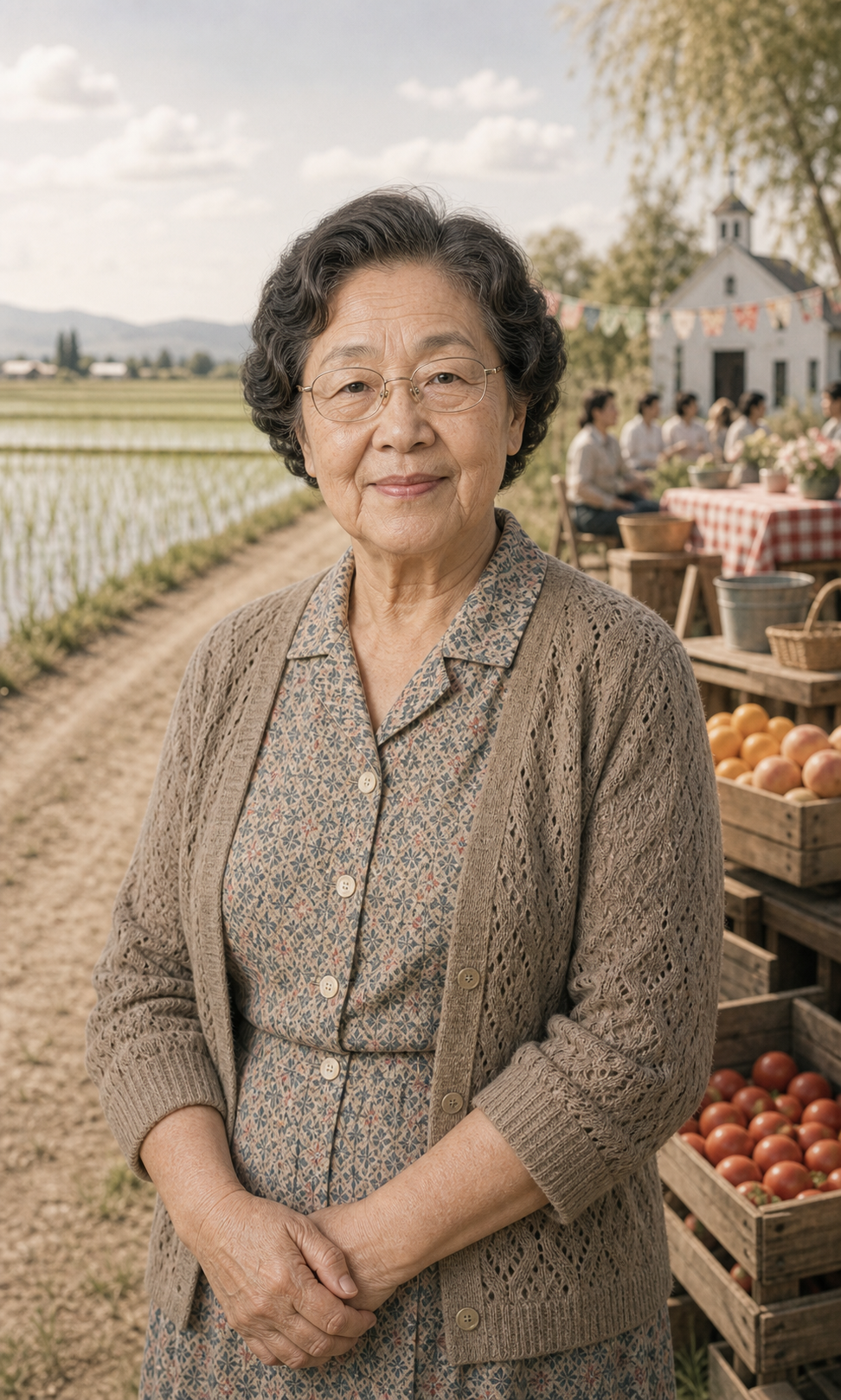
A life remembered
Born in Maxwell, California, in 1922, Carrie Yoon Kwon grew up wherever work took her family: rice farms, fruit stands, laundries, boarding houses, and Delano fields. Her parents, Young Ho Yoon and Toyn Kim Yoon, built a life from picture-bride correspondence, produce work, small business experiments, and deep loyalty to Korean patriotic organizations. Her account is also unusually attentive to the work of Korean women, whose labor and social judgment kept households and patriotic networks functioning.
Carrie spoke in detail about marriage, divorce, typing work near USC, church life, children, and community memory. She remembers Korean National Association gatherings, segregated theaters in Delano, wartime auxiliary activities, movie dates, a home typing business, later faith formation in an Anglo church, and the challenge of keeping Korean identity alive as later generations married across communities. That practical intelligence stayed with her from Central Valley farm towns to Los Angeles church offices, family homes, and museum conversations.
Based on interviews held by the USC Digital Library.
1910s-1930s
Picture-Bride Parents and Moving Work
Carrie was born in Maxwell, California, in 1922, the only daughter among four brothers. Her father, Young Ho Yoon, came from Pyongyang around 1912, and her mother, Toyn Kim, came later as a picture bride after a correspondence that began while she was a student nurse in Korea. Carrie's account of her mother's first failed attempt to sail and later first-class passage preserves both difficulty and humor.
The family moved often. Carrie's father worked on a Sacramento-area rice farm, tried a restaurant in Oakland, worked at a fruit stand in Whittier, ran or worked around a Hollywood laundry, and returned repeatedly to produce work. By 1936 the family moved into Central Valley farming, passing through Dinuba, Parlier, and Delano.
Her mother worked alongside her father through nearly every venture. Carrie remembered births attended by midwives, Korean women helping one another in remote places, and a household where survival required every adult's labor. The family was poor, but Carrie's memories often emphasize connection rather than deprivation.
Carrie's picture-bride story also highlights her mother's agency. Toyn Kim first resisted the exhausting journey after being forced off a ship, then reconsidered when passage became possible under better conditions. Carrie told the story with affection because it showed both vulnerability and choice: a young woman weighing nursing school, family pressure, opportunity, and the imagined promise of America. Her mother's unfinished nursing path also foreshadows Carrie's later awareness of gendered opportunity: women were capable, but family economics often redirected them.
1930s
Delano, Dinuba, and Korean Connection
Carrie remembered one summer in Dinuba as a joyful Korean social world. Families gathered at one another's homes, young people organized hayrides, and Korean neighbors gave the Yoon children a sense of belonging that was harder to find in ordinary schools. Delano had fewer Korean families, but even there church, boarding houses, and visiting pastors kept the community linked.
Her father often visited Korean bachelor laborers and political collectors from Los Angeles. Carrie later understood that those gatherings around meat, drink, and talk were not merely social; they were part of the Korean National Association's patriotic fundraising and news network. Even when money was scarce, her parents donated because Korea's cause felt necessary.
The Korean community gave children friends, rituals, and expectations. Carrie spoke Korean at home, learned to read and write at Korean school, and moved through a world in which March First commemorations, church women, and politics were part of the ordinary calendar. The community could feel small, but it gave shape to life.
The women's gatherings in Delano and nearby towns mattered as much as the formal meetings. Carrie understood later that a church service in a pastor's home could also be a social club, news exchange, and support network for isolated women. In places with only a few Korean families, companionship itself was a sustaining institution. These small gatherings also helped children imagine themselves as part of a people, not merely isolated Asian families in rural California. For Carrie, those spaces made Korean belonging feel warm rather than merely dutiful.
1930s-1941
School, Race, and Young Womanhood
Carrie did not remember racial prejudice as constant in childhood, partly because Korean families stayed close to one another. In Los Angeles she attended schools with mostly white children but did not visit classmates' homes as later generations might. In Delano, she associated more with Japanese American students, even while aware that her parents' generation carried painful memories of Japanese rule in Korea.
Segregation became visible in places like the Delano movie theater, where Asians and other nonwhite patrons were expected to sit apart. Carrie accepted some of these arrangements as the way life was, while her brother Charles was angered by their unfairness. Her memories show how siblings could react differently to the same racial order.
As the only daughter, Carrie's expected path differed from her brothers'. Her mother encouraged her to marry rather than pursue a career, while brothers were expected to seek higher education when the family could manage it. Carrie married young, at eighteen, after a courtship within the Korean community.
Her memories of school and dating show how race shaped intimacy even when it was not announced. White classmates could be friendly at school without becoming home friends; proms required practical arrangements with Asian boys who felt more like brothers; Japanese American friendships could coexist with parental warnings. Carrie's account captures the quiet boundaries that structured adolescence. The boundaries were often informal, but they shaped who visited, who dated, who felt welcome, and who learned to keep feelings private.
1941-1950s
Marriage, War, and Work
Carrie's first husband, Nark Kim, was a commercial artist and musician. They dated briefly, went to movies because dinner was too expensive, and married in a modest church wedding with cake, ice cream, coffee, borrowed wedding pieces, and a gown made by her mother-in-law. The early marriage brought affection but also adjustment, age difference, and different expectations about work and independence.
World War II reshaped their lives. Nark entered military service and officer training, and Carrie worked at Santa Ana Army Air Base after earlier employment at I. Magnin. She also remembered a short-lived Korean women's auxiliary connected to preparedness and community pride, with khaki uniforms, marching practice, and the feeling that Korean Americans should contribute visibly.
Carrie became a mother to Carolyn in 1945 and Brian in 1947. After marital difficulties, she made the difficult decision to divorce, a step that carried stigma in her generation. The Korean community, knowing both spouses, treated her with understanding, and she rebuilt life around church, children, and work.
The divorce period is handled with unusual candor. Carrie did not dramatize the marriage's difficulties, but she made clear that expectations about women's dependence, age difference, and personality mattered. Choosing separation required moral courage in a community where divorce was rare, and her later stability depended on work that respected both motherhood and independence. Carrie's calm account of the choice presents divorce as both personal pain and practical self-preservation. Her later work life grew from that same ability to adapt without surrendering self-respect.
1950s-1970s
Typing Business and Church Life
A home typing business near USC became one of the most important turns in Carrie's life. Grace Lim and Pete Lim helped her enter the work, and typing allowed Carrie to earn income while remaining available to her children. Students came to the office, and the work connected her household to university life and the Korean American network around Jefferson and Catalina.
Church gave Carrie a second family after divorce. She moved from Methodist circles into Presbyterian life and made sure her children could attend Sunday school and Korean school nearby. Later, after remarriage, she entered an Anglo church in West Los Angeles and described the experience as initially uncomfortable but eventually spiritually transformative.
Her faith deepened through classes, sermons, and a congregation that took Bible study seriously. Carrie described herself as still learning, even as an older adult. That humility is part of the texture of her oral history: she does not present herself as an authority so much as someone shaped by work, parenting, community, and belief over time.
The typing business also made Carrie's home a small campus service economy. Students came with theses, papers, and deadlines; she supplied accuracy, speed, and reliability from a room arranged around children's needs. the work was both domestic and professional, an example of how Korean American women created flexible livelihoods from skills that institutions depended on but rarely celebrated. The business also placed Carrie in the intellectual traffic of USC without requiring a formal campus role, a quiet but meaningful form of participation.
Later Years
Identity, Generations, and Museum Memory
Carrie thought carefully about identity across generations. Her parents wanted their children to learn American ways while retaining Korean community ties; later, she worried that intermarriage and dispersion might weaken Korean American memory. She helped with organizations such as AKCO partly so children of the older community could meet one another and know who they were.
Her reflections on the Korean American Museum show why she wanted earlier generations' experiences preserved. She saw the museum as a way for a much larger Korean population in Los Angeles to preserve what earlier generations had lived through: labor, church, patriotism, small business, and the experience of becoming American without erasing Korea.
Carrie spoke candidly about dances, prom, typing, divorce, discomfort at church, children, race, and Korean food. In her memories, daughters, mothers, wage earners, and neighborhood organizers did much of the daily work that held Korean American communities together.
By the end of the account, Carrie was thinking beyond her own household. She wanted children and grandchildren to know Korean history even when marriages, churches, and neighborhoods became mixed. Her museum reflections are not nostalgia alone; they are a practical response to dispersion, a way to give later generations a place to encounter the stories that family talk might no longer carry. Her concern was not purity, but memory: she wanted mixed and dispersed descendants to inherit enough history to recognize themselves.