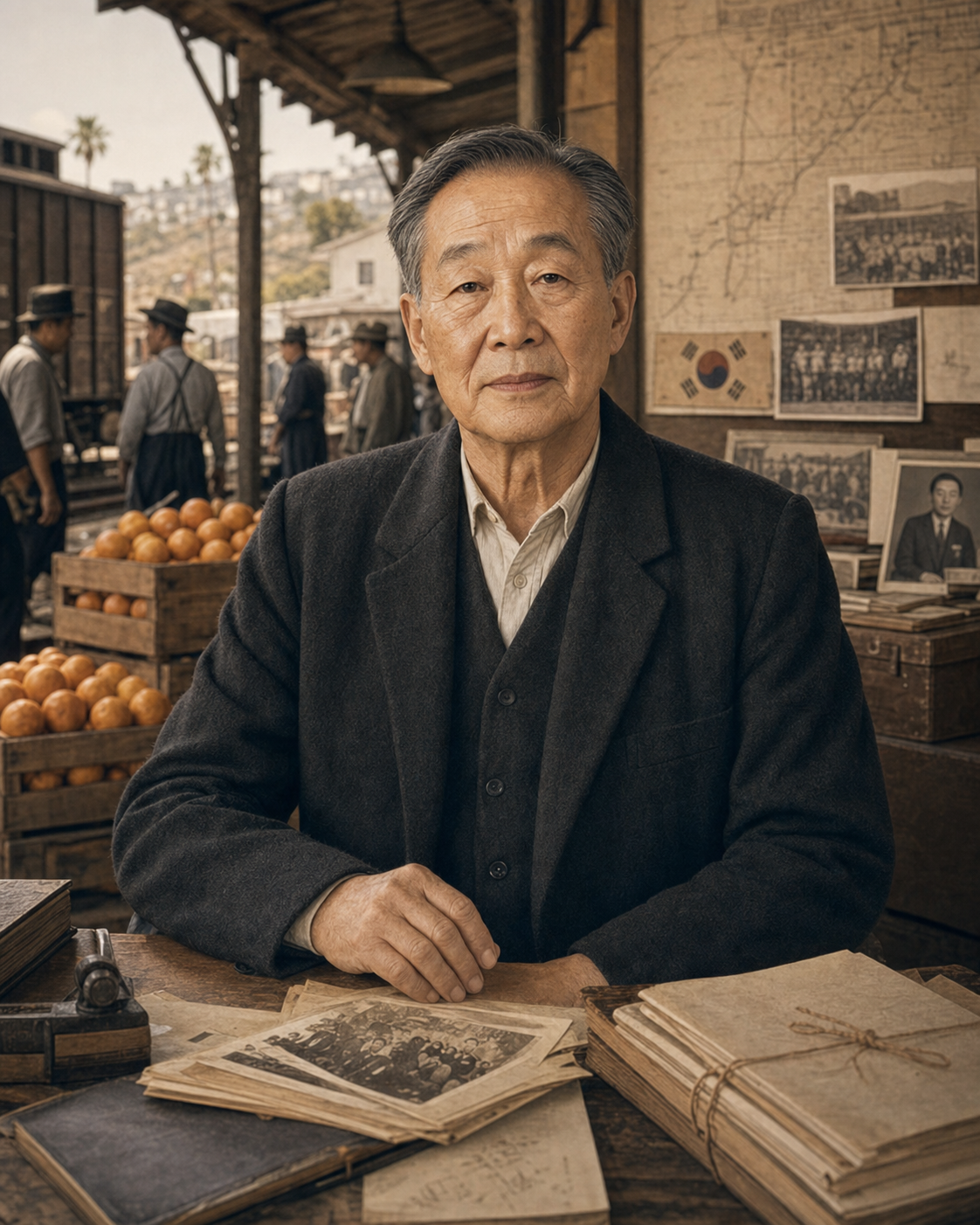
A life remembered
Byung Uk Rhee moved through Hawaii, San Francisco, labor camps, railroad work, Korean schools, and the institutions built by early Korean immigrants. It also includes notes about Mrs. Rhee, whose wartime care and religious conviction form a powerful companion story.
Some dates and institutional sequences remain uncertain because Rhee's memory was uneven and family members sometimes helped him recall names and events. The supported arc is nevertheless clear: Rhee helped Korean migrants find work, organize community, and sustain the independence cause from abroad, while Mrs. Rhee later sheltered girls displaced by the Korean War.
Based on interviews held by the USC Digital Library.
Early 1900s
Hawaii, San Francisco, and Early Work
It appears that Byung Uk Rhee came through Hawaii before reaching the continental United States. In Hawaii he recalled difficult plantation-related labor and also work connected to immigration and interpreting. The details are fragmentary, but they point to a young immigrant moving among sugar labor, language mediation, and the practical demands of survival.
San Francisco appears as another early setting. Rhee spoke of immigration, work, and movement during a period when Korean migrants were often forced into the hardest jobs and depended heavily on one another for information. He remembered them as vulnerable, poorly treated, and in need of advocates.
Rhee framed this early work as service to Koreans rather than as personal achievement. He repeatedly returned to the pitiable condition of Korean laborers and to the need to help them eat, work, and survive. That moral vocabulary shapes the rest of the account.
The early passages also suggest a man used to translating between worlds. Whether the work was literal interpretation at immigration offices or practical interpretation between Korean laborers and American employers, Rhee's usefulness came from being able to make one side legible to the other. In immigrant communities, that kind of mediation could decide who worked, who ate, and who was heard. Such mediation rarely appears in formal organizational histories, yet it was essential to the daily survival of immigrants who could not negotiate alone. That role required trust from both sides, and Rhee's memories suggest how carefully such trust had to be earned.
Labor Years
Labor Brokerage and Railroad Crews
Rhee repeatedly returned to the work of finding jobs for other Koreans. Rhee described helping Koreans find work with railroad crews, where men maintained and repaired track, and with agricultural employers in orange, pear, and peach work. He remembered negotiating with employers and placing not one or two people, but large numbers of workers when hunger and unemployment were urgent.
The work was physically harsh and socially unequal. Rhee described Americans dismissing or underestimating Koreans, and he linked his efforts to the absence of any formal labor protection for immigrants. In his memory, arranging jobs meant more than wages; it meant preventing people from being stranded, hungry, or exploited beyond endurance.
He also emphasized language as a tool. Even limited English could become power when workers had none, allowing one Korean to speak to companies, explain needs, and insist on fairer treatment. Rhee's story belongs to the history of labor intermediaries who made survival possible in places official records rarely describe.
Railroad work in the account functions almost as a symbol of immigrant hardship. Track maintenance meant following the line, repairing what others used, and living close to exhaustion. Rhee remembered it through the problem of placing people into crews, but behind that placement stood men who were far from home, often without English, and dependent on someone willing to argue for them. The railroad passages place Korean American history along industrial routes across the West as well as on farms and in churches.
Community
Schools, Youth, and Community Organization
Rhee's memories include Korean youth associations, schools, and church-linked activities. He spoke of teaching, organizing, and helping build institutions in Hawaii and on the mainland. These were not separate from labor; education and work placement were both ways to give Korean immigrants a future in a country that treated them as temporary hands.
The interview also connects him to early Korean nationalist networks. Names such as Syngman Rhee and Park Yong-man appear in the questioning and answers, though the exact institutional sequence is unclear. Rhee understood himself as part of the Korean National Association's wider independence network.
His account of organization stresses unity. He discussed efforts to bring competing Korean groups together under a national name and purpose, and he treated political organization as a necessary response to colonial domination. For Rhee, community building in America and the cause of Korea were inseparable.
The school and youth work also shows how early Korean communities refused to accept labor as their only future. Even when men had to take brutal jobs, organizers still spoke of education, language, and national purpose. Rhee's memories suggest that teaching and arranging work were parallel forms of rescue: one addressed the day, the other the generation. This vision of education gave immigrant children and workers a claim on the future, even when present conditions reduced them to hard labor. language classes and youth work were safeguards against a future defined only by employers.
Independence Era
Independence Networks and Public Memory
Rhee remembered a world where Korean migrants, students, religious leaders, laborers, and political organizers crossed paths constantly. A person might help with jobs one day, school the next, and nationalist meetings the next. Others urged the elderly Rhee to speak because they believed he held memories no one else could supply.
The account does not always allow firm chronology, and Rhee himself sometimes resisted or deflected detailed questions. That resistance is part of the document's value. It shows the difficulty of extracting formal history from lived memory, especially when the remembered events were shared, improvised, and spread across many people.
What remains strong is the portrait of a man who saw Korean immigrants as a people in need of dignity. He spoke of labor, association, and national identity as practical matters, not abstractions. To organize was to help people work; to help people work was to keep the Korean cause alive.
The person guiding the conversation sometimes supplied names for Rhee to confirm, so those exchanges do not establish every detail independently. They do show how urgently later community members sought the memories of one of the few surviving witnesses to early Korean associations and independence work abroad.
Korean War
Mrs. Rhee and Wartime Care
Mrs. Rhee did not want her own voice recorded at that moment, but she told the person guiding the conversation about fleeing to Pusan during the Korean War with her daughter and taking in girls who needed refuge. The number remembered was thirty-seven, a household of wartime care sustained by courage and faith.
Mrs. Rhee reportedly refused to seek help at first because she considered the girls her responsibility. When officials later sent food, clothing, and supplies after registering the girls, she accepted them as unsolicited support. Her story adds a second dimension to the family life story: public organizing in America alongside private rescue during war in Korea.
The person guiding the conversation described her as devoutly Catholic, humble, and almost saint-like in manner. That was a personal impression, but it conveys how deeply her story affected the room.
She carried the same sense of responsibility into her care for displaced girls: when institutions were overwhelmed, her household became a shelter. She and Rhee shared a household ethic of helping those without protection.
Later Years
Work, Faith, and a Life Recalled in Fragments
Byung Uk Rhee's recollections do not form a smooth chronology. It bears the marks of age, repeated questions, Korean-language memory, and the difficulty of pinning down institutions founded many decades earlier. Rhee described labor and organizing from the perspective of someone who had negotiated jobs and built institutions among early immigrants.
Much of Rhee's work left little paper trail: he found railroad work, negotiated farm jobs, helped schools and associations operate, and insisted that Korean migrants were a people rather than a disposable labor pool. Work, language, and nationalist commitment remained intertwined throughout his life.
Together, their memories link plantation and railroad labor, Korean independence politics, Catholic faith, refugee care, and the fragile but essential work of remembering.
Rhee's memories are interwoven with questions from his family, comments from the person guiding the conversation, and Mrs. Rhee's story as remembered by others. Together these recollections cannot supply a flawless timeline, but they do preserve a family remembered for helping Koreans survive work, displacement, factional division, and war.